Sunday, January 30, 2011

January 1661 by Gillian Bagwell

Samuel Pepys began the New Year of 1661 by writing in the diary that he had started on the first day of the momentous year of 1660, summing up the state of his personal life and the affairs of the country. On January 1 he wrote, “I do live in one of the houses belonging to the Navy Office, as one of the principal officers, and have done now about half a year. After much trouble with workmen I am now almost settled…. myself in constant good health, and in a most handsome and thriving condition. Blessed be Almighty God for it. As to things of State.—The King settled, and loved of all. The Duke of York matched to my Lord Chancellor’s daughter, which do not please many. The Queen upon her return to France with the Princess Henrietta. The Princess of Orange lately dead, and we into new mourning for her….. The Parliament, which had done all this great good to the King, beginning to grow factious, the King did dissolve it December 29th last, and another likely to be chosen speedily.”

The king’s mother, Queen Henrietta Maria, realizing that she had lost the battle against the marriage of her son James the Duke of York to Anne Hyde and the acceptance of their barely-legitimate son, finally gave up. While at Whitehall on January 1, Pepys saw “the Duke of York bring his Lady this day to wait upon the Queen, the first time that ever she did since that great business; and the Queen is said to receive her now with much respect and love.” The Queen also made peace with Anne’s father, Edward Hyde, the king’s chancellor. But she stuck to her plans to return to France with her youngest daughter, Minette, and on January 2, Pepys wrote “The Queen’s things were all in White Hall Court ready to be sent away, and her Majesty ready to be gone an hour after to Hampton Court to-night, and so to be at Ports mouth on Saturday next.”

The baby who had been at the center of such a storm was christened on January 1, and later made Duke of Cambridge. Sadly, he died only a few months later, as would several other little boys born to his parents and given that title. Of the seven children of James and Anne, only Mary and Anne would live to adulthood, and both would eventually sit on the throne, Mary and her husband William of Orange ousting her father in the “Glorious Revolution” or “Bloodless Revolution” of 1688. James eventually had a son who lived, by his second wife, and that James, eventually known as the “Old Pretender,” became the focus of the Jacobites, who believed that he and not his German cousin George I should have succeeded to the throne. In turn his son Charles – the famous Bonnie Prince Charlie or “the Young Pretender” was at the center of the disastrous Jacobite rebellions of the mid-eighteenth century.

But back to January 1661. The journey of the queen and Minette to France was almost immediately beset by disaster. On January 11 Pepys wrote “This day comes news, by letters from Portsmouth, that the Princess Henrietta is fallen sick of the meazles on board the London, after the Queen and she was under sail. And so was forced to come back again into Portsmouth harbour; and in their way, by negligence of the pilot, run upon the Horse sand. The Queen and she continue aboard, and do not intend to come on shore till she sees what will become of the young Princess. This news do make people think something indeed, that three of the Royal Family should fall sick of the same disease, one after another.”

The poor queen must have been terrified, having lost her youngest son the Duke of Gloucester to smallpox in September and her daughter Mary of Orange from the same disease less than three weeks earlier. But on January 15 Pepys wrote “This day I hear the Princess is recovered again,” and on January 27, he recorded that “Before I rose, letters come to me from Portsmouth, telling me that the Princess is now well, and my Lord Sandwich set sail with the Queen and her yesterday from thence for France.”

Twelfth Night supper

On January 6 came Twelfth Night, with its traditional celebrations to end the Christmas season. Pepys went to the theatre after dinner “leaving 12d. with the servants to buy a cake with at night,” and later, “after a good supper, we had an excellent cake, where the mark for the Queen was cut, and so there was two queens, my wife and Mrs. Ward; and the King being lost, they chose the Doctor to be King.” It was a merry evening. According to Pepys, “the talk of the town now is, who the King is like to have for his Queen.” The candidates included the Princess of Denmark, the sister of the Prince of Parma, and Catherine of Braganza, the Infanta of Portugal, who Charles would marry in 1662.

Catherine of Braganza, the Infanta of Portugal

On January 2, Pepys “bought the King and Chancellor’s speeches at the dissolving the Parliament last Saturday.” There would not be a new Parliament until May, and the coronation, which had been planned for January, had been put off until April because of the death of the king’s sister. Nevertheless, there was business to attend to.

The government was still dealing with the enormous problem of disbanding the army and navy. In December, Pepys and his colleague Sir George Carteret had come up with the plan of paying the sailors half what they were owed and giving them tickets vouching that they would be paid the other half in three or four months. On January 21 he wrote “This morning Sir W. Batten, the Comptroller and I to Westminster, to the Commissioners for paying off the Army and Navy …and we sat with our hats on, and did discourse about paying off the ships and do find that they do intend to undertake it without our help; and we are glad of it, for it is a work that will much displease the poor seamen, and so we are glad to have no hand in it.”

The Restoration of the monarchy was an opportunity to start off on a new foot with both the navy and commercial shipping. On Jan. 22 Pepys went to the Comptroller’s house, and “read over his proposals to the Lord Admiral for the regulating of the officers of the Navy, in which he hath taken much pains, only he do seem to have too good opinion of them himself.” Then Pepys “met with the King’s Councell for Trade, upon some proposals of theirs for settling convoys for the whole English trade, and that by having 33 ships (four fourth-rates, nineteen fifths, ten sixths) settled by the King for that purpose.”
There were pleasant maritime matters afoot, too. On January 15 Pepys wrote “the King hath been this afternoon at Deptford, to see the yacht that Commissioner Pett is building, which will be very pretty; as also that that his brother at Woolwich is in making.” Pepys heard that news after he “took barge and went to Blackwall and viewed the dock and the new Wet dock, which is newly made there, and a brave new merchantman which is to be launched shortly, and they say to be called the Royal Oak.” The Royal Oak was the name that had been given to the tree at Boscobel where Charles had hidden for a day during his desperate odyssey to escape after the Battle of Worcester. The naming of this ship was quite likely the first use of the name to commemorate that event, but over the centuries there have been countless pubs, inns, and other enterprises named The Royal Oak.


Charles in the Royal Oak by Isaac Turner

In October, after several of the men responsible for killing his father had been put to death, Charles suspended the sentences of the rest of the regicides. When a bill for their execution was introduced in the new Parliament in 1661, Hyde suggested to the king that the bill be allowed to “sleep in the houses” and not officially brought to him. Charles replied “I must confess I am weary of hanging except upon new offenses,” so the men already in prison remained alive.

In December there had been what amounted to a false alarm about a plot against the king. But in early January there was a real rising, led by the fanatical preacher Thomas Venner. On January 7 Rugge’s Diurnal recorded “a great rising in the city of the Fifth-monarchy men, which did very much disturb the peace and liberty of the people, so that all the train-bands arose in arms, both in London and Westminster, as likewise all the king’s guards; and most of the noblemen mounted, and put all their servants on coach horses, for the defence of his Majesty, and the peace of his kingdom.” The same day Pepys wrote “This morning, news was brought to me to my bedside, that there had been a great stir in the City this night by the Fanatiques, who had been up and killed six or seven men, but all are fled. My Lord Mayor and the whole City had been in arms, above 40,000.”

On January 9, Pepys was “waked in the morning about six o’clock, by people running up and down … talking that the Fanatiques were up in arms in the City. And so I rose and went forth; where in the street I found every body in arms at the doors. So I returned (though with no good courage at all, but that I might not seem to be afeared), and got my sword and pistol, which, however, I had no powder to charge; and went to the door, where I found Sir R. Ford, and with him I walked up and down as far as the Exchange, and there I left him. In our way, the streets full of Train-band, and great stories, what mischief these rogues have done; and I think near a dozen have been killed this morning on both sides. Seeing the city in this condition, the shops shut, and all things in trouble, I went home and sat, it being office day, till noon.”

On January 10 Pepys learned that “all these Fanatiques that have done all this, viz., routed all the Trainbands that they met with, put the King’s life-guards to the run, killed about twenty men, broke through the City gates twice; and all this in the day-time, when all the City was in arms; are not in all about 31. Whereas we did believe them (because they were seen up and down in every place almost in the City, and had been about Highgate two or three days, and in several other places) to be at least 500. A thing that never was heard of, that so few men should dare and do so much mischief. Their word was, ‘The King Jesus, and the heads upon the gates.’” Retribution was swift. On January 19, Pepys went “by coach to White Hall; in our way meeting Venner and Pritchard upon a sledge, who with two more Fifth Monarchy men were hanged to-day, and the two first drawn and quartered,” and on January 21, “This day many more of the Fifth Monarchy men were hanged.”

Despite the turmoil, King Charles was as usual finding time for his personal interests and pastimes. On January 6, John Evelyn wrote “I was now chosen (and nominated by his Majestie for one of that Council) … a Fellow of the Philosophic Society, now meeting at Gresham Coll: where was an assembly of divers learned Gent: It being the first meeting since the return of his Majestie in Lond:.” On January 10 Evelyn recorded “I went to the Philosophic Club; where was examin’d the Torricellian experiment: I presented my Circle of Mechanical Trades.” On January 25, “To Lond, at our Society, where was divers Exp. on the Torrella sent us by his Majestie.” The group continued to meet, and on July 15, 1662, King Charles chartered “The Royal Society of London.” The Royal Society still exists, supporting science with research fellowships, awards, prize lectures, and medals.

And of course Charles found time for two of his other passions, theatre and music. Plays were often acted at court, and on one occasion Pepys, at Whitehall on business, “staid to hear the trumpets and kettle-drums, and then the other drums, which are much cried up, though I think it dull, vulgar musique.”

The public theatres were going great guns as well, and thanks to Samuel Pepys, we know of several shows that were presented in January 1661, and have a front row seat for the first few weeks in which women were acting in England. On January 3, Pepys went “to the Theatre, where was acted ‘Beggars’ Bush,’ it being very well done; and here the first time that ever I saw women come upon the stage.” On January 4, he wrote “After dinner Mr. Moore and I to the Theatre, where was ‘The Scornful Lady,’ acted very well, it being the first play that ever he saw.”

Pepys was observing a very interesting period of transition. Along with the brand-new actresses, the men who had been playing the women’s roles were still appearing. On January 7, Pepys attended “‘The Silent Woman,’ the first time that ever I did see it, and it is an excellent play. Among other things here, Kinaston, the boy; had the good turn to appear in three shapes: first, as a poor woman in ordinary clothes, to please Morose; then in fine clothes, as a gallant, and in them was clearly the prettiest woman in the whole house, and lastly, as a man; and then likewise did appear the handsomest man in the house.” This was a gender-bending role, involving a young man pretending to be a woman. But on January 29, Pepys went to the Duke’s playhouse, where “after great patience and little expectation, from so poor beginning, I saw three acts of ‘The Mayd in ye Mill’ acted to my great content” – and it was a man, James Nokes, who was playing the title female role of the Mayd.

On January 8, Pepys “took my Lord Hinchinbroke and Mr. Sidney to the Theatre, and shewed them ‘The Widdow,’ an indifferent good play, but wronged by the women being to seek in their parts. “To seek” meant the actresses were lost, or didn’t know what they were doing. Perhaps inevitable, as they were young and inexperienced, and no doubt knew they were a curiosity, and the subject of prurient interest.

On January 19 Pepys saw The Lost Lady, “which do not please me much,” but he gave it another try on January 28, “which do now please me better than before; and here I sitting behind in a dark place, a lady spit backward upon me by a mistake, not seeing me, but after seeing her to be a very pretty lady, I was not troubled at it at all.”

Even staid John Evelyn, “after divers yeares that I had not seene any Play” saw The Scornful Lady on January 25.

On January 31, Pepys went to the theatre again, “and there sat in the pit among the company of fine ladys, &c.; and the house was exceeding full, to see ‘Argalus and Parthenia,’ the first time that it hath been acted: and indeed it is good, though wronged by my over great expectations, as all things else are.” He saw it again a few days later but lamented “though pleasant for the dancing and singing, I do not find good for any wit or design therein.”

It’s interesting to find Pepys, such an enthusiast for the theatre, commenting in February, “I see the gallants do begin to be tyred with the vanity and pride of the theatre actors who are indeed grown very proud and rich.”

On February 12 he went back to see The Scornful Lady, “now done by a woman, which makes the play appear much better than ever it did to me.” The king apparently thought so too, as in 1662 he decreed that from then on all women’s parts would be played by women. The days of the boy actor were done.

The weather that month was unusually nice. On January 21 Pepys wrote, “It is strange what weather we have had all this winter; no cold at all; but the ways are dusty, and the flyes fly up and down, and the rose-bushes are full of leaves, such a time of the year as was never known in this world before here.” On January 29 he went with two companions “over the water to Southwark, and so over the fields to Lambeth, and there drank, it being a most glorious and warm day, even to amazement, for this time of the year.”

January 1661 ended on a somber and rather ugly note. Charles I had been executed on January 30, 1649, and on January 27 Pepys recorded “This day the parson read a proclamation at church, for the keeping of Wednesday next, the 30th of January, a fast for the murther of the late King.” But that was not enough. On January 28, according to Rugge’s Diurnal, “The bodies of Oliver Cromwell, Henry Ireton, John Bradshaw, and Thomas Pride, were dug up out of their graves to be hanged at Tyburn, and buried under the gallows. Cromwell’s vault having been opened, the people crowded very much to see him.” And on January 30, “the carcases of Cromwell, Ireton, and Bradshaw (which the day before had been brought from the Red Lion Inn, Holborn), were drawn upon a sledge to Tyburn, and then taken out of their coffins, and in their shrouds hanged by the neck, until the going down of the sun. They were then cut down, their heads taken off, and their bodies buried in a grave made under the gallows.”

Tyburn tree


The experiment of the Commonwealth was over, dead and buried twice over, and the Restoration of the monarchy was complete.

Sources and further reading:

Online:

The Diary of Samuel Pepys - http://www.pepysdiary.com/

Publications:

1660: The Year of Restoration, Patrick Morrah (Beacon Press, 1960)

The Diary of John Evelyn, ed. Guy de la Bédoyère (Boydell Press, 1995; First Person Singular, 2004)

The London Stage, 1660-1800, A Calendar of Plays, Entertainments, and Afterpieces Together with Casts, Box-Receipts, and Contemporary Comment, Part I, 1660-1700, ed. William Van Lennep et al. (Southern Illinois University Press, 1963)

Pepys’s Diary, Volume I, selected and edited by Robert Latham (Folio Society, 1996)

___________________________________________

Gillian Bagwell is the author of the recently published novel The Darling Strumpet, based on the life of Nell Gwynn, who rose from the streets to become one of London’s most beloved actresses and the life-long mistress of King Charles II.

This is the ninth and final article in a series chronicling the events from May 1660 through January 1661, in commemoration of the 350th anniversary of the Restoration of the English monarchy, the reopening of the playhouses, which had been closed for eighteen years under Cromwell, and the first appearance of an actress on the English stage, in contrast to the old practice of boys playing women’s roles.

For links to the other articles and information about Gillian’s books, please visit her website, gillianbagwell.com


HT News

I was saddened to hear of the passing of British novelist Diana Norman on Thursday. Using her real name, Diana Norman published a number of historical novels many of which are sadly out of print, but it is probably under her pseudonym of Ariana Franklin that she is more well known recently. She had released four novels in the Mistress of the Art of Death series featuring Adelia Aguilar, a 12th century amateur sleuth/coroner.

She leaves behind her husband, prominent British art critic Barry Norman, and two daughters, as well as legions of fans.

Pardonable Lies by Jacqueline Winspear

A deathbed plea from his wife leads Sir Cecil Lawton to seek the aid of Maisie Dobbs, psychologist and investigator. As Maisie soon learns, Agnes Lawton never accepted that her aviator son was killed in the Great War, a torment that led her not only to the edge of madness but also to the doors of those who practice the dark arts and commune with the spirit world." Maisie accepts the assignment - determined to prove Ralph Lawton either dead or alive - and in doing so is plunged into a case that tests her spiritual strength, as well as her regard for her mentor, Maurice Blanche. The mission also brings her together once again with her college friend Priscilla Evernden, who served in France and who lost three brothers to the war - one of whom, it turns out, had an intriguing connection to the missing Ralph Lawton.

This is my third Maisie Dobbs mystery and my favourite so far. In this one Maisie ends up involved in three different mysteries - she tries to help a young girl charged with murder; she is hired to prove if a young aviator, Ralph Lawton, was actually killed during the war and her old school friend Priscilla asks her to find out how one of her brothers died in the war.

I think that what made me like this one so much is that there was a bit more of history here than in previous books. Maisie actually has to travel to France to find out the answers she needs and a lot is mentioned about life during the war. Then there seemed to be less of Maisie's "supernatural" powers in this one which, to me, is always a good thing. And her mentor Maurice Blanc seems to be more involved than we knew in the war's intelligence service.

There were strong characters, interesting plots and the mysteries were engaging although we could guess at a distance what had separated Ralph Lawton from his father and I think Maisie finding what happened to him involved quite a bit of luck. In the end my favourite resolution was the mystery of what happened to Priscilla's brother.

I am now looking forward to see how Maisie will do in future mysteries since she probably won't feel as close to Maurice as she did thus far.

Grade: 4/5

Friday, January 28, 2011

Hugh and Bess by Susan Higginbotham

Forced to marry Hugh le Despenser, the son and grandson of disgraced traitors, Bess de Montacute, just 13 years old, is appalled at his less-than-desirable past. Meanwhile, Hugh must give up the woman he really loves in order to marry the reluctant Bess. Far apart in age and haunted by the past, can Hugh and Bess somehow make their marriage work?


Just as walls break down and love begins to grow, the merciless plague endangers all whom the couple holds dear, threatening the life and love they have built.

I've heard much about Susan Higginbotham's books but I had never tried any when this Hugh and Bess attracted my attention. I know that it is not her first book and that the first - The Traitor's Wife - is a sort of prequel to this story but since I already had this one I couldn't resist picking it up.

I did find it a nice, fast read. It is mostly a romance but with a strong historical background that gives you an idea of what was happening in England at the time. Besides the main families here - Montacute and Le Despenser - we see bit of the king, of Joan the Fair Maid of Kent and even of Isabella, the She-Wolf of France. Those parts were interesting and I was sorry not to have more historical detail.

Still, this is a sweet story of two people falling in love after they marry, much against the bride's wishes. How they get to know each other and start trusting each other before they manage to make their marriage work.

After reading this one I got curious about The Traitor's Wife and I have now added it to my WL.
Grade: 4/5

Wednesday, January 26, 2011

Susan Higginbotham on Why I Love Research

Today we are pleased to welcome back author Susan Higginbotham whose latest book, The Queen of Last Hopes has recently been released.
~~~~~~~~~~~~~~~~~~~~~~~~

When I was in high school and undergraduate school, fighting off saber-toothed tigers on the way to my classes, there were few words that struck more dread in my heart than these: “research paper.” Most often, this meant going to the library to find out what I could about a topic that held no interest for me, checking out the library’s meager holdings on the topic, consulting my trusty World Book encyclopedia, and then cobbling together a paper which consisted chiefly of paraphrased sources and a lame concluding section where I struggled to present my own thoughts on the subject (other than my real thoughts, which generally ran in the direction of “Thank God I’ve almost done with that BS. Now I can listen to my new Jackson Browne LP.”). To add insult to injury, the thing then had to be typed on a typewriter (yes, a typewriter), a production which involved copious amounts of Liquid Paper, onion-skinned paper, and Coca-Cola.

But the world has evolved, and so I have I. Now I love researching my novels—and the deeper I delve, the happier I am.

Why is research so fun? Let me count the ways. First, when a novelist uses primary sources in doing research—such as wills and letters—she can “meet” a character in a way that’s not possible just through reading a biography. In researching my newest novel, The Queen of Last Hopes, I came across William de la Pole’s heartbreaking last letter to his little son, Margaret of Anjou’s starkly simple will, and René of Anjou’s lovely romance, The Book of the Love-Smitten Heart. All of these documents played their part in my conception of my characters.

Research also allows a novelist to separate historical myth from historical fact. In researching The Stolen Crown, my last novel, I found that a number of stories about the Woodville family—for instance, that Katherine Woodville was twice the age of her husband Henry Stafford, Duke of Buckingham—were myths, unsupported by contemporary sources and often created by modern-day admirers of Richard III. Likewise, in researching The Queen of Last Hopes, I realized that stories about Margaret’s vengeance-crazed nature and sexual promiscuity were largely the product of Yorkist propaganda, brought to dramatic life by Shakespeare and mindlessly recycled by modern novelists. True, it’s disheartening to realize how many myths, half-truths, and assumptions unsupported by fact have collected around historical figures—but it’s also exhilarating to sort out the truth for oneself and to present maligned historical figures in a fresh light.

Doing research can also lead to fascinating surprises. For instance, in a notorious letter, Louis XI demanded that Margaret of Anjou’s dogs—the only possessions she owned that he considered to be of any interest to him—be brought to him. Historians writing in English have reported that this letter was written after Margaret’s death, but when I looked up the letter in the French source in which it appears, I learned that it was dated before Margaret’s death. Similarly, in Googling through French sources, I found a description of Margaret’s funeral and a listing of her goods—relics and cloth—that went to the Church after her death. Only one English historian whom I know of mentions the funeral, and only in passing, while none whom I have found mentions the list of goods. The relics in particular confirmed my belief that Margaret was a religious woman, who may have found comfort in her faith in her last years.

And finally, historical research allows me to buy books about my favorite historical subjects and write them off on my income taxes as business expenses. For a reader, that’s heaven.

So what’s not to love about doing historical research?

Susan's latest book The Queen of Last Hopes was released by Sourcebooks in January 2011. To find out more about this book, about Susan, or her previous books, explore Susan's website, read her blog, find her on Facebook and Twitter.

Stay tuned for our next post which is a review of Hugh and Bess, one of Susan's earlier books!

Tuesday, January 25, 2011

Giveaway winner of A Royal Likeness


The winner of A Royal Likeness by Christine Trent is...


Congratulations! Thank you to everyone who entered our giveaway.

Monday, January 24, 2011

HT Recommends - Books set in 19th century Syria and Lebanon


Reader Kay asked us for the following recommendations:
My father was a first generation Syrian-American (until after WWII, when he was suddenly Lebanese). I know very little about the background of his parents and grandparents. (...)The family came from Tripoli and that general area. I’d love to read some historical fiction about life during the 1800s, especially the mid-to late 1800s.


This is an area we are not very familiar with and although we did some research we found very few titles. So we would like to ask you all for some suggestions to add to our own:

Amin Maalouf - The Rock of Tanios
Joelle Stolz - The Shadows of Ghadames
Tamar Yellin - The Genizah At The House Of Shepher

Can anyone help expanding this list?

Saturday, January 22, 2011

The Innocent by Posie Graeme-Evans

The year is 1450, a dangerous time in medieval Britain. Civil unrest is at its peak and the legitimacy of the royal family is suspect. Meanwhile, deep in the forests of western England, a baby is born. Powerful forces plot to kill both mother and child, but somehow the newborn girl survives. Her name is Anne.


Fifteen years later, England emerges into a fragile but hopeful new age, with the charismatic young King Edward IV on the throne. Anne, now a young peasant girl, joins the household of a wealthy London merchant. Her unusual beauty provokes jealousy, lust, and intrigue, but Anne has a special quality that saves her: a vast knowledge of healing herbs. News of her extraordinary gift spreads, and she is called upon to save the ailing queen. Soon after, Anne is moved into the palace, where she finds her destiny with the man who will become the greatest love of her life -- the king himself.

 
The Innocent has been in my TBR pile for quite some time. It is set during the period of the War of The Roses and I've read quite a few books with the same setting so, while I am often curious about that period, I also fear that my expectations will be too high and I tend to postpone picking them up unless they are recommended by friends.

The story starts in 1450 with a birth, the baby lives but the mother dies in labour. We find out that she was being protected by Royal Guards till they were ambushed in a forest.

Fast forward fifteen years and Anne, a young girl, is brought by her foster mother to the city to work as a servant in merchant's house. Her knowledge of herbs saves the merchant's wife who was dying and eventually her healing gift brings her to the attention of the court's doctor and she plays a role in helping Edward IV's Queen giving birth to their first daughter.

At court Anne attracts the King's eye and in time she discovers she is not just little Anne but actually a bastard daughter of the previous King, Henry VI, and a young gentlewoman. While she struggles not to give in to the attraction between her and the King she also has to deal with the fact that she is now an eventual threat to his throne and that she has gained a few enemies along the way.

I have to say that I found this an entertaining and fast read, it's not heavy in historical detail and the story focuses much more in Anne's everyday life and feelings so I would think of this more as historical romance than historical fiction, especially the second half of the story. However I did have some problems with Anne.

She seemed too perfect. A fifteen year old girl who can heal better than doctors, evade unwanted advances, became friends with those she serves and still maintain a wide eyed innocence seemed a bit unreal. Then, she finds her way to court still maintaining the same innocence, gaining other's admiration and managing to attract the King just with a glance and a touch or two. And the King, who is known for his numerous meaningless affairs, manages to fall in love with her deeply. I don't know about you but to me it seemed too much of a good thing happening to one person.

One other thing that bothered me was the change in her after she discovers she is a royal bastard. It's almost as that gave her instant maturity. She starts thinking that she has a role in the politics of the time and that she has to think of her future according to her new bloodlines. It's not that I think she might not have had a role but she is only an illegitimate daughter. I'm not sure if she would be such a big threat to Edward's crown.

Still, as I said, it makes for an entertaining read, if you think you won't be bothered by these aspects this may well be the book for you. This is the first book in a trilogy and I am undecided whether I should track down the other two or not...

Grade: 3.5/5

Thursday, January 20, 2011

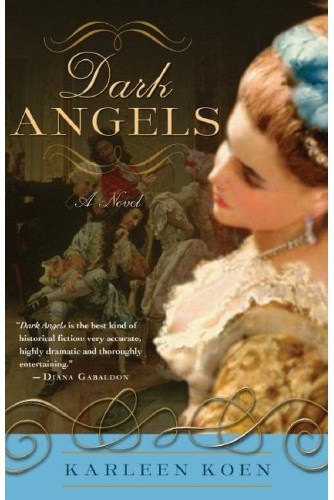
Dark Angels by Karleen Koen

Alice Verney is a young woman intent on achieving her dreams. Having left Restoration England in the midst of a messy scandal, she has been living in Louis XIV's Baroque, mannered France for two years. Now she is returning home to England and anxious to re-establish herself quickly. First, she will regain her former position as a maid of honor to Charles II's queen. Then she will marry the most celebrated duke of the Restoration, putting herself in a position to attain power she's only dreamed of. As a duchess, Alice will be able to make or break her friends and enemies at will.

But all is not as it seems in the rowdy, merry court of Charles II. Since the Restoration, old political alliances have frayed, and there are whispers that the king is moving to divorce his barren queen, who some wouldn't mind seeing dead. But Alice, loyal only to a select few, is devoted to the queen, and so sets out to discover who might be making sinister plans, and if her own father is one of them. When a member of the royal family dies unexpectedly, and poison is suspected, the stakes are raised. Alice steps up her efforts to find out who is and isn't true to the queen, learns of shocking betrayals throughout court, and meets a man that she may be falling in love with—and who will spoil all of her plans. With the suspected arrival of a known poison-maker, the atmosphere in the court electrifies, and suddenly the safety of the king himself seems uncertain. Secret plots are at play, and war is on the horizon—but will it be with the Dutch or the French? And has King Charles himself betrayed his country for greed?

This was my first read by Karleen Koen. A book set in Charles II's court sound interesting and full of intrigue and I decided to pick. I also have a biography of his Queen in my TBR pile and thought this could be an interesting first introduction to the period.


The main character is a young lady, Alice de Verney, a former lady-in-waiting to Queen Catherine who followed Princess Henrietta to France on her wedding to Monsieur, the brother of the French King Louis XIV. The beginning of this novel sees them returning to England for a brief visit as Princess Henrietta serves as go-between for both Kings.

Alice is a consummate courtier. Used to court life all her life she is very sure of herself and of what she wants and is not above manipulating others to get it. In the first chapters we find out that her travel to France is due to having been betrayed by her fiancé and best friend, when an unplanned pregnancy forces them to wed she deals with her feelings by running away and trying to avoid them now that she is back. When she can't avoid them she strikes back at them and refuses forgiveness.

Some people might have problems with Alice but I felt that for a while there was genuine pain behind her actions which helped me accepting them. It's when it comes to her scheming for revenge, she plans to marry her ex fiancé's uncle and so become higher than him in social ranking. Still, for someone who has lived with intrigue and scheming all her life this may just be ordinary behaviour. I also liked her faithfulness towards Queen Catherine. The Queen is in the King's good graces only when she accepts his infidelities and it seems she has few friends when she loses it.

I had more trouble accepting her behaviour towards her friend Barbara and one of the reasons was that I felt Barbara was left with friends that were less good than Alice. Despite all her stubbornness, her pride and her manipulations Alice actually seemed the best one of the lot. Through her eyes we see the King Charles II, his court, his advisors and how everyone is only interested in advancing themselves at the expense of others. I couldn't have been easy living surrounded by lies and deceit every day.

When Princess Henrietta's party returns to France and her arrival is soon followed by her death, Alice suspects poison was at work. She and the other English attendants are soon returned to England and after a while one of Princess Henrietta's Ladies - Louise Renée de Kerouaille - follows them. Without realising it Alice is also manipulated by others. Eventually she comes to that conclusion but what truly upsets her and drives her to her breaking point is the fate of her friend Barbara.

There is a thread of romance that follows Alice throughout part of the book and I thought that was not well woven in the rest of the story. The conclusion to that comes very abruptly after the man had been in love with someone else for most of the action and I did feel it was particularly believable. In fact, my biggest complaint of the book is precisely its ending. I felt there should be a conclusion, a moral if you like and that this ending comes too soon and cuts short the story and the sense of closure that I needed.

There are a lot more characters walking in the pages of this novel and I really enjoyed how Koen mixed real historical characters with fictional ones. I have since found out that this is a prequel to her first novel - Through a Glass Darkly - and I think that I'll have to go and find that one to add to my list. The urge to revisit an older Alice is big.

Grade: 4/5

Tuesday, January 18, 2011

Island of the Swans by Ciji Ware


Best friends in childhood, Jane Maxwell and Thomas Fraser wreaked havoc on the cobbled streets of Edinburgh with their juvenile pranks. But years later, when Jane blossoms into a beautiful woman, her feelings for Thomas push beyond the borders of friendship, and he becomes the only man she wants. When Thomas is reportedly killed in the American colonies, the handsome, charismatic Alexander, Duke of Gordon, appeals to a devastated Jane. Believing Thomas is gone forever, Jane hesitantly responds to the Duke, whose passion ignites her blood, even as she rebels at his fierce desire to claim her.

But Thomas Fraser is not dead, and when he returns to find his beloved Jane betrothed to another, he refuses to accept the heartbreaking turn of events. Soon Jane's marriage is swept into a turbulent dance of tender wooing and clashing wills--as Alex seeks truly to make her his, and his alone. . . .
When I discovered this book was being republished, last year, and was marketed as historical fiction I was very glad that I had an earlier copy on my shelves. So last week I was in the mood for some HF and decided to pick it up.

Based on the life of Lady Jane Maxwell, the Duchess of Gordon, who was a leading society lady in her time and a rival of the Duchess of Devonshire, this sounded like an interesting read. It starts with Jane as a child and her friendship with her neighbour Thomas Fraser and it follows her through her adult years when she truly becomes a woman to be reckoned with and a society matchmaker who married all her children well.

It covers a vast period of time and so a lot of events. There are reflections on Scotland of the Bonnie Prince Charlie defeat, the American war, the reign of King George III and the political protagonists of the period. I found all those mentions very interesting although at some points it seemed a bit too much. Too many things going on at the same time that made me pause and reread or check dates to see if I was following everything.

But the main thing in the story is not this rich background of events and characters of history. The main thing is the love triangle between Jane, her husband Alexander and her childhood sweetheart Thomas. And because of it I think this is much more an historical romance novel than an historical fiction novel.

Having said that, I have to mention that I did not particularly like Jane. She is a selfish brat at first, although I think that's because this was written in 1989 and feisty young heroines were the norm then. And Thomas is a hothead. I couldn't help but sympathise with Alex at first -  if only Thomas hadn't come back from the dead I'm sure he and Jane would have dealt well together. As it is, we have a life time of drama and heartbreak and I couldn't understand how they didn't seem to be able to move on from their misery once they decided not to be together.

Ware is very good at creating heart wrenching scenes, full of agony and heartbreak and during those parts I was glued to the story. However I have my doubts that so much drama, while creating an interesting, albeit a bit over the top romance, is a realistic representation of the lives of the people involved.

Grade: 3.5/5

Saturday, January 15, 2011

Challenge: The Alphabet in Historical Fiction

It's time for a new letter in The Alphabet in Historical Fiction but first let's take a look at our entries for the letter X:


1. Cat ( X is for EXeter)


2. Teddy (X is for Xingu)

3. Sarah (X is for Xenia)

4. Carrie C. (X is for Louis XI)

5. Heather (X is for Xavier)


And now it's time to remember the rules and introduce the new letter!
Each fortnight you have to write a blog post about an historical fiction book of your choice (it might even be something you already read before), but it MUST be related to the letter of the fortnight.
You have several possibilities:
- the first letter of the title

- the first letter of the author's first name or surname

- the first letter of a character's first name or surname

- the first letter of a place where an historical event took place


You just have to choose one of them and participate.

Please check our blog each 1st and 15th of the month to find out our new letter, and then link your post (not your blog) back to our page through Mr Linky (see below). Then come and check to see who else has posted and visit their blog to find out all the details of the book they were reading.

You'll have until January 14th to complete your mission, the next letter will be published on January 15th and it's the letter Y:


HT News

Are you fascinated by all things Eleanor of Aquitaine? Would you like to be guided by best selling author Sharon Kay Penman as you tour around France to retrace her life? If you answered yes to those questions, head over to Sharon's blog to have a look at the itinerary for the tour she is leading in June.

The new historical fiction related challenges keep on popping up all the time. Here are some more that you might be interested in.

Dar from Peeking Through the Pages is running a number of different challenges this year which might appeal to the historical fiction fans. The first is the Sara Donati Wilderness Series challenge (a series I enjoyed and read the last book of last year - the book made it onto my best reads for the year list), the Jean M Auel Earth's Children Series challenge  and finally the 2011 Outlander Challenge. Click on the links for the relevant details!

Another Outlander Series Challenge is being hosted at The Lit Bitch

If you are interested in Christian Historical Fiction then the 2011 Christian Historical Fiction Challenge could be the challenge for you!

Friday, January 14, 2011

HT News

The Langam Prize for American Historical Fiction 2010 has been awarded to Ann Weisbarger for her book The Personal History of Rachel DuPree, with American Historical Fiction Honorable Mention for 2010 being awarded to Robin Oliveira for My Name is Mary Sutter and Director's Mention for 2010 given to Kelli Carmean for Creekside: An Archeological Novel and Jackson Taylor for The Blue Orchard. You can read why the novels received these accolades at the prize page.

Lizzy from Historically Obsessed is hosting her first challenge - Lauren Willig Reading Challenge 2011 - featuring the fun Pink Carnation series of novels - dashing spies, fiesty heroines and so much more. The challenge is kicking off with a giveaway of the first novel in the series. Click on the link above to find out more about the challenge.

Wednesday, January 12, 2011

A Venetian Affair by Andrea di Robilant

Giustiniana Wynne meets Andrea Memmo when she is only sixteen, and he is not much older. They fall passionately in love, but are prevented from openly pursuing the ordinary course of love and marriage by her mother, his family, and the rigid social structure in which they live. But these are no ordinary teenagers. Tenacious, talented, and philosophical, they try for years to engineer various plans intended to bring them together in spite of class differences, governmental opposition, and prolonged separation. All their efforts fail in conventional terms, but they succeed in remaining lifelong friends. Their correspondence, which was necessarily secret in their lifetimes, is now public and is a literary achievement perhaps more enthralling than any novel, because of its historical truth.


When Andrea di Robilant's father found a stash of letters in the old family Palazzo in Venice a journey of discovery began. The discovery of an 18th century doomed love affair between their ancestor Andrea Memmo and Giustiniana Wynne, a half English young woman.

This book is the compilation of those letters with di Robilants explanations and contextualisation of the period and the political incidents and social customs of the time. As a love story I must confess that reading some of the letters made me feel somewhat like a voyeur. The intimacy that they share was obviously for their eyes only, the letters were written in code by the way, and makes sense only to them.

But they do tell a lot more of Venetian society in the last decades of the Republic. Andrea and Giustiniana are of such different stations in society that a marriage between them is deemed impossible for most of the book and when considered is destroyed by rumours and revelations of the past. We realise that Venetian society was ruled by an old, unbreakable code that forbade marriages outside the oldest families for its sons and daughters, and that the old customs were maintained and enforced by a group of Inquisitors. The Republic also had strict rules about who was allowed to enter and reside in Venice not to mention that society eventually accepted or excluded the ones that were different or did not behave according to the norm.

To continue their affair the lovers plan was to marry Giustiniana off to some old man as married ladies had much more freedom of movements. That never happened and eventually Giustianiana leaves Venice but they never cease corresponding, maintaining their love and describing their lives. I found their life story a bit sad, they had to conform to the society they lived in and in doing so some of their actions are less than correct and certainly brought them no happiness. In the end, I felt that what stayed with me was the larger picture of Venice's story during the 18th century.

I found this an interesting story but better read as a work of nonfiction. It may be a bit too dry for historical fiction lovers.

Grade 4/5

Monday, January 10, 2011

The Canterbury Papers by Judith Koll Healey

The only thing I felt was a strong hand around my neck, another around my waist, and -- before I could cry out -- I smelled the thick, sweet scent of a mandrake-soaked cloth. Unforgiving hands clapped it against my face, and all went dark.


Alaïs, the king of France's sister, is abducted while on her mission for the wily Eleanor of Aquitaine, the former Queen of England, to retrieve hidden letters that, in the wrong hands, could bring down the English king. In exchange, the French princess was to receive long-heldand dangerous information. Now Alaïs, along with help from the very intriguing leader of the Knights Templar, must unravel a tangled web of family secrets and lies.

I am always very fond of stories that bring some light to those minor, forgotten characters of history. I am fully aware that if they are minor characters a lot of the writer tells me is pure fiction but I like to imagine that it could have been so.

When I found a book about Princess Alais of France, of which I only knew she was Richard, the Lionheart's betrothed and that they never married because she became his father's mistress, I couldn't help but be interested. As many of the HF being published today this one belongs to a subgenre, it's a historical mystery. Princess Alais would have had a baby by King Henry and about 20 years lately here she is trying to find out what happened to the child she believed dead.

I found this an interesting story, it is written in a light tone and you get an overview of what was happening in England and France at the time. Alais was once used as a pawn between Eleanor of Aquitaine and King Henry and now she is set up to be one again. Luring her with information about the child, she is quickly captured by King John who is trying his best to find the same information and eliminate a potential threat to the throne.

However I did feel that Alais was a bit too daring, and shall we say modern, in her way of thinking at times. That made it a lighter read than what I would have liked. The author also felt the need to add a love story, I have nothing against that but making it so quickly consummated definitely made it look a bit too much like a romance novel. Overall I would have preferred a more solid read in terms of medieval behaviours and way of life but I still found it a pleasant read if not a memorable one.

Grade: 3.5/5

Sunday, January 9, 2011

HT News: Chat with Gillian Bagwell

Following on from the highly successful chat nights that Amy from Passages to the Past has hosted with Susan Holloway Scott and to discuss The Brothers of Gwynedd by Edith Pargeter, Amy has announced the next chat event.

This time, the chat is with Gillian Bagwell, author of the soon to be released novel about Nell Gwynn, The Darling Strumpet.

If you are interested in participating then here are the details:

When: Monday, January 10th
What Time: 6:30 - 7:30 pm EST
Where: http://www.passagestothepast.com

Why I Love Domestic Detail by Katharine McMahon

We are pleased to welcome Katharine McMahon, author of The Crimson Rooms to Historical Tapestry with a Why I Love guest post today.

~~~~~~~~~~~~~

Why I Love Domestic Detail

Two reasons: because I’m short-sighted and because I’m nosy. I’ll begin with the first. I am very myopic, always have been. As a child of about six I was put into hideous free specs with wires round the ears, pink or blue or brown plastic - actually quite fashionable now if you peeled off the plastic. Of course I refused to wear them except in dire necessity and went about half-blind instead.

As a result, the outside world was very intimidating because I couldn’t see it; I couldn’t make out people’s faces, I couldn’t play ball so I preferred to be in. So there I was with a book, tucked up in the adult world, snuffling my way round the insides of houses as children do, so that each had a smell and textures indelibly printed on my mind: my grandparents’ house smelt of oil paints and pipe-smoke and baking, oh the smell of my grandfather’s tobacco pouch when I was allowed to fill his pipe. Afterwards my fingertips smelt delicious and I can still feel the rough inside of the bowl as I tamped the tobacco shreds down – he was very careful and I wasn’t allowed to drop a single speck.

There were three great aunts in a house in Wembley - an inner suburb of London (the aunts became known as the Wembles) - and I remember dark corners, cologne, big, old furniture. There’s a lot of those Wembles in The Crimson Rooms because they were maiden aunts, born at the end of the nineteenth century, bereaved during the First World War or deprived of men they would never meet; brave , witty, career women. As I wrote The Crimson Rooms I had one toe in that vivid childhood world of teas and knitting and talk.

The Crimson Rooms, although a murder story, is a very domestic book, because Evelyn Gifford, its heroine, like all career women, shifts between the professional and the domestic. And in her case, because she’s a lawyer, and a very lowly one at that, she has to enter other people’s domestic worlds. I love finding the perfect detail. Somewhere in my memory is a small, damp, terraced house we rented once, with a kitchen in the back full of woodlice, and when my newly wed victim, Stella Wheeler, is murdered on a picnic, I imagined her emerging from just such a kitchen because she’s a slovenly housekeeper who loves fashion, so I gave her that dank kitchen, a dishcloth hanging out of a bowl, but upstairs rows of cheap but immaculate frocks. And I remembered how my old bedroom in my parents’ home had felt after I left it - not mine at all - so that when Evelyn goes to look at Stella’s old rooms, she finds just a hint of her; a scent in the sleeve of a dressing gown, some unloved toys, an unslept- in bed.

I find in fact that the only way of writing about the really big things, is to concentrate on the really small. In The Rose of Sebastopol, when one of the heroines, Rosa, goes missing in the middle of a war, she leaves a very domestic box containing a needlebook and a few other momentoes. Her cousin, Mariella, a Victorian miss, finds that her skill with a needle is in fact a valuable commodity, given that the army was totally ill-prepared for the vicious Crimean winter. The plight of the army is encapsulated by Mariella’s attempts to sew its uniforms back together. When Stella Wheeler, in The Crimson Rooms dies in mysterious circumstances, she leaves an oilskin sponge bag with a wet toothbrush, because of course, having no upstairs water, she’d have had to carry her toiletries down to the kitchen each day. And when Evelyn Gifford, the heroine of The Crimson Rooms, falls in love, the setting of her affair is teashops and courtrooms, where she becomes entranced with the angle of her beloved’s knee or the turn of his head. Like I said... it’s the small things we notice.

And I’ve also been told that my novels are unusually full of smells. But then life is, don’t you find? But I do wonder if actually as a child I was hyper sensitive to smell because the visual world was so fuzzy. I think smell is a wonderful way of evoking the past. We can all do it, I bet, think of a childhood experience and smell it too. Imagining the past is to imagine a very different mix of smells; coal fires, bread toasted on a fork, over-cooked meat in basement kitchens.

I said at the beginning I loved detail because I was nosy. I always want to know what things mean. I first became addicted to theatre not because of what was happening on the stage but because I wanted to know where the actors went once they’d mysteriously disappeared into the wings. If we visited an old house - my mother loved to take me to see the houses once belonging to the Brontes or Florence Nightingale or Churchill – I always wanted to see into the locked rooms. And I can never understand people at parties who have no questions or curiosity but are happy to talk endlessly about themselves. What a lot you can learn by asking the right questions (or the wrong ones). Actually, this is exactly the process of building plot and character – what happened? Why? What is she wearing that for? She’s working as a lawyer. Why? How did that happen? Who is ringing her doorbell at two in the morning? Writing a novel is posing a million questions, and then finding the answers. Lucky I’ve had a lifetime’s training in looking for clues.


~~~~~~~~~~~~

Katharine McMahon is the author of several historical fiction novels including The Rose of Sebastopol and The Crimson Rooms, which is being released in paperback in US on 4 January 2011.

You can find out more about Katharine and her books at her website.

Saturday, January 8, 2011

Hearts and Bones by Margaret Lawrence


Hannah Trevor, a midwife in a small Maine town, discovers the body of a young wife and mother, along with a note naming Hannah's secret past lover and the father of her illegitimate daughter as the woman's murderers.


Ever since I read, and really enjoyed Sara Donati's into The Wilderness that I have been looking for books with a similar setting. Hearts and Bones is also set in America and around the same time and I couldn't resist picking it up.

Unlike Donati's this book is a murder mystery. The heroine is Hannah Trevor, a midwife living with her aunt and her deaf, and illegitimate, daughter in Rufford, Maine. When she finds a young woman raped and murdered who left a letter accusing three men, one of which is Hannah's child's father, she can't resist doing an investigation of her own. Unable to believe the worse of the man she loved she eventually finds a link between the dead woman, the three mentioned men and some others not mentioned in the letter.

Despite being a great lover of mysteries I think what I loved best in the story was the sense of time and period. How life was actually hard for this people, how some of the wounds of the Revolutionary War were still open and how Hannah, that we could consider a bit too modern for those times, is looked sideways for her behaviour does making it believable. However I found that she unraveled what was happening a bit too quickly to be believable.

The story is dark, there are some pretty horrible crimes mentioned and some people never recover from them. The aftermath and consequences of the war are very present here and play an important part in the action. It's also very atmospheric; you can almost see the characters as they walk around doing their business, which definitely contributed to my enjoyment of the story. It made for an interesting read and I wouldn't mind picking the other books in the series to find out what happens next to Hannah and Daniel.

Grade: 4/5

Wednesday, January 5, 2011

Historical Fiction Reading Challenge - January

 
(you can find the original post here)

It's time for our challenge! Each month, a new post dedicated to the Historical Fiction Reading Challenge will be created. Let's remember the rules:
  • everyone can participate, even those who don't have a blog (you can add your book title and thoughts in the comment section if you wish)
  • add the link(s) of your review(s) including your name and book title to the Mister Linky we’ll be adding to our monthly post (please, do not add your blog link, but the correct address that will guide us directly to your review)
  • any kind of historical fiction is accepted (fantasy, young adult, graphic novels...)
See you next month !

Eagerly Anticipating in 2011


It's time again for our team to choose the books that make us tremble with anticipation in this new year of 2011. The decision wasn't easy, some even draw some blood but all ended well. Here are our choices:

Ana's pick:

After picking two of Elizabeth Chadwick's books as my favourites in the 2010 my choice for this post had to be her next book - Lady of the English - which will be published in June 2011. I am intrigued by her choice of main characters, I have read several books mentioning Matilda but I don't know much about Adeliza. I can't wait to see where she will take us.

Two very different women are linked by destiny and the struggle for the English crown. Matilda, daughter of Henry I, is determined to win back her crown from Stephen, the usurper king. Adeliza, Henry's widowed queen and Matilda's stepmother, is now married to William D'Albini, a warrior of the opposition. Both women are strong and prepared to stand firm for what they know is right. But in a world where a man's word is law, how can Adeliza obey her husband while supporting Matilda, the rightful queen? And for Matilda pride
comes before a fall ...What price for a crown? What does it cost to be 'Lady of the English'?


Alex's pick:

After fighting tooth and nail for the next Elizabeth Chadwick (this is quickly becoming a HT tradition!) and losing to Ana, I decided to go for a book I'm now waiting for some years: The Land of the Painted Caves by Jean Auel. I've been following this series since I first read The Clan of the Cave Bear when I was still in highschool and 9 years after The Shelters of Stone, I just cannot say how eager I am to finally read the end of Aya and Jondalar's adventures.

The Land of Painted Caves continues the story of Ayla, her mate Jondalar, and their little daughter, Jonayla, taking readers on a journey of discovery and adventure as Ayla struggles to find a balance between her duties as a new mother and her training to become a Zelandoni—one of the Ninth Cave community’s spiritual leaders and healers. Once again, Jean Auel combines her brilliant narrative skills and appealing characters with a remarkable re-creation of the way life was lived thousands of years ago, rendering the terrain, dwelling places, longings, beliefs, creativity, and daily lives of Ice Age Europeans as real to the reader as today’s news.
(excerpt from Jean Auel's press release)

Kelly's Pick:

My first instinct was to put the new book by Michelle Moran as my pick, but that was my pick for last year and it just didn't come out this year. So, while I am still excited about that book I decided to pick a different one for this year. Kearsley was my favourite new find for 2010, so I am looking forward to more in 2011!

When Eva's film star sister Catrina dies, she leaves California and returns to Trelowarth, Cornwall, where they spent their childhood summers, to scatter Catrina's ashes and thus return her to the place where she belongs.
But in doing so Eva must confront ghosts from her own past, as well as those from a time long before her own. For the house where she so often stayed as a child is home not only to her old friends the Hallets, but also to the people who had lived there in the eighteenth century. Eva finds herself able to see and talk to these people, and she falls for Daniel Butler, a man who lived and died long before she herself was born.
Eva begins to question her place in the present, and in laying her sister to rest, comes to realise that she too must decide where she really belongs, choosing between the life she knows and the past she feels so drawn towards. (from Amazon)

Teddy's Pick:

I am so glad that Kelly didn't pick this one after all.  I have to have it, it's a necessity, really!


The world knows Madame Tussaud as a wax artist extraordinaire . . . but who was this woman who became one of the most famous sculptresses of all time? In these pages, her tumultuous and amazing story comes to life as only Michelle Moran can tell it. The year is 1788, and a revolution is about to begin.

Smart and ambitious, Marie Tussaud has learned the secrets of wax sculpting by working alongside her uncle in their celebrated wax museum, the Salon de Cire. From her popular model of the American ambassador, Thomas Jefferson, to her tableau of the royal family at dinner, Marie’s museum provides Parisians with the very latest news on fashion, gossip, and even politics. Her customers hail from every walk of life, yet her greatest dream is to attract the attention of Marie Antoinette and Louis XVI; their stamp of approval on her work could catapult her and her museum to the fame and riches she desires. After months of anticipation, Marie learns that the royal family is willing to come and see their likenesses. When they finally arrive, the king’s sister is so impressed that she requests Marie’s presence at Versailles as a royal tutor in wax sculpting. It is a request Marie knows she cannot refuse—even if it means time away
from her beloved Salon and her increasingly dear friend, Henri Charles.

As Marie gets to know her pupil, Princesse Élisabeth, she also becomes acquainted with the king and queen, who introduce her to the glamorous life at court. From lavish parties with more delicacies than she’s ever seen to rooms filled with candles lit only once before being discarded, Marie steps into a world entirely different from her home on the Boulevard du Temple, where people are selling their teeth in order to put food on the table.

Meanwhile, many resent the vast separation between rich and poor. In salons and cafés across Paris, people like Camille Desmoulins, Jean-Paul Marat, and Maximilien Robespierre are lashing out against the monarchy. Soon, there’s whispered talk of revolution. . . . Will Marie be able to hold on to both the love of her life and her
friendship with the royal family as France approaches civil war? And more important, will she be able to fulfill the demands of powerful revolutionaries who ask that she make the death masks of beheaded aristocrats, some of whom she knows?

Spanning five years, from the budding revolution to the Reign of Terror, Madame Tussaud brings us into the world of an incredible heroine whose talent for wax modeling saved her life and preserved the faces of a vanished kingdom. (From Amazon)


Marg's pick:


So, Ana chose Chadwick, Alex chose Jean Auel, Kelly chose Susanna Kearsley and Teddy chose Michelle Moran. What's a girl to do when so many great options that I want to read have already been chosen?

Actually, it wasn't such a huge dilemna because I have been waiting for The Wild Rose by Jennifer Donnelly to come out for years! I read the second book in the Rose trilogy in 2006, and have been looking for details of when the next book would be released since then. At one stage, it showed as being released in May  2008 on Amazon.co.uk, but that didn't happen, and then the date was changed to May 2009. Now that there is actually a cover, and confirmation on Jennifer Donnelly's website that it will be released in August 2011, I have everything crossed that I will finally get to read the finale to this fantastic trilogy!

* This cover image was found at Passages to the Past. I couldn't find any other official images around, and there's no synopsis available yet, but expect to hear a lot more about this book during this year.