Showing posts with label Roman History. Show all posts

Tuesday, February 15, 2011

The Silver Pigs by Lindsey Davis


Rome. AD 70. Private eye Marcus Didius Falco knows his way around the eternal city. He can handle the muggers, the police and most of the girls. But one fresh sixteen-year-old, Sosia Camillina, finds him a case no Roman should be getting his nose into. Some friends, Romans and countrymen are doing a highly profitable, if highly illegal, trade in silver ingots or pigs. For Falco it's the start of a murderous trail that leads far beyond the seven hills.


Although I do read a lot of historical mysteries the Roman period is not one I often find in the stories I read. That is one of the reasons I was curious about this one but, I think, also one of the reasons why it took me so long to get into the story.

The plot revolves around silver ingots (the silver pigs the title refers too) and who has been trading them illegally. However I have to say I was much more interested in Didius Falco and the characters he meets and that surround him than the mystery itself of who was trading them.

In the beginning of the story Falco meets a young girl, Sosia Camilina. When she is killed he vows to find who did it and discovers that her death is related with the ingots. Sosia belonged to a noble and powerful family and Falco ends up being hired by her uncle to discover what is going on. That will take him to Britain where he meets Sosia Camilina's cousin, Helena Justina, and unfortunately for him to work as a slave in the mines.

Falco and Helena hate each other at first sight but that will eventually evolve to another king of relationship. I did like both of them immensely but especially Helena, she was tough, sharp-tongued and fun. She and Falco will eventually work together and will find out who did kill Sosia Camilina but also who is behind a plot against Emperor Vespasian.

Falco moves easily between the lower ranks of society and the more powerful families thus giving us interesting observations of the roman society. He also has an interesting family and his mom and niece are added as colourful secondary characters.

An interesting, and sometimes funny read that is worth the time spent with it.

Grade: 4/5

Monday, May 17, 2010

The Green Bronze Mirror by Lynne Ellison

15 year old Karen is exploring the sea side when she finds an ancient looking mirror in the sand. Now everyone knows that if you find an old mirror, do not stare into it. Of course Karen does and she is transported through time to ancient Rome. Some solders happen upon her and believe she is a runaway slave.

She is taken to a house where she is given to a slave to give her decent clothes and to wash her. Shorts and a tee shirt were very odd clothes indeed. She was taken to the market place and sold. She was a slave to Mistress Julia and was made to take care of Julia's two children. She made friends with some of the other slaves and fell for a older slave boy, Kleon.

Christianity was a new religion back then and when the fires started and destroyed home after home, the Christians were blamed and persecuted. Karen and Kleon flee together to avoid persecution. Eventually Karen confesses to Kleon that she is from the future and he helps her find her way back.

Lynne Ellison wrote this short young adult novel in 1966, when she was just a teenager. It was just re-issued in 2009 by CnPosner Books. The copy I received was a final copy, not an advance reader edition. However, page after page I found spelling errors and word omissions. Instead of fixing these, the publisher has all of the errors listed on their website and invite readers to notify them of any other errors they may have missed. Though I really enjoyed the story, I found these errors rather annoying. I know it costs money to reprint books but I feel that it is unprofessional and does not do Lynne Ellison's good story justice.

Karen told Kleon that the time that she lives in everyone in the world is Christian and how wonderful it is. There is no persecution. I guess this is also suppose to be Christian fantasy novel, because the world I live in, not everyone is Christian and there are still all kinds of people who get persecuted because of their religion. That said, I did like Karen as a character and I liked the story of her as a slave. The story took place when the Roman Empire was ruled by Nero and Ms. Ellison did bring the ancient time to life.

3/5

Note: The publisher just informed me that they did a new printing of the book to correct all the the errors.

Friday, September 18, 2009

Michelle Moran Week - Review of Cleopatra's Daughter


The marriage of Marc Antony and Cleopatra is one of the greatest love stories of all time, a tale of unbridled passion with earth-shaking political consequences. Feared and hunted by the powers in Rome, the lovers choose to die by their own hands as the triumphant armies of Antony’s revengeful rival, Octavian, sweep into Egypt. Their three orphaned children are taken in chains to Rome; only two– the ten-year-old twins Selene and Alexander–survive the journey. Delivered to the household of Octavian’s sister, the siblings cling to each other and to the hope that they will return one day to their rightful place on the throne of Egypt. As they come of age, they are buffeted by the personal ambitions of Octavian’s family and court, by the ever-present threat of slave rebellion, and by the longings and desires deep within their own hearts.

The fateful tale of Selene and Alexander is brought brilliantly to life in Cleopatra’s Daughter. Recounted in Selene’s youthful and engaging voice, it introduces a compelling cast of historical characters: Octavia, the emperor Octavian’s kind and compassionate sister, abandoned by Marc Antony for Cleopatra; Livia, Octavian's bitter and jealous wife; Marcellus, Octavian’s handsome, flirtatious nephew and heir apparent; Tiberius, Livia’s sardonic son and Marcellus’s great rival for power; and Juba, Octavian’s watchful aide, whose honored position at court has far-reaching effects on the lives of the young Egyptian royals.

Selene’s narrative is animated by the concerns of a young girl in any time and place–the possibility of finding love, the pull of friendship and family, and the pursuit of her unique interests and talents. While coping with the loss of both her family and her ancestral kingdom, Selene must find a path around the dangers of a foreign land. Her accounts of life in Rome are filled with historical details that vividly capture both the glories and horrors of the times. She dines with the empire’s most illustrious poets and politicians, witnesses the creation of the Pantheon, and navigates the colorful, crowded marketplaces of the city where Roman-style justice is meted out with merciless authority.

Based on meticulous research, Cleopatra’s Daughter is a fascinating portrait of imperial Rome and of the people and events of this glorious and most tumultuous period in human history. Emerging from the shadows of the past, Selene, a young woman of irresistible charm and preternatural intelligence, will capture your heart.
From Random House.ca

It is hard to believe that this is Michelle's third book. That means that we have known each other for three years! And, what a great three years that has been. I received an ARC of Nerfertiti back when it was still a bit unusual to receive ARCs. Nowadays, everyone does it, but it did used to be a bit harder to accomplish. I don't even remember what the circumstances were, but I was so excited to read the book. I love Egyptian history, but don't really nearly enough of it. I am so glad that I said yes, though, because reading that book has lead to me reading three great books by a very nice person who has become a friend. This is the second year for Michelle Moran Week and the third year that she has appeared on my blog in some capacity. Now, on to the actual review!

Cleopatra's Daughter was another great novel from Moran. I only just finished it yesterday, so this review is a bit late. September has been busy, but I did finish it! That's the important thing, right! When I invite Michelle to appear on the blog it is months before her book is out, so I never really know what to expect. The big thing for me and this book is I actually knew the story, but not from the point-of-view of Selena. The novel built on my knowledge and last night after finishing it I was discussing what I knew and what I learned with one of my friends. There were several times through the book that I learned something new and thought about it, and for me that is what a good historical fiction book is supposed to do. It will lead me to pick up a non-fiction book for comparision, too, so then I support the book industry. It's a full-circle act.

The novel is told from the point-of-view of Selena. She grows through the book. Her childhood was wonderful, but then her parents both died. She was taken to Rome, along with her two brothers, to be figureheads for Octavian's cause. They actually lived with Octavia, Octavian's sister and the ex-husband of Mark Antony, which was a little strange but Octavia appeared to hold nothing against them. Even though the story was told by Selena, I still felt that we got to know the other characters through her and by the end I had a sense of who they all were. Octavian was written a lot like I always expected him to act. Same with his sister. She was in many ways the exact opposite of her brother. It actually worked well for them, though, because one saw what the other would likely miss. Octavian's daughter, Julia, was spoiled but had also suffered through her young life. You both found her annoying and felt for her throughout the book. There were a lot of characters I only slightly knew existed, so I learned a lot about them.

This book covers the highs and lows of Selena's life. You really experience her emotions through the pages and feel for her at the right times. I really liked her. Michelle portrayed her wonderfully and made me love her by the end. Even though I knew how things were going to end, I have to say that I loved the ending. It was perfect, in my opinion. Anything other than would really spoil things. I think this book will appeal to those that love historical fiction, but really it is is a book for many people. It has a readable style and it doesn't get bogged down with facts. I recommend this book strongly and hope lots of people take a chance on it and enjoy it.


Monday, October 22, 2007

Dreaming the Hound by Manda Scott

AD 57: Caradoc is lost for ever, betrayed to Rome and exiled in Gaul, leaving Boudica bereft, to lead the tribes of the west in an increasingly bloody resistance against Roman occupation.

Only if she can drive Rome from the land will she find the peace she needs and to do that she must once again raise the tribes of the east. But her people, the Eceni, languish in the shadow of the Legions, led by a man who proclaims himself king and yet allows slavers to trade freely in his lands.

Across the sea, Boudica's half-brother has been named traitor by both sides. He, too, seeks peace, on a journey that takes him from the dreaming tombs of the ancestors to the cave of a god he no longer serves.

Only if these two meet can their people - and all of Britannia - be saved. But the new Governor has been ordered to subdue the tribes or die in the attempt, and he has twenty thousand legionnaires ready to stop anyone, however determined, from bringing Britain to the edge of revolt...


Breaca, also known as the Boudica, has been living a kind of half life. She maintains her warfare against the hated Roman occupiers, but she keeps herself somewhat distant from her friends and her family. Her children do all they can to win her attention and love but can't seem to quite capture her attention, and her son in particular is beginning to resent her for it. She has been in the east for a number of years, but fate has something different in mind for her, and so she begins a journey back to her homeland in the west, back to face her destiny as one of the royal family of the Eceni tribe. When she returns to the Eceni it is with the intention of raising a war host against the Romans, but she finds that the current 'king' of the Eceni is a client king of the Romans. 'Tagos himself walks a fine line - he needs to tow the Roman line, but only in order to ensure as much as possible that his people aren't destroyed. Breaca agrees to be 'Tagos queen, which will allow her to continue her quest without drawing too much attention to herself, for if the Romans' realise that Breaca is the Boudica both she and her people would be completely destroyed in no time at all.

As Breaca tries to covertly arm and train an army, she begins to know her children a bit better, particularly her daughter Graine who is an exceptional dreamer. Her relationship with her son, Cunomar, is still somewhat distant, and becomes more so when his friend is captured by the Romans and sentenced to death. He runs to one of the other tribes, but when he returns, Breaca recognises that her son has become a man and a warrior and they can begin to work together.

When 'Tagos dies, he leaves behind a very unusual will, one which draws Breaca into a fight for life for both herself and her family, with potentially devastating results.

One of the things that I said in my review of Dreaming the Bull was that Boudica really wasn't the focus of the book. That definitely was not the case in this book - she was front and centre, along with her children and Julius Valerius. I have to confess that the journey of Julius Valerius is the one that I find most interesting in this series. He has undergone such transformations throughout the three books in this series, from a tribesman to a slave to a Roman centurion, and in this book he seems to find who he really is meant to be. Valerius has been isolated in Hibernia, branded a traitor by Rome, and hated by the tribes for everything he did. Luckily, there is one man, Luain mac Calma, the dreamer of Mona, who still believes in him, and prompted in many ways by him, Valerius begins yet another transformation. Whereas when he was a centurion, Valerius did everything he could to forget his former identity, this transformation seems to recognise both parts of who he has been and finally Valerius can gain some peace and can open himself up to those around him.

In reality, this book is one of the middle books in a series of four, so in many ways this book was really moving all the main characters into their places so that everything is in readiness for the grand finale that is to come in the next book. Where some authors might struggle with that, this was not one of those books that you consciously think of as a middle book and therefore not as strong as the opening and closing books. In fact, of the three Boudica novels I have read so far, this was the strongest in my opinion!

I am very much looking forward to reading the fourth book in the series.

Rating 4.5/5


The books in this series are:


Dreaming the Eagle
Dreaming the Bull
Dreaming the Hound
Dreaming the Serpent-Spear

Thursday, September 20, 2007

The Dawn Stag by Jules Watson

This is the second book in the Dalriada trilogy that started with The White Mare. This was posted on my personal blog but I have posted it here in anticipation of finishing my review of the third book in the trilogy.

AD 81. Agricola, the ruthless governor of Roman Britain is intent on capturing the last unconquered territory in Britain - Alba, Scotland.

Rhiann is an Alban priestess and princess who submitted to a political marriage to Eremon, an exiled Irish prince. Out of duty, grew love - a powerful and desperate love that will bind them together through conflict and betrayal. Now in them lies the hope of a nation. For Agricola's army is formidable - brilliantly armed and heavily supported. To the people of Alba it is a wall of steel and fire advancing across their homeland, bringing with it desolation.

The predestined day draws near: the armies of Alba and Rome will meet in an epic battle to decide the fate of a country. Rhiann searches for guidance in the spirit world, little realizing how big a part she will play in this endgame. Eremon knows only that he must risk - and sacrifice - many lives, perhaps even his own.


I read The Dawn Stag a couple of months ago and was quite surprised at how much I enjoyed it. Whilst I like the idea of reading about Rome, I haven't actually read that many! But combine Scotland (or Alba as it is known in this book) and Rome and I am definitely interested.

This book takes up where The Dawn Stag left off and covers a period of approximately three years. In the summer months there are battles to be fought against the increasingly frustrated Romans, and in the winter time to recover and to be together, focussing on what it is that they are fighting for - a free Alba.

Whilst the story of Rhiann and Eremon is definitely interesting, and one that I wanted to follow, the author does not forget about the secondary characters. There is love and there is loss, happiness and heartache. The other interesting character was Agricola, the leader of the Romans. He is facing a huge loss of prestige and reputation if he cannot defeat these uncivilized warriors and soon, yet he gets drawn into losing battle after losing battle, and becomes increasingly frustrated.

I have to say that to me it felt like there was a greater focus on the mystical in this novel. Rheann is Ban Cre - not only the carrier of Royal blood, and possibly mother to one of the next leaders of her people, but also their spiritual leader. It is Rheann who must reconcile herself with the events of her past and find her way back to the Goddess, who must draw the other tribes together to fight in unison with the forces led by her husband to give them any chance to defeat the enemy, who must fight to save lives, including some of those that she loves.

The relationships are well written, and the events, about which is really known, feel real and compelling. The only thing about this book that concerned me was really the ending. There is a third book out in this trilogy in May next year called The Boar Stone, but it really felt as though the story was all wrapped up in this book. Having read the synopsis I guess I have an idea of how the third book will tie in with the first two books, but I suspect that for the most part we have seen the last of Rhiann and Eremon, and the other's that we have come to know and love from Dunadd. If not for the ending, this book probably would have ended up with the same rating as the first book, which was 4.5 out 5.

Instead, I am giving it a rating of 4/5


The books in this trilogy in order are:

The White Mare
The Dawn Stag
The Boar Stone

Monday, September 17, 2007

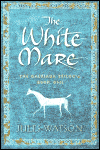
The White Mare by Jules Watson

I have just finished reading the third book in this trilogy now, so thought I would post my reviews that were originally posted on my blog of the first two books in the trilogy.

AD 79. Agricola, the ruthless governor of Roman Britain has just subdued the Welsh. Now he has turned to the last unconquered territory in Britain - Alba, Scotland.

For Rhiann, an Alban priestess and princess, the thread of invasion changes her life irrevocably. The king, her uncle, has no heir, and it is her duty to submit to a political marriage. But she is emotionally scarred from a terrible trauma, and can imagine nothing worse than matrimony. Desperately, she looks for a way out, but sees only the Romans closing in.

Into this volatile situation sails an Irish prince, Eremon, exiled from his home by familial treachery. His aim is to win renown and regain his throne, but first he has to deal with an unexpected alliance, prove himself a military leader, and unite the feuding tribes of his adopted country.

Against this backdrop of looming war Rhiann finds herself embarking on an unexpected journey of love and loss that will the true purpose of her life.

The White Mare is the first novel in the Dalriada Trilogy and marks the arrival of an exciting new talent in historical fiction. In the grand tradition of the saga, it is a tale of heroic deeds, of kinship and kingship, and the struggle for power, honour, freedom, and love.


One of the things I love about reading is the way that you can travel to other places and/or times, without actually leaving modern comforts behind!! This book transported me to Scotland (Alba) in AD 79. The Roman forces are massing in the south of Alba waiting for the order to be given to conquer the wild tribes of the north once and for all, given Rome control over the whole of the mainland Britain.

With the prospect of war looming, Eremon arrives. He is fleeing from a usurper that has taken his rightful place as King from one of the tribes of Ireland, and is looking for a place to spend time regrouping until he can go and take back what is rightfully his. His plan is to make a name for himself, and one way that can happen is if he becomes war leader of the tribes. However, that will take some doing, because the tribes of Alba are notorious for their ongoing feuds and battles. Eremon sees that the only way to defeat the Romans will be to be fighting as one cohesive unit, and works his way towards that girl.

Rhiann is a princess and also a priestess, and she has one pressing duty - to provide a royal heir. Quite interestingly, author chooses to have the crown pass through the females of the family, so that if Rhiann has a son, then he will become King, instead of the more traditional way of passing the crown from father to son. Rhiann is a leader of her people and a very strong woman, in all ways except one. She is traumatised from events that happened several years ago where her foster family was all killed, and she herself suffered terribly. These events have left her with a terrible distrust of men, and warriors in particular.

When it is agreed that a political match be made between Rhiann and Eremon, she is terrified of what is to come, and for a long time after the wedding she maintains a completely distant persona. Gradually though, Eremon and Rhiann begin to work together for the good of the people of Alba, although it is fair to say that there are setbacks along the way. They also work together towards healing of both their relationship and their minds.

The author doesn't back away from the faults of the characters, moving the story forward through the mistakes and errors in judgement that occur.

With a strong emphasis on the role of fate and on the role of religion during those times, there is almost a mystical feel to this book. It has to be said that I haven't read a lot about Roman times, or the tribes of the time, so I have no idea how feasible some of the ideas are that are presented in the book, but they seemed reasonable enough to me as I read it. What I look for in a book is readability, and for a story that hooks me in and makes me want to keep reading. Using these two as measurements, this sprawling sage is a winner!

I enjoyed it immensely and I will definitely be reading the sequel, The Dawn Stag, and the final book in the Dalriada trilogy, which is due out early next year.

Rating 4.5/5


The books in this trilogy in order are:

The White Mare
The Dawn Stag
The Boar Stone

Friday, September 14, 2007

Dreaming the Bull by Manda Scott

Among the tribes, none would believe that their most hated enemy, the bloodthirsty cavalry commander astride a pied war-horse - could be one of their own....or that he might hold their fate in his hands. But as the fires of the war between the tribes and the occupying armies of Rome rage on, dozens of lives will be drawn in to the conflict....Caradoc, the Eceni warrior who will come face-to-face with the emperor himself...Cunomar, son of a warrior queen, who will learn about war - and sacrifice - at his parents' side...Agrippina, the mesmerizing empress whose guile equals that of her husband...Claudius, the omnipotent yet terrified ruler mired in a war he must win at all costs. And then there is Valerius. Caught between worlds, he has the hardest task of all - coming to terms with this heritage and on a perilous journey back to a fateful confrontation with the most feared woman in Brittania...Boudica.

A novel that travels from the wilderness of the British Isles to the teeming streets of ancient Rome, from the remote barracks of frontier legions to the shores of Gaul, Dreaming the Bull is a historical sage of extraordinary power, rich with passion and courage and heroism pitched against overwhelming odds. Written with uncompromising mastery, this is fiction that captures the heart, challenges the mind, and offers us and utterly enthralling experience of history in the flesh and blood of its making.


This is the second book in the Boudica series by Manda Scott, following on from Dreaming the Eagle. In some ways it seems a bit strange that this series of four books is called the Boudica series, because the focus of this book really did seem to be Julius Valerius and Caradoc, with Boudica being more of a cameo player, but then again I suspect that a book labelled as being about Boudica will bring a ready made audience!

This book opens a number of years after the end of Dreaming the Bull. The Romans are still in Britain, and Boudica and her warrior husband Caradoc still maintain their almost guerilla like warfare against the Romans. Whilst the warriors are generally confident there is one Roman soldier they fear - Julius Valerius - a man who seems to be something more than a man, a man who seems to be without fears of his own. What they can't know, is that Julius Valerius is struggling to come to terms with his own identity, both his current one, and the one from his past that he has carefully locked away. As with many secrets from the past, they are not as locked away as they need to be, and as Julius continues with his warfare the ghosts begin to visit him, and to bring back memories of his true identity.

When Caradoc and some of his family are captured and taken to Rome, the narrative leaves Scotland and Boudica behind, and instead we are taken to the world of Imperial Rome. Caradoc and his people must firstly survive the punishment that the Emperor wants to give them for being the biggest problem that he had in the whole empire, and then survive living in the built up world of Rome where they are free to live in the city, but if they make any attempt to leave they will be killed. It is only after several years, and with the help of an old enemy that there may be any hope at all of getting home, but that will be an exhilarating adventure in and of itself.

Whilst this is not the kind of book that you are instantly drawn into and captivated by, to the point of exclusion of all else, ultimately it is a rewarding read, and the ending is definitely interesting enough to make you want to read the next book in the series sooner rather than later!

Rating 4/5

The books in this series in order are:

Dreaming the Eagle
Dreaming the Bull
Dreaming the Hound
Dreaming the Serpent Spear

Sunday, September 2, 2007

Dreaming the Eagle by Manda Scott

I am about to write up my review for the second book in this series, so I thought I would repost this review which was originally put up on my blog earlier this year!


With a novelist's grace and a historian's power, critically acclaimed author Manda Scott brings her immense storytelling gifts to an epic work of historical fiction. Dreaming the Eagle breathes life into history, creating a vibrant portrait of the early years of the Celtic queen, Boudica. With haunting images and unforgettable characters, Scott draws us into a completely different world...a world of myth and heroism, beauty and brutality...where a young woman journeys to greatness at the crossroads of history...


She is Breaca nic Graine, born to the Eceni, a tribe of dreamers and hunters, storytellers and artisans. While fierce in battle, they are a peaceful people, men and women of pride and mystery, in whose lives the real and the fantastical exist side by side. But theirs is not a peaceful world; it is a world of bloody conflict, where neighboring tribes war among themselves while a greater enemy gathers strength across the ocean.. Against this seething backdrop, Breaca will come of age and prove her brilliance in battle, catapulting her to the forefront of her tribesmen, who will rename the copper-haired warrior: Boudica:"She Who Brings Victory."

Many will share in Breaca's extraordinary destiny... Eburovic, the beloved father who always knew that his impetuous firstborn was destined for greatness... Caradoc, the legendary warrior whose love for Breaca is rivaled only by his hatred of Rome... Corvus, the Roman soldier who will become a powerful - and unlikely - ally. Soon as violence and treachery threaten a fragile peace, as an emperor named Caligula rises to power in a distant land, Breaca will once again be called to battle. And this time, the future of a people will rest in her hands as she faces a near-impossible task: to rally the splintered Celtic tribes against the encroaching might of Rome.

Filled with breathtaking sights and sounds - from the beauty of an ancient tribal ritual to the blood lust of a gladiator's arena, from the deafening roar of battle to the quiet passion of lovers - and brimming with raw adventure and vivid historical detail, this magnificent novel has it all: mystery, passion, hatred, lust, war, romance, miracles. It is a work of masterful storytelling by one of the most exciting and original new voices in historical fiction.


Wow...that is an extensive inside cover flap copy, and to be honest I am not going to regurgitate any of the story because this covers it mostly adequately.

The book is broken into four parts. I found the first part quite slow going, where the author was setting up all the meaning of the dreaming, the way that the tribes interacted with each other, and with their animals, and the basis of the warrior training that Breaca received. Once the story moved into the 2nd part and beyond, the story picked up pace and it was easier to get sucked into the story.

There are a couple of things that I think that were misleading in the blurb above. The first is from the final paragraph, where it talks about the "quiet passion of lovers". If you go into this book expecting to read a balance between the history, and the romantic attachments of the main characters then you will be disappointed. The romantic outcome is telegraphed from very early in the book. By the time I was getting towards the end of the book I was actually expecting that this part of the story would be carried into the next book, instead of the inevitable happening in this book.

It is also interesting that there is no direct mention of Breaca's brother Ban in the blurb either, because in many ways his story is the counter balance to Breaca's own. He is a major character, and there were significant chunks of the narrative where the focus was on Ban, and not on Breaca.

There were many, many characters, and at times I really had to struggle to keep track of some of them, and to be honest I think the author did too. There was one fairly major protagonist who was dealt with, but there was absolutely no reaction whatsoever from any of the other characters, which given his role in things was very, very surprising at least to me.

This is no light and fluffy account of what have may have happened - it is in turns gruesome and harsh, mystical and reverent and very believable.

For me there is an inevitable comparison to be made to the Jules Watson books I have read, The White Mare and The Dawn Stag. The settings are not identical but I would think it is fair to say that the tone and intentions of the books are very similar, even though there are several distinctions between them. I think that Jules Watson's books are better able to sustain an emotional involvement on the part of the reader, but there is less reliance of the fantasy elements in this book. It is not that the fantastical, mythical parts of the story aren't there, but I do think there is less reliance on them to move the plot forward.

The hook at the end of the story for the next book is definitely well and truly there, and I for one have been caught on it! The next book has already been picked up from the library!


The books in this series in order are:

Dreaming the Eagle
Dreaming the Bull
Dreaming the Hound
Dreaming the Serpent Spear