Showing posts with label Medieval. Show all posts

Sunday, September 2, 2012

A Place Beyond Courage by Elizabeth Chadwick

In honour of the US release (finally!) of A Place Beyond Courage, I am today posting a slightly adapted review of the book. I originally wrote this review 4 years ago, and I think that since that time, this book has kept a special place in my heart not because it is the book that I have rated highest by Elizabeth Chadwick but rather because of the way she was able to bring me around to like John Marshal. The cover and synopsis are from the newly released US version of this book.
The early twelfth century is a time for ambitious men to prosper, and royal servant John FitzGilbert Marshal is one of them. Raised high as the kin of the deceased King Henry battle each other for England's throne, John reaps rich rewards but pays a terrible price for the choices he makes - as do his family. His wife, fragile, naïve Aline is hopelessly unequipped to cope with the demands of a life lived on the edge and, when John is seriously injured in battle, her worst nightmare is realised. Sybilla, bright, forthright sister to the Earl of Salisbury, finds herself used as a bargaining counter when her brother seeks to seal a truce with his troublesome neighbour, John FitzGilbert. And then there is Sybilla's small son, William, seized hostage by the King for John's word of honour. But sometimes keeping your honour means breaking your word...

Before I read this book, I knew three things about John Marshal. The first was that he was father of William Marshal, a man I had read about, and swooned over, in two earlier Elizabeth Chadwick novels (The Greatest Knight and The Scarlet Lion). The second was that he suffered a terrible injury at Cherwell when he was caught in a burning abbey, and a piece of lead melted onto his face causing permanent disfigurement and the loss of sight in his left eye. The third thing that I knew was that when William was four years, John was forced to give him to King Stephen as a hostage, and John famously said to Stephen that he didn't care if he killed William as he had the anvils and hammer to create more children (roughly paraphrasing of course).

To be honest, because of the third of those things listed above, I was a little surprised to hear that Elizabeth Chadwick had written a book where the main character was John Marshal, because I couldn't really imagine how she would go about making John easy to relate to, when it appeared as though he was quite unfeeling and callous as a man. I am very pleased to say that she succeeded!

This book is predominately set during the very troubled times in the mid 1100s when the war between King Stephen and the Empress Matilda caused great upheaval and destruction across England. When Matilda's father, King Henry, died without naming an heir, there were many lords who bridled at the thought of being ruled over by a woman and therefore sided with the dead King's nephew, Stephen. Still others believed that it was King Henry's wish for his daughter to follow in his footsteps, and thus began a twenty year period of war when the countryside was ravaged.

This same period is covered extensively in Sharon Kay Penman's book, When Christ and His Saints Slept, and having that background certainly aided in my enjoyment of this book. Where Penman's focused heavily on what was happening personally with Stephen and Matilda, many of those same events are on the peripherals of the narrative of this book, except where the events directly touched on John Marshal's life.

John was the loyal Marshal of King Henry - the man responsible for making sure that there was order in court, for the procurement of supplies, horses, etc amongst other things - a man with his finger on the pulse of court life. When Henry died, he also filled that role for Stephen as well. However, there were many at court who were not overly fond of John, and his neighbours were also coveting his lands and were determined to take them, whatever the cost.

In order to preserve his life, and his possessions, John has to take the extraordinary step of swapping sides, and becomes part of Matilda's retinue. What follows are a series of skirmishes, battles and sieges, culminating with the siege at Newbury where John so famously denied his feelings for his son.

Lest you think that this is a book just of battles, Chadwick also gives us glimpses into John's two marriages. The first is to Aline, a somewhat timid and pious woman, who wants nothing more than to have John by her side, and to do her duty. She is a woman who is very obviously not up to the job of being wife to the Royal Marshal, with all the entertaining, and responsibilities that go along with that post. I did feel for Aline as she struggled within her marriage and home, but also for John as he realises that this marriage is one that cannot continue for both of their sakes.

Then, we see his marriage to Sybilla, a partnership that started out as a way to stop an escalating enmity with her brother, Patrick of Salisbury, one of John's neighbours. Where Aline was timid, Sybilla is bold and intelligent, with an ability to charm the people around her from the dairy maids, to those from the highest stations in the land.

Chadwick's portrayal of John Marshal is by no means of a saint who has been portrayed unfairly through the ages. There is no doubting his courage, his competence in his role, let alone his ambition and determination. He is a totally three dimensional character - warts and all.

Similarly, the authors skill in conveying the details of life and times of the twelfth century, from the dresses, food, smells and tastes is exceptional.

One thing to be aware of is that the author has to cram twenty years worth of events into just over 500 pages, so it is crucial to keep an eye on the dates at the beginning of each chapter to keep some kind of perspective in terms of time elapsed.

This was the third Elizabeth Chadwick book that I read and really enjoyed. Since then I have worked my through most of her back list! Still a few to go and I am being very slow, savouring my journey through them knowing that once I get through them all then I will have to wait impatiently for each new release.


Don't forget we are also giving away a copy of A Place Beyond Courage. All the details are here

Sunday, April 29, 2012

Strongbow: The Story of Richard and Aoife by Morgan Llywelyn

In a desperate attempt to reclaim his lost kingdom, Aoife's father offers her in marriage to Strongbow, son of the Anglo-Norman conqueror Lord Pembroke. This dramatic portrait of a fierce warrior who sought glory in a hostile foreign land and his wild Irish princess is an epic saga of love, war, and survival in 12th-century Ireland.


I first read about Richard and Aoife in Denee Cody's The Conquered Heart. I loved it! A historical romance that had real characters and a real historic setting? Just what I love the most. I set about researching everything I could about them to see if what I had read was real or not. I didn't find much and what I found was mostly courtesy of Wikipedia.

A few years later I found the books of Elizabeth Chadwick. I love her books, have been reading them as they are published and she is one of my favourite authors. You can see how thrilled I was when I saw Richard and Aoife's daughter as one of the main characters in a couple of her books. I loved those books but I still wanted more about Strongbow. I was quite happy when I discovered this book existed and quickly managed to get my hands on it.

The book is written, both from Richard and Aoife's point of view, in alternate chapters. It depicts first Richard's childhood and young adult years. His relationship with his father, and how that will influence him for the rest of his life, his relationship with his father. Then Aoife's relationship with her own father, a man with a fearless reputation but apparently very close to his children.

When Dermot MacMurrough, Aoife's father needs help to regain power and lands in his native Ireland he goes to England in search of a champion. To convince Richard he promises him what he cherishes the most, Aoife and his own kingdom after his death. Aoife isn't as happy as her father with the bargain but she eventually agrees to the marriage. She and Richard will fight and conquer both the lands and power that her family and his will wanted.

While it was nice to have an overview of events, the book is small and it covers a long period of time, I would have preferred to have more detailed information about, not only their relationship, but also about the daily aspects of their everyday life. The differences between Norman and Irish ways and their adjustment to each other and their new life. It also the first I heard of Richard’s first marriage and children and of him and Aoife having boys. I was under the impression he had only one son, who died early, and Eve, who became William Marshall’s wife…

I wonder if this is a good example of Llywelyn’s work? I’ve heard of her before but mostly in connection with Lion of Ireland, her book about Brian Boru.

I will continue to look out for books about Richard and Aoife. A couple of years ago I reread The Conquered Heart and, after all the meatier medieval reading I had been doing it seemed lighter and more romancified than what I remembered. I guess my hope is that Elizabeth Chadwick will eventually think of them as main characters for one of her books. That would make me really happy!

Grade: 4/5

Monday, May 30, 2011

Queen by Right Anne Easter Smith includes giveaway

From the award-winning author of A Rose for the Crown, Daughter of York, and The King’s Grace comes another masterful historical novel—the story of Cecily of York, mother of two kings and the heroine of one of history’s greatest love stories.


Anne Easter Smith’s novels are beloved by readers for their ability “to grab you, sweep you along with the story, and make you fall in love with the characters.”


In Cecily Neville, duchess of York and ancestor of every English monarch to the present day, she has found her most engrossing character yet. History remembers Cecily of York standing on the steps of the Market Cross at Ludlow, facing an attacking army while holding the hands of her two young sons. Queen by Right reveals how she came to step into her destiny, beginning with her marriage to Richard, duke of York, whom she meets when she is nine and he is thirteen. Raised together in her father’s household, they become a true love match and together face personal tragedies, pivotal events of history, and deadly political intrigue. All of England knows that Richard has a clear claim to the throne, and when King Henry VI becomes unfit to rule, Cecily must put aside her hopes and fears and help her husband decide what is right for their family and their country. Queen by Right marks Anne Easter Smith’s greatest achievement, a book that every fan of sweeping, exquisitely detailed historical fiction will devour.

Back in my pre blogging days I read and loved Sharon Kay Penman's Sunne in Splendour which was predominantly about Richard III. Reading that book sent me on a journey through lots of Ricardian fiction and one of my favourite reads at that time was Anne Easter Smith's debut novel A Rose for the Crown. In the nearly five years since I read that book, I had intended to read more from this author. With this new book, Queen by Right, I finally got around to actually doing so.

There can be no doubting whether Anne Easter Smith is for York or Lancaster when it comes to deciding which side she would have backed had she had to pick side in the war of the Roses, or at least there isn't much doubt based on the two books I have read so far. That should be sufficient warning to expect that York is good and Lancastrian is pretty much not!

Having now read most of this book, I must say I am a little amazed that we haven't heard more about Cicely's life before now. She has always been mentioned in books about Edward and Richard, her two sons who both ruled England, but Anne Easter Smith manages to give Cicely's story depth and interest all of it's own.

The novel opens with the woman who has been known as the Rose of Raby due to her beauty and also as Proud Cis for her bearing, grace and dignity. Now though, she is deep in mourning. Her beloved husband is dead, as are several of her other family members, and now she must find a way to carry on and support her remaining children.

Looking back retrospectively we see her meet and fall in love with her husband Richard and follow their lives together through their time in France and Ireland, parenting their many children and then to the conflict that pitted the Yorks against the formidable and nasty Margaret of Anjou, known through history as a she-wolf. Whilst battling for the rewards due to a man of his stature, Richard walks a fine line between loyalty and treachery against King Henry.

Of Cicely personally we meet a devout woman who believes passionately in the Virgin Mary. Her spiritual development is affected pretty early on as a result of the interactions that the book suggests she had with Jeanne de Arc. I am not sure that there is much historical basis, but with the timing all fitting, this part of the narrative has made it possible for the reader to view some of the most famous events of the time through the eyes of Cicely. Coincidentally, today is the anniversary of the death of the saint known to most of us as Joan of Arc.

As much as I have enjoyed reading this book, there are a couple of small things that I feel that I should mention. The first relates to Cicely and Richard's sex life. Whilst the scenes are not overly graphic in nature, I am not sure that we needed to be present for the conception of practically every child she had (and there were a lot!).  The second thing was that there appeared to be times where the author lost track of some of the characters, particularly the children, and keeping all of the key players straight in the conflicts later in the book was some times a little difficult. These are minor complaints though.

For the most part, we are given a fascinating glimpse into the life of a woman who is ancestor to nearly every king or queen of England since her death, was mother to two kings, and who seems to have left more of an imprint in the pages of historical fiction than a lot of other women of her time.

Luckily for me, I have two more of Anne Easter Smith's books sitting on my shelf that I can go back and read!


Thanks to Amy from Historical Fiction Virtual Book Tours for organising the blog tour that this post is part of and for arranging for me to receive an e ARC.

~~~~~~~~~~~~~~~~~~~~~~~


Thanks to HF Virtual Blog Tours and  the publishers we have a copy of Queen by Right to give away! 


- open to US residents
- leave a comment and don't forget your email address
- the contest closes June12 at midnight GMT

Thursday, February 17, 2011

A Vision of Light by Judith Merkle Riley


Margaret of Ashbury wants to write her life story. However, like most women in fourteenth-century England, she is illiterate. Three clerics contemptuously decline to be Margaret’s scribe, and only the threat of starvation persuades Brother Gregory, a Carthusian friar with a mysterious past, to take on the task. As she narrates her life, we discover a woman of startling resourcefulness. Married off at the age of fourteen to a merchant reputed to be the Devil himself, Margaret was left for dead during the Black Plague. Incredibly, she survived, was apprenticed to an herbalist, and became a midwife. But most astonishing of all, Margaret has experienced a Mystic Union—a Vision of Light that endows her with the miraculous gift of healing. Because of this ability, Margaret has become suddenly different—to her tradition-bound parents, to the bishop’s court that tries her for heresy, and ultimately to the man who falls in love with her.

Although I've found some pretty strong women in the medieval stories I read this is the first time where one convinces a man to use his time and skills to tell a woman's story. Just that premise alone intrigued me and kept me glued to the pages.

The story we are told is Margaret of Ashbury's tale. She is married to a wealthy London merchant and a voice as told her to write her story. Since she can't write she has to find someone who will and her husband indulges her every desire.

She finds a destitute monk, Brother Gregory, who is willing to do it for coin and so starts the narration of her life story since she was a little girl. I did love the detail put in describing a woman's everyday life and the daily worries and thoughts that sometimes were so different from men's.

Margaret has a colourful life. She was married young to a beastly man who treated her badly, was abandoned on the side of the road after catching the black plague, learns a trade, joins a band of actors and moves to London where she leads a successful life as a midwife, is eventually accused of witchcraft but ends up being saved and marries her current husband.

While she tells all this to Brother Gregory they get to know each other and develop a relationship of sorts. She knows how cranky and easily provoked he can be and he eventually starts respecting her. The story deals with some serious aspects of the time but the author manages to include some humourous tidbits which make it a lighter reading than it otherwise would be.

I guess my only complaint is the supernatural aspects of the story. I can't help but being sceptic of such events and while they didn't bother me too much here on principle I would prefer not to have Margaret talking to God and having healing powers.

Grade: 4.5/5

Friday, January 28, 2011

Hugh and Bess by Susan Higginbotham

Forced to marry Hugh le Despenser, the son and grandson of disgraced traitors, Bess de Montacute, just 13 years old, is appalled at his less-than-desirable past. Meanwhile, Hugh must give up the woman he really loves in order to marry the reluctant Bess. Far apart in age and haunted by the past, can Hugh and Bess somehow make their marriage work?


Just as walls break down and love begins to grow, the merciless plague endangers all whom the couple holds dear, threatening the life and love they have built.

I've heard much about Susan Higginbotham's books but I had never tried any when this Hugh and Bess attracted my attention. I know that it is not her first book and that the first - The Traitor's Wife - is a sort of prequel to this story but since I already had this one I couldn't resist picking it up.

I did find it a nice, fast read. It is mostly a romance but with a strong historical background that gives you an idea of what was happening in England at the time. Besides the main families here - Montacute and Le Despenser - we see bit of the king, of Joan the Fair Maid of Kent and even of Isabella, the She-Wolf of France. Those parts were interesting and I was sorry not to have more historical detail.

Still, this is a sweet story of two people falling in love after they marry, much against the bride's wishes. How they get to know each other and start trusting each other before they manage to make their marriage work.

After reading this one I got curious about The Traitor's Wife and I have now added it to my WL.
Grade: 4/5

Thursday, November 18, 2010

The Passionate Brood by Margaret Campbell Barnes

In this compelling novel of love, loyalty, and lost chances, Margaret Campbell Barnes gives readers a new perspective on Richard the Lionheart's triumphs and tragedies. Drawing on folklore, Barnes explores what might have happened if King Richard's foster brother were none other than Robin Hood, a legendary figure more vibrant than most in authentic history. Thick as thieves as Richard builds a kingdom and marshals a crusade, the two clash when Robin Hood so provokes the king's white hot temper that Richard banishes him. The Passionate Brood is a tale of a man driven to win back the Holy Land, beset by the guilt of casting out his childhood friend, and shouldering the burden of being the lionhearted leader of the Plantagenets.

 
The last book I read from Margaret Campbell Barnes was Within the Hollow Crown, which was about Richard II, and was quite slow and plodding and laborious to read. Leaving out the fact that this book is about another Richard, this time Richard I, I would not use any of these words to describe The Passionate Brood: A Novel of Richard the Lionheart and the Man who Became Robin Hood. Instead words like romanticised and idealised, fast paced, adventurous and over the top come to mind.

First, a note about the subtitle of this novel. To my mind it is a little misleading to suggest that the reader is going to find out more about Robin Hood because whilst there is a Robin in the novel, and there is an explanation for his outlaw status, there is precious little page time spent exploring the actions of the man who has achieved such legendary status over the years.

The male leading character for the drama that unfolds in these pages is undoubtedly Richard II, who history knows as Richard the Lionheart. As a character he dominates the pages. He is a man who is passionate, quick tempered, driven, pious and so much more. As king, Richard spent barely any time in England, but rather spent much of his time away on Crusade, coming close to reaching Jerusalem, but not close enough.

There is one character in particular who does manage to steal a little of the limelight from Richard where she is given page time, and that is his sister Joanna. I would love to read something about her at some point. Let's face it, most of the time I would be happy to read about any of this fascinating family. At one stage this book was released under the title Like Us, They Lived. I definitely think The Passionate Brood fits so much better!

We follow Richard as a young man, engaged to Anne of France whom he dislikes intensely (this young woman has sometimes been referred to as Alais in other novels ) and we travel with him as he journeys to Navarre where he meets the beautiful Berengaria who captures his heart. We join both Richard and his young bride as they go on Crusade, as he shows the military leadership for which he is still famous, the fighting with the other leaders, most notably Phillip of France, and then on his ill fated journey home where he is kidnapped and the country of England is nearly impoverished trying to raise the required ransom.

For a king who spent very little time in England, and whose wife didn't set foot in the country whilst she was Queen, Richard is still remembered with much fondness now. There is plenty of speculation about him, particularly in relation to his sexuality, but there is none of that in this novel. The Richard we find within the pages of this book is painted in broad strokes, not necessarily glossing over some of his less than stellar moments, but certainly presented in a highly romanticised fashion.
Reading this book has certainly piqued my interest, in particular for the next Sharon Kay Penman book which is telling Richard's story.
Over the years I have read a number of Margaret Campbell Barnes novels and for the most part I have liked them. This book is however my new favourite book from this author. It was a rollicking good read.

Rating 4.5/5

Many thanks to Sourcebooks for sending me a copy of this book or review purposes

Originally posted at Adventures of an Intrepid Reader

Friday, October 15, 2010

The Iron King by Maurice Druon


The Iron King (Le Roi de Fer) is the first book of an historical French series named The Accursed Kings (Les Rois Maudits) written by Maurice Druon. The story is set in the 14th century France during the last years of the reign of the King Philip IV, the Fair also known as The Iron King.

Philip is described as a severe, distant and intelligent man with quite a sense of humor, but his presence alone is enough to intimidate everyone, even when he tries to be nice. While often seen as a cruel and cold man by all those around him, his loneliness is blatant in each scene. He is a king who felt more at ease surrounded by his dogs and hunting than in court or with his family. Known in history as the man who destroyed the Knights Templar, the persecution of seven years culminated with the execution of the Great Master, Jacques de Molay.

We also follow other stories, like the Tour of Nesle Affair, a scandal amidst the Royal French family where Margaret and Blanche of Burgundy, daughters-in-law of the King, were found guilty of adultery with the two Aulnay brothers. The third daughter-in-law, Joan of Burgundy, was also punished for hiding the lovers and passing down messages. If there was also suspicions of infidelity, the support of her husband saved her from the same fate as her sister and cousin.

The author doesn’t hesitate to fill out the history blanks with some drama, which can sometimes be a little excessive but nothing that spoils the story, at least not for me. The scene that remains vividly in my memory is the execution of Jacques de Molay and how he cursed all those who participated in his condamnation. While I was reading it, I was holding my breath completely under the spell of Druon’s words.

Maurice Druon is known for his extensive historical research and he easily manages to create a perfect balance between history, humor and even romance. He brings back history to life with strong characters, captivating dialogues and a fascinating 14th century France filled with powerful moments: the demise of the Capetian dynasty, the disappearance of one of the most important religious orders, the Knights Templar, or even the upcoming Hundred Years War.

Years ago when I was studying history, this book was a must read for any history buff in France. The series was even adapted to the small screen twice, first in the 70′s (which I really recommend to any period drama lover) and the latest one in 2005. After all those years, the book remains, for me, one of the best French historical fiction pieces. I intend to buy and read the rest of the series as quick as possible (something I planned to do for years and never had the chance!).

The Accursed Kings series:

1. The Iron King
2. The Strangled Queen
3. The Poisons of the Crown
4. The Royal Succession
5. The She-Wolf of France
6. The Lily and the Lion
7. When a King Loses France

Grade: 4.5/5

Monday, October 11, 2010

The Greatest Knight by Elizabeth Chadwick


Royal protector. Loyal servant. Forgotten hero.

A penniless young knight with few prospects, William Marshal is plucked from obscurity when he saves the life of Henry II's formidable queen, Eleanor of Aquitaine. In gratitude, she appoints him tutor to the heir to the throne, the volatile and fickle Prince Henry. But being a royal favorite brings its share of danger and jealousy as well as fame and reward.

A writer of uncommon historical integrity and accuracy, Elizabeth Chadwick resurrects the true story of one of England's greatest forgotten heroes in a captivating blend of fact and fiction. The Greatest Knight restores William Marshal to his rightful place at the pinnacle of the Middle Ages, reflecting through him the triumphs, scandals, and power struggles that haven't changed in eight hundred years.

Let me set the stage for you. I blog here with four other bloggers. Or, should I say they blog and I pop in from time to time? One thing I know about them for sure, though, is that 3 of them love Elizabeth Chadwick. Teddy is like me and hadn't read Elizabeth Chadwick until recently. I have known Marg for years and she has been telling me that I should read Elizabeth Chadwick. Then, between her, Ana, and Alex there have been wonderful reviews of her books. With a gift card I received for Christmas last year I finally bought this book and then it took me almost a year to actually get around to reading it! I am so glad that I did, though. I had started it earlier in the year, but I couldn't get into. This time I sat down with it and the pages just flew by. Chadwick has a wonderful way with words, characters, and setting. She really made everything come alive.

This is a novel about William Marshal. He is a hero in Henry II's court. He serves the entire family before his term is over in some way and has connections to many of the great events that happen during the time period. The thing I really liked about the book was that while there was a lot of character building, there was also a lot of action. I like reading about battles and victories to keep the book flowing. If an author gets bogged down in what I consider trivial things I get a bit bored. Now once in this book, though, did I find myself bored. I kept wanting to know what was going to happen to William next. By the end of the book you will feel like you really know him. Chadwick has a real talent for throwing in little facts and tidbits. They don't take away from the story, but add to it.

I was also really interested in Chadwick's portrayal of the royal family. She actually made all of them a bit more human, so even if you hated them in the past you could almost sympathize with their actions. Eleanor has always intrigued me and I thought she really became human in this book. Yes, she was still interested in power and not in the midst of a great relationship, but there were those little moments where you could forget she was one of the great leaders of England and see her for the regular person she was. It was the same with her children. Henry interested me, too, because the more recent portrayal of him that I had seen was in Ariana Franklin's series. There were some similarities, but there were also moments where I felt I was reading about an entirely different person.

I just loved this book. It will be on my best of list for the end of the year for sure. I really feel this review is not doing the book justice at all, but I did love it! That's really all you have to know, right? Also, thank you to Marg, Ana, and Alex for bragging this author up every chance you got and finally lead me to take the plunge and read her. I appreciate it!

Thursday, August 19, 2010

A Murderous Procession by Ariana Franklin

Adelia is back in this thrilling fourth installment of the Mistress of the Art of Death series

In 1176, King Henry II sends his ten-year-old daughter, Joanna, to Palermo to marry William II of Sicily. War on the Continent and outbreaks of plague make it an especially dangerous journey, so the king selects as his daughter’s companion the woman he trusts most: Adelia Aguilar, his mistress of the art of death. As a medical doctor and native of Sicily, it will be Adelia’s job to travel with the princess and safeguarding her health until the wedding.

Adelia wants to refuse—accompanying the royal procession means leaving behind her nine-year-old daughter. Unfortunately, Henry has arranged for the girl to live at court, both as a royal ward and as a hostage to ensure that Adelia will return to the king’s service. So Adelia sets off for a yearlong royal procession. Accompanying her on the journey are her Arab companion, Mansur, her lover, Rowley, and an unusual newcomer: the Irish sea captain O’Donnell, who may prove more useful to Adelia than Rowley would like.

But another man has joined the procession—a murderer bent on the worst kind of revenge. When people in the princess’s household begin to die, Adelia and Rowley suspect that the killer is hiding in plain sight. Is his intended victim the princess . . . or Adelia herself?
Having spent a couple of years living in relative obscurity, happily raising her daughter, sharing her home with her friends and when possible spending time with her lover, Rowley, Adelia Aguilar is not best pleased when she is summoned by King Henry II. He has a task for her. She has been chosen to accompany the King's young daughter Joanna from England to her wedding in Sicily. Also in the party is Rowley and her Arab companion Mansur but her daughter is going to be lodging with Queen Eleanor, both for her development, but also as surety that Adelia will return to England.

The journey itself is dangerous. The procession goes through France, to Aquitaine, through the Languedoc region where the Cathar heresy is spreading and so is the Church's eagerness and enthusiasm in squashing that faith, and then onto Sicily. Along the way the young princess is accompanied by a large party. There are her servants, her ladies in waiting, the requisite churchmen, a few knights and soldiers. For different parts of the journey we also get glimpses of her brothers, Young Henry and Richard, who is now most famously known as Richard the Lionheart. We also spend time in the court at Aquitaine, famous for courtly love and also in the inhospitable mountains of the Languedoc region of France where Adelia comes into contact with two Cathar women and very nearly finds herself being treated as one.

In keeping with the attitudes of the time, Mansur and Adelia are mistrusted by many of their travelling companions, especially after some of their travelling companions begin to be murdered. It isn't clear though exactly who it is that is the target. Is it the princess? Is it someone who is hoping to steal the priceless treasure that is travelling with the party, or is it someone who is targeting Adelia herself?

I never thought I would find myself saying this about a Ariana Franklin/Diana Norman novel, but I didn't really enjoy this one that much.There are a number of reasons why.

The first is that the author used quite an unusual technique in that where ever we were inside the thoughts of the characters then those thoughts were italicised. No great drama there, except that we spent the majority of time inside the thoughts of Scarry, who is the villain of the piece but then we were following Adelia's thoughts, and then back to Scarry. At one point, I was waiting for us to get a glimpse into the thoughts of the dog. And yes, we know the whole time through the book who the villain is. What we don't know is who he is disguised as and what role he has within the travelling party. That mystery in itself is not too badly handled.

The second is that I didn't like Rowley as much as I usually do. I have liked Rowley in the previous books with his unusual mix of knight and churchman sensibilities. Here is a man who is in love with a woman but is restricted from being able to be with her because he was appointed to a role within the church and because of her occupation and beliefs. In this book he has morphed into a jealous and domineering lover (and yes, you are reminded repeatedly that he and Adelia are lovers). It is difficult for Adelia and Rowley because he is a church man and therefore can not be seen to have a lover and so they are forced to stay away from one another during the procession, but at one stop on their journey he hires a room for them, and basically on arrival he walks in and says " Renting this hovel is costing me a fortune. Now get your clothes off."  Yes, he was always a man's man with man's needs but it just didn't feel to me as though this is the way that Rowley would have spoken to Adelia in the previous books.

Adelia was also a bit more petulant than she normally seemed to be to me, often being angry with Rowley and Mansur and not speaking to them etc. Admittedly everyone around her seemed to know what was happening to her and they did their best to make sure that she didn't know which annoyed  her, but still. I didn't like this aspect of her character.

I am not sure if it is that I am not remembering this from the previous books but it seems to me that this book was a lot coarser than the earlier books in the series. For example, at one point the Bishop of Avergnon is imagining the burning at the stake of a Cathar woman and the description given is:

When Gerhardt had gone, his lord poured himself another glass of the vintage from his vineyard near Carcassonne and sipped it while he engineered a new vision of Ermengarde his black-clad tauntress, this time tied to a stake with faggots laid around her feet.

He saw himself thrusting a torch into the wood like a penis into her parts and sighed because, alas, that pleasure must be left to the executioner. One day, though, yes, yes, one day, the flames he'd light would consume them all...men, women, and children.

This really was most excellent wine.

There were also a number of new characters introduced from a new maid named Boggart, and the charismatic, charming, almost swashbuckling captain O'Donnell. I am not sure what the purpose of introducing O'Donnell was really. I liked O'Donnell a lot, and I would be happy to read more about him, but without giving too much away it almost seemed as though it was an unfulfilled attempt at a love triangle. I suspect though that we will see more of O'Donnell in future books in the series, which may give us more insight into what the author was trying to achieve.

In no way am I suggesting that I am giving up on this author, because I have enjoyed far too many of her books over the last few years to let one disappointment get in my way. I might be a little more wary though when I start the next book.


Rating: 3/5

Thursday, July 15, 2010

Why I love Eleanor of Aquitaine by Robert Fripp *GIVEAWAY*

As I write this, the Atlantic magazine is running a cover story: "The End of Men: how women are taking control of everything," by Hannah Rosin (July, 2010.)

Contrast that with my concept of Eleanor of Aquitaine as she dictates her memoirs in the year 1203. In this passage she is looking back on her first decade in Paris as the queen of France, beginning in 1137. "Women were wombs," she begins, "wombs to put to marriage; wombs to breed; wombs to command; wombs who would meekly obey. A man served two masters, his lord and the Church. A woman served three, for she obeyed her man before the other two."

Eleanor's campaign (if it was a campaign) to improve the status of noble women borrowed from the teachings of at least two influential men. One was the philosopher Peter Abelard; the other, the charismatic wandering preacher, Robert d'Arbrissel, founder of Fontevrault, the abbey for nuns as well as monks and always governed by a woman. (Eleanor is buried there.)

Here she is on Abelard: "Peter’s message was: question blind faith, for it is blind. And question that which you obey. That was why we women were so fond of him. Not just for his audacity. He raised at least the hope of a free mind. How bold he made us feel. What vicarious joy!"

In Robert d'Arbrissel she finds, "...a man of vision. He came from Brittany, a land of Celts whose ancient tales expound on British legends. They tell of magical and healing powers possessed by women in the days of the great King Arthur. Celts are not jealous of female arts: rather they revere them. It is no coincidence that both d’Arbrissel and Abelard were Bretons. The Celtic mind permits Woman her full measure of humanity."

"Historical Tapestry" asked me to explain, "Why is Eleanor of Aquitaine so popular in fiction right now?" After a decade working on "Power of a Woman..." I can say: Because her time is now.

The first years of the past century saw women struggle for the right to vote. The first decade of this century finds them continuing to break from a cocoon of condescension to achieve emancipation in the fullest sense -- in human life and living. Transpose the following passage into modern terms as "my" Eleanor rejects her centuries-old conditioning; and observe how her ancient dream slips into place in the jigsaw of our modern times. Here is Eleanor on what must have seemed to her an impossible hope:

"In the time of my grandmothers, worthies of the Church spilled earnest ink and heated breath upon this question: do women possess immortal souls? The men who asked that question held that women were but passive vessels for the nurture of their husbands' seed. Think of it, Aline. The very proposition begs a second question: do women give birth to soul-less snakes or to the souls of men? All men are born of women. So, how is it that a beast-like thing, having no soul, gives birth to kings? Pah! I myself have carried God’s anointed! Jesus was of woman born! Even a Church whose one good eye looks kindly upon males concedes the truth of that! So how can it be that women have less claim to souls, or claim to lesser souls?"

In Eleanor of Aquitaine's character I discovered the toughness and agility of the feminine spirit that my late mother-in-law possessed in abundance. So, who was she?

Cipe Pineles reached New York from the wreckage of the Austro-Hungarian empire in the early 1920s with her mother, two sisters and some English acquired by reading Charles Dickens aloud. She soon graduated high school, at the same time winning The Nation's national essay contest. As a young designer she knocked on doors with her portfolio for a year before magazine entrepreneur Condé Nast himself placed her in a job with potential. She never looked back.

What had Cipe Pineles in common with Eleanor? They were cut from the same cloth. They both had the practical intelligence – the nous, in Britain -- to show flexibility, pragmatism, courage and persistence under fire. They both made progress in the face of systemic opposition by men. Under Condé Nast, Cipe became the first woman appointed art director of major consumer magazines. Throughout her working life she competed in a tough, men-only field, and in each of her jobs the majority of people reporting to her were men. For thirty years I watched Cipe pull threads in managing professional and family matters. She was also the most gregarious, most generous woman one could meet. She threw great parties.

Eleanor of Aquitaine had been brought up in the relatively relaxed social and religious climate of Poitou and Aquitaine. Her only brother died, requiring that Eleanor be led from the feminine shadows and groomed to assume a degree of leadership normally reserved for males.

Her move to Paris as the queen of France at the age of 15 took Eleanor to a different world, one where priests and abbots ruled, and where sanctity challenged joy and gaiety. The sudden change must have weighed like a leaden blanket. But Eleanor held fast to the ambit of her youthful mind, inching forward where she could and learning from severe mistakes. Her years as the mistress of Paris may have been grim, but they taught perseverance in the face of adversity and, no doubt, toughened her cool reserve. Here is Eleanor instructing her young secretary, Aline, in deportment:

"There is a quality about a woman in her prime, transcendent of the flesh, for which men pine. Mark me, Aline, men's quest to possess us is a much greater thing than a stag sniffing hinds.

"Thus was I worshipped, in song and in verse. I say this to you now, not from the folly of vanities past, but as the earthly embodiment, long ago, of that essence which is the power of a woman.

"That is what draws, Aline. That is what draws men in. It is an essence of grace not captured or crafted in fine fabric and squirrel fur, though it may clothe itself in them. It does not depend upon beauty; it lives in a radiant hauteur, a comely and commanding presence. It finds life in the rustle of silk, but not the silk; in the lightest of footfalls, but not the foot; in the bearing, apart from the being."

Why is Eleanor popular now? Because, by seeing far, she projected potential for women's success into a future time -- our century -- as well as her own.

Medieval Europe's formidable Eleanor of Aquitaine dictates her memoirs in Robert Fripp's "Power of a Woman. Memoirs of a turbulent life: Eleanor of Aquitaine," Copyright Robert Fripp 2010. Visit http://eleanor.robertfripp.ca// for excerpts, reviews, a blog, an "Eleanor of Aquitaine timeline" and a reading group guide.

____________________________________________________

Robert Fripp kindly offered three copies of his book and also 10 copies of  "Eleanor of Aquitaine's Timeline" in PDF for a giveaway.

GIVEAWAY RULES:

- two book copies US only and one copy Worldwide
- leave a comment and your email adress (one entry per household)
- contest closes 30 July at midnight GMT.

We'll select randomly the three winners of Power of a Woman and 10 others for "Eleanor of Aquitaine's Timeline". Good luck to everyone!

Friday, June 18, 2010

Katherine by Anya Seton

It's impossible to be an historical fiction fan without hearing about Anya Seton's Katherine. For years I only read good things about it and several of my friends couldn't stop recommending it. Like many of those great books you intend to read for ages, but the right occasion never seems to show up, Katherine waited quite a while in my dusty TBR pile. When the Historical Tapestry team decided to organize a season about Anya Seton I jumped of joy. I couldn't ask for a better excuse!

The story begins with young Katherine de Rouet leaving the nunnery where she lived for several years after her father's death. She is to join her sister, Philippa, at court. Beautiful and shy, the young woman soon attracts the attention of two men, the creepy Hugh Swynford and the mysterious John de Gaunt. The first one is completely obsessed with her and does everything in his power to marry her, to Katherine's great despair. The marriage is unsurprisingly unhappy and soon Katherine and John meet again under other circumstances.

John of Gaunt is a man of his time. Duke of Lancaster, the third son of the King Edward III, he is ambitious, arrogant and surprisingly fragile. When he meets Katherine, it's clear he doesn't know what to do about her. He is attracted and repulsed at the same time to that breathtaking beautiful and earthly young woman who looks so different from his ethereal blond wife, Blanche.

After spending years in an unhappy marriage with Swynford, Katherine find herself free to be with John, who meanwhile also lost his spouse to the Black Death. With the passing of years and four children later - the Beaufort - the couple seems to have created a perfect harmony between them. But Katherine starts to doubt about her lover's affections and his constant absences seem to confirm her fears...

Katherine Swynford and John of Gaunt are very human and that's what makes them so interesting. There were some moments where I wasn't very fond of John and his excessive ambition. He was so intense that I kept waiting for Katherine to get burned. Same for the young woman's overzealous religiousness but those are my modern opinions getting in the way, and I didn't have any troubles setting them aside for a while.

While this book is about John and Katherine relationship, I never felt that Anya Seton used any love story cliches. If some scenes between them are very romantic, others are painstakingly real. John marries for power and political alliances, like most of the men of his station. Katherine knows that her low birth makes it impossible for her to be a suitable spouse for the King's son. The only way they could be together was as lovers and, at first, they seem both content with the situation. The fact that many years later, John defies all social conventions and marries his long ago mistress makes me love even more this man who was always ready to fight for what he wanted.

Once again, the historical research is done carefully which will immediately seduce all history lovers. Seton will make you travel back in time gracefully never failing to hold your interest, showing you how remarkably talented she is. Her portrayal of the English 14th century is masterfully weaved with its court intrigues and machinations, giving us glimpses of crucial events as The Hundred Years War, the Peasant's Revolt or even the impact of the merciless Black Death. For several hours I truly felt I was living in Medieval England.

Katherine is definitely a book who deserves a special place among my keepers. I'm off to search for Anya Seton's entire back list.

Grade: 5/5

Tuesday, June 8, 2010

Green Darkness by Anya Seton


I've had this book in my TBR pile for more than a year. I had picked it up because I loved Katherine and I wanted to read more books by Seton. Also this book has a theme that fascinates me - reincarnation, karma, good and evil... - even if I'm not sure if I believe it or not. Maybe it was my feelings toward it that kept me from picking it up for so long but now I'm really happy that I did.

The book starts in the sixties of the XX century. Celia Marsdon, a young american girl, married Richard a british gentleman and his fascinated by british history. They are having some problems as Richard's behaviour becomes strange. During a weekend house party Celia plans a visit to a nearby estate and feels strangely disturbed especially after hearing mention of a young woman being walled up alive 400 years previously. It's soon obvious that unknown forces are affecting both Celia and Richard who both display uncharacteristic behaviour who will lead them to a brutal scene that leaves Celia in a coma and Richard with a death wish.

A interested and active participant in all this is Dr Akananda, a hindu medical doctor, friend of Celia's mother, who believes in reincarnation and how past lifes may affect your present one. He starts an unconventional healing treatment trying to save Celia by making her relieve her past.

So a big part of this book, I should actually say the bigger part, is set in Tudor times during the reign of Henry VIII's children. As the drama unfolds we soon identify most of the present day characters in the historical ones.

I think one of Seton's strong points is how well she makes characters come to life both by good characterisation and vivid settings' descriptions. After we jump to the past I was totally immersed in the reading and didn't want to have to interrupt it when real life called. I have only one thing to mention regarding the story in the past, I think we had a lot of build up and then the actuall tragic event happened too quickly and with little detail, I also realise though that to deal with it differently would probably evoke too much anguish in the reader so maybe that was a good thing. After the action returns to the XX century Celia is already recovering and it's ultimately her who takes Richard through the final steps of the healing process.

Although we could consider this book an historical romance because there is a love story that takes centre stage, this is much more complex than just the love story. According to the Author's note in the beginning: The theme of this book is reincarnation, an attempt to show the interplay - the law of cause and effect, good and evil - for certain individual souls in two english periods.

_____________________
Originally posted on July 07

Saturday, May 29, 2010

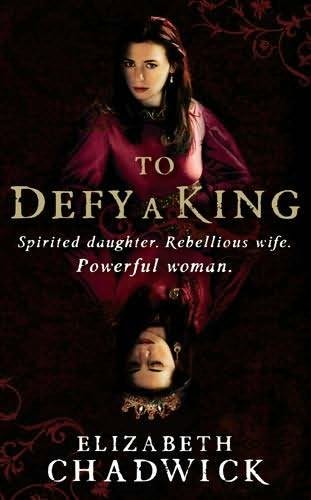
To Defy A King by Elizabeth Chadwick

A story of huge emotional power set against the road to Magna Carta and the fight to bring a tyrant king to heel.

The privileged daughter of one of the most powerful men in England, Mahelt Marshal's life changes dramatically when King John suspects her father of treason. Her brothers are taken hostage and to keep her safe, Mahelt's father marries her to Hugh Bigod, heir to the great earldom of Norfolk. Mahelt finds adapting to her new life hard and although she comes to care for her husband deeply, defying her powerful father in law brings disgrace and threatens her bond with Hugh.

As the Magna Carta crisis looms, King John sets out to subdue the rebellious Bigods and when the royal forces besiege Framlingham Castle, Mahelt is caught up in a heart-rending struggle, knowing that she and her marriage might not survive as wide rifts open between family members.
 
After having read the stories of William Marshall and Isabelle de Clare I was looking forward to read about their eldest daughter, Mahelt Marshall. Elizabeth Chadwick is another author that never lets me down and I am happy to say that To Defy a King was another wonderful read.


The book starts with familiar events but now from Mahelt's perspective. When her parents decide to go to Ireland they want to leave her well cared for and so negotiate a marriage between Mahelt and Hugh Bigod, the eldest son of the powerful Earl of Norfolk. Mahelt is very much aware of her importance as a Marshall and of her sense of honor which sometime clashes with her father in law's will. Hugh, however, realises that his young wife's spirit is what attracts him and that he will have to employ subtlety to make her grow up and learn where her loyalties must now lie.

Although they are in good standing with the King, the Bigods have to take care about who they associate with and Mahelt's reckless actions may well put them in danger. They are connected with the King through Hugh’s half brother William Longespée but the relationship between the two is strained at best. It will take some time and persuasion till Mahelt learns to balance her feelings and weigh what's really important, to think of herself as a Bigod. And while Mahelt and Hugh work on their marriage, King John continues his rule through war and fear. Soon Hugh and the other barons start plotting to limit his power and protect their rights and privileges. If her father was always the king’s man even when in disgrace, now Mahelt sees her husband rebelling against the king and take up arms to defend what he believes in.

To Defy A King is a lovely book! Chadwick’s characters are people that you can identify with, who have the same basic expectations about life, love and society in general that everyone has and in each of her books there's a solid background of research that really brings to life the everyday events of the Middle Ages without it being obvious.

If Mahelt is a strong heroine, Hugh is the one I appreciated all the more because of the way he read his wife and managed to make her grow up and learn her place without crushing her. I wonder how Chadwick manages to consistently write male characters that are wonderful examples of humanity and sensitivity without losing any of their manliness? There are many reasons to pick up this book, the solid historical background, the plot that makes use of it and the engaging characters will appeal to every historical fiction lover but the truth is that her descriptions of feelings, emotions and needs with which we can identify will make this a terrific read for everyone.

Grade: 5/5

** And don't forget to check on our To Defy a King conversation **

Monday, May 24, 2010

To Defy a King by Elizabeth Chadwick

From acclaimed novelist Elizabeth Chadwick comes a story of huge emotional power set against the road to Magna Carta and the fight to bring a tyrant king to heel. 

The privileged daughter of one of the most powerful men in England, Mahelt Marshal's life changes dramatically when her father is suspected of treachery by King John. Her brothers become hostages and Mahelt is married to Hugh Bigod, heir to the earldom of Norfolk. Adapting to her new life is hard, but Mahelt comes to love Hugh deeply; however, defying her father-in-law brings disgrace and heartbreak. 

When King John sets out to subdue the Bigods, Mahelt faces a heartbreaking battle, fearing neither she, nor her marriage, is likely to survive the outcome ...

Magnificent in scope and detail, with characters that leap off the page, this is historical fiction at its finest.

Elizabeth Chadwick's last new book was released around about 20 months ago and consequently it felt I had been waiting for this book for an eternity. The problem with such highly anticipated books is that when you finally get to read it, the book often doesn't live up to the anticipated enjoyment of it. I am pleased to say that this is one occasion when that didn't happen! It was fortunate for me that my son wasn't well and so I had time to sit down and read, and I finished reading this book in just over a day.

In some ways this book is a rounding out of the various novels that this author has been writing over the last few years. The Greatest Knight was the first EC novel that I read, and it featured William Marshal, as did the follow up book The Scarlet Lion. Then I read A Place Beyond Courage which is about William Marshal's father John. The heroine of this novel is John's granddaughter, William's daughter, Mahelt. Similarly, Hugh is the son of Roger and Ida who were the main characters in The Time of Singing.

Mahelt is the cherished eldest daughter William Marshal, one of the most influential men in England. Being respected and influential isn't however enough to keep you safe from the machinations of one of the most changeable kings in English history - King John. With two of the Marshal's sons already being held hostage by the mercurial king, the Marshals are planning to stay out of John's way as much as possible by withdrawing to their lands in Ireland, but before they do that they want to marry their eldest daughter Mahelt to the best possible husband, in this case Hugh Bigod, son of another very influential and powerful man, Roger Bigod, Earl of Norfolk.

Mahelt is sent to Framlingham to live with her new family, although at this early stage she is married but not really a wife, and so it is a little difficult for her to find her place in the household. It is also difficult for her as she is a spirited and head strong young woman who is used to thinking for herself, and so she clashes with the very rigid and set in his ways Earl who struggles with her independence and her tendency to say what she thinks in quite a direct manner.

As the young couple truly begins their married lives together, they have to face challenges caused by these clashes with Hugh's father, as well as with the growing instability caused by John's constant demands, and then with the fact that Mahelt and her new family find themselves on the opposite side of the political arena to her own family. And when the Bigod's find themselves in danger, even if they survive the trials they are undergoing, there is no guarantee that Hugh and Mahelt's marriage can survive the aftermath.

Whilst there are many people who willingly go off into danger to protect the freedoms that we so often take for granted, I really am glad that we do not have to deal with the inevitability of our loved ones going off to fight to some degree every single summer. There is not only the danger of them being injured or killed, but also that they may be captured and held hostage.  I thought this scene between Ida (Hugh's mother) and Mahelt was very touching.


Ida bent over her sewing once more, but had to stop again as tears splashed on to the fabric. "My sons," she said in a grief-stricken voice. "I bore them from the travail of my body. I bathed and tended and watched over them and soothed their hurts with love and ointments. Now again and again they ride to war. Their father spent so many months away serving the King that our good years were wasted and in our twilight, there is only long familiarity like two stones rubbing together with the harder one wearing away at the softer until the softer is dust. I watch my boys leaving their wives and children - leaving me - and the pattern repeats itself all over again." She fixed a drenched gaze on Mahelt. "The first thing a man asks of his newborn son is 'Will he be a good soldier? Will he have a strong fist?' Never do they ask: 'Will he be a good husband and father?' And as mothers we never ask that question. That is what makes me weep.

"Unless our sons become monks, they are bound to be soldiers," Mahelt replied pragmatically. "It is their station in life. The first thing I would ask is: 'Will he be honourable? Will he be strong - not of fist, but of principle?' We should change what we can and make the best of what we cannot."

Ida wiped her eyes again and forced a smile. "That sounds like your great father talking."

Mahelt flushed. "It was what we were taught from the cradle." She gave a self-deprecating laugh. "I am too impatient. I want to change everything."
One of the interesting relationships in the book was between Hugh and his half-brother William Longespee, who in turn is half brother to King John. There had long been a difficult relationship between the two men which started in childhood, and relates to the fact that whilst William has royal connections, he was removed from his mother at a very young age. William is also the kind of man who has to be the best and have the best, almost as though trying to make up for his illegitimacy. He was fiercely loyal to his royal brother, King John, until finally events forced him to reconsider that position. The relationship between Hugh and William is multi-layered, often difficult, some times untrusting, and yet, they are brothers.

Once again Elizabeth Chadwick provides the reader with a tantalising glimpse into the medieval past, into the political machinations of the time, the business of running an important household, but never without losing sight of the hearts of the people involved.


Ne vuz sanz mei, ne mei sanz vus.

(No you without me, nor I without you)

Another excellent read from one of my favourite historical fiction authors. I gave this one a rating of 5/5


*** Don't forget to check out the conversation between Alex, Ana and myself about this book.

Saturday, May 22, 2010

Reading about... Agnès Sorel, la Dame de Beauté

Some years ago, I had the chance to see “La Vierge et l'Enfant entourés d'anges”(The Virgin and the Child surrounded by angels), one of the most known works of Fouquet. I vividly remember being mesmerized by the lady in the portrait. She was like no other Virgin Mary depiction I ever saw before. The colors of the angels surrounding her, her expression and the face, that face I quite never forgot. Weeks later, I found in a bookstore Jeanne Bourdin's book about the lady of the painting: Agnès Sorel, also known as The Lady of Beauty (La Dame de Beauté). I bought it immediately.

Some months ago, I accidentally saw another book about her and I couldn't resist grabbing it right away. This brought back old memories and I couldn't stop thinking about her.


La Vierge et l'Enfant entourés d'anges by Jean Fouquet

Agnès Sorel was the first official royal mistress in France. She created a position that would be coveted by many other women through the centuries. When she meets Charles VII (Joanna d'Arc's king Charles), she's very young and a lady in waiting of Isabella, Duchess of Lorraine. Agnès was an educated, refined and fashionable woman who was very aware of her assets. Charles, in the other hand, was far from handsome and for many years was known for his indecision and lack of charisma. Certainly someone pleasant but far from being a strong leader and powerful king. When he reached his forties, Charles changed and became more sure of himself. Some historians claim it was Agnès doing but other are sure this transformation begin before they met.

Agnès Sorel by Jean Fouquet
A fair and lovely young woman and a newly self assured king. Before they knew it, they were living a passionate love story. But many resented Agnès and her influence over Charles. Her taste for fashion and finery made her the center of mockery and scorn of her peers and even the French people. Her habit of giving strategic positions to her family members and friends didn't help her reputation either. The Dauphin, Louis, hated her fiercely and didn't hide his feelings for her or even for his father's weakness, who he thought manipulated. He wanted to rule and impatiently waited for an opportunity to win the throne.


Charles VII by Jean Fouquet
Pregnant with her fourth child, Agnès decided to travel to be with her lover, away at war in Rouen. In her way home, while staying in a local manor at Jumièges (Normandy), she is seized by violent cramps in her middle section. A few hours later she dies in agonizing pain and her child follows some weeks after. She was twenty-eight years old.

A distressed Charles VII orders two magnificent tombs: one for her heart and the other for her body. And quickly, he replaced her by her cousin, Antoinette Maignelais, also a fair maiden who resembled Agnès...

La Dame de Beauté by Jeanne Bourin (slightly romanticized version of Agnès life)
Agnès tomb at Loches (click here to enlarge)

French books I read about Agnès Sorel:
Other French books I heard about:
English books I found after some research:
Agnès Sorel's death always seemed suspicious and if many looked at the Dauphin as the main suspect, nothing could be ever proved. And several other people had as many reasons to eliminate the royal mistress as the king's son...

In 2004 a team of French scientists decided to examine Agnès skeleton who survived all those centuries of church renovations and grave robbing. They could not prove if she was murdered or not, but one thing was sure, her body contained very high levels of mercury who was a perfect poison. The same product was also used for worms treatment those days. A dosage accident is considered but her doctor was one of the most renowned of the realm. Accident or murder? We'll never know...

Considered by many of her contemporaries as the most beautiful woman in the world, Agnès Sorel continues to fascinate. I for instance would love to see more of her in historical fiction.

Thursday, May 20, 2010

Joanna by Roberta Gellis


In A World Of Deceit And Danger, Love Was The Deadliest Risk Of All Beautiful, iron-willed heiress to power, Joanna secretly burns with an explosive inner passion as wild and– radiant as her flaming red hair. But her deepest emotions are tragically frozen by the cold fear of a man’s tender love.

Ensnared in the violent lusts and dangerous intrigues of King John’s decadent court, she defies every outward peril-only to come face-to face with the terror in her own heart. Caught between willful pride and consuming desire, she struggles to avoid surrendering herself to the irresistible fires raging within her.


After reading the first two books of The Roselynde Chronicles, I knew I had to continue the series even if I knew that Alinor and Ian de Vipont were not the main characters of the story.

Joanna is the eldest daughter of Alinor and her first husband, Simon. She is the heiress of Roselynde and was raised accordingly to her rank. Joanna is young but of marriageable age and her parents want her betrothed to Geoffrey Fitzwilliam, the young son of William of Salisbury. Geoffrey had a hard life at court as a child, being the constant target of Queen Isabella’s hate for his father. King John is on the throne and Geoffrey and Joanna will have to deal with revenge and jealousy from their both sovereigns.

The young man and Joanna know each other since childhood, since he was raised in Roselynde as Ian’s squire. Despite the situation, they don’t know each other well and it’s obviously since the beginning of the story that their relationship would not be a smooth one.

I have to say that it is a joy to return to Roselyne and to read Roberta Gellis. Her historical research and attention to detail are a real pleasure to read. My main problem with this book were the misunderstandings between Joanna and Geoffrey. Yes, they are young and inexperienced but it seemed they couldn’t have a single conversation without jumping to conclusions, having immediately a fight and leave each other bitterly. I was tired of this attitude halfway through the book making it almost painful to read. Quite disappointing when I read Roselynde and Alinor in one sitting and was eager for more.

While I was still interested to know a little more about Alinor and Ian’s life (Ian de Vipont is such a wonderful man!), I cannot say that I really cared about this young couple. Nonetheless, it is still an interesting read mostly because of the rich historical background also present in the two previous books of the series.

I’m definitely reading the other books of The Roselynde Chronicles even if I read some so-so reviews about them.

Grade: 3/5

Thursday, April 29, 2010

A Mortal Bane by Roberta Gellis

Magdalene la Batarde is the madam of the Old Priory Guesthouse in Southwark. She and her women are expected to engage in a number of sinful delights, but bloody murder isn't one of them--until Baldassare, the messenger, dies.Though Baldassare wasn't a regular client of the Old Priory Guesthouse, Magdalene and her women refuse to allow his death to go unavenged. Of course, their efforts aren't completely altruistic. Chances are if they don't find the killer, they will be assumed guilty because they are whores, and they will be gutted and hanged.Into this sea of intrigue steps the handsome Sir Bellamy of Itchen.


The bishop of Winchester, who was served for many years by Baldassare, orders Bellamy, his most trusted knight, to investigate the murder and tells him that Magdalene has been accused of the crime. Bellamy is instantly captivated by his chief suspect but is also convinced that she is hiding something. Sure that she is involved in the messenger's death right up to her beautiful eyebrows but unable to believe she's a killer, Bellamy must find out how and why Baldassare died--or watch the mysterious Magdalene meet her fate on the gallows.

As you probably already know I am one of those people who thinks Roberta Gellis cannot write a bad book, some less good yes but never a bad one. I am glad to report then that I really loved reading A Mortal Bane and it definetely joins the group of her good books.

It is a medieval murder mystery set in a whorehouse located in an old priory that the Bishop of London has let to Magdalene La Batarde. Magdalene was once a whore herself but now she just controls the business, checks that everything is in order for her "guests" who come and visit her women. All of the women have some disability, one is deaf, another is blind and so on... Madalene provides them with a ceiling and they all seem reasonably happy with their lot. But one day one of their visitors is murdered in the church next door. Magdalene just knows that the whores will be the first ones to be blamed so she decides to conduct a private investigation. When the victim is revealed as a papal messenger even the Bishop of London is called upon to discover the culprit.

I really enjoyed reading about these people, Magdalene was a bit reserved at first and we get to know her better as the action progresses. The whores are treated more superficially and we don't know all of them all that well although I suppose that can happen in future books. Sir Bellamy of Itchem is the Bishop of London' man, charged with investigating the crime he starts to feel a bit jealous of the visits to Magdalene's house till he discovers she only manages the business. And there's also William of Ypres, Stephen's man in the war against Matilda which gives us a glimpse of the politics of the period, he is also Magdalene's protector which pleases Bellamy a bit less... The characters were interesting and engaging and I couldn't wait to find out what happened next.

I have no idea if whores could rent from the church but I think Gellis wrote a compelling story that seemed to me with a believable medieval atmosphere. The morals of the time, from church members and otherwise are called into question and there are several twists and turns before the culprit is finally found. As a whole a really interesting story. I will be looking forward to read the next books in the series.

Grade: 4/5

Tuesday, April 6, 2010

Roselynde by Roberta Gellis


A Woman Of Passion, A Man Of Honor... A Sweet Burning Love Yearning For Fulfillment.

In an era made for men, Alinor is at no man's mercy. Beautiful, proud and strong-willed, Alinor is mistress of Roselynde and of her own heart as well--until she meets Simon, the battle-scarred knight appointed to be her warden, a man whose passion and wit match her own.

Boldly Alinor defies lionhearted King Richard's command to marry one of the land-greedy nobles swarming around her and shrewdly maneuvers through Court intrigues and alliances to be near the man who has awakened her to tender yet volatile love. Their struggle to be united against all obstacles sweeps them from the pageantry of the Royal Court to a daring Crusade through exotic Byzantium and into the Holy Land. As they plunge into the events of a turbulent age, they endure bloody battles, political treacheries and heart-rending separations before their love conquers time and destiny to live forever.


Roselynde is the first book of the famous series The Roselynde Chronicles by Roberta Gellis. I've been reading excellent reviews about it for ages and Ana T. is always recommending me this series (she is such a patient and persistent friend!;-)). I finally followed her advice.

One Saturday afternoon, I picked up the book and just couldn't stop until the very last page. No need to say that I immediately read the second one, Alinor, even if I dreaded some aspects of the story, especially the fate of our heroine's 1st husband.

Normally, I'm not very fond of very young heroines, they are often immature and very childish. At the first sight, Alinor seems to fit in this category, but just for some seconds. She might be young, but she is far from being the usual spoiled aristocratic young miss. She knows her value and her strengths. Since her birth she was taught by her grandfather how to manage her lands and business without relying in a man. This is quite unusual for these times but not unheard of. Strong women like Nicola Lahaye or even the ruthless queen Alinor were perfect examples of amazing women who wanted much more than men (and the Church!) allowed them to have.

Her relationship with Simon is quite unusual. Some might think that the age different is a bit too much, but these two are good for each other. There's a good symbiosis going on since the beginning, and despite Simon's objections concerning their age (he really is disturbed by his attraction to a much younger woman), I could hardly imagine anyone else at the side of someone like Alinor.

What pleased me the most in Roselynde? The politically incorrect view of the Middle Ages. Roberta Gellis isn't afraid of talking about subjects that normally would hurt our modern sensibilities but who were considered perfectly normal in those times, like the common use of camp whores or some physical abuse from husband to wife. Not that I would ever approve of such behavior, of course, but it makes me admire even more these women who stood up for what they wanted in times when their rights were close to nothing.

The historical background is also very rich and entrancing. Following the Lionheart in his quest along the Mediterranean and also some aspects of his life immediately remind me how little I like this English king. The author also mentions several times his possible homosexuality but even today historians are not convinced and mostly believe he was simply an asexual man who was more interested in his quests than actually have sex with everything that moved (like so many sovereigns before and after him). Prince John is, like always, the creepy and vindictive character who we all hate passionately. I often wonder if he really deserves it...

To be honest, I don't know if I would have picked this book only looking at the cover. Roselynde is not a historical romance, it's pure historical fiction with some strong romantic elements. It's also one of my best reads of 2010!

Grade: 5/5