Showing posts with label Alex's Reviews. Show all posts

Thursday, March 14, 2013

Lady of Ashes by Christine Trent


In 1861 London, Violet Morgan is struggling to establish a good reputation for the undertaking business that her husband has largely abandoned. She provides comfort for the grieving, advises them on funeral fashion and etiquette, and arranges funerals.

Unbeknownst to his wife, Graham, who has nursed a hatred of America since his grandfather soldiered for Great Britain in the War of 1812, becomes involved in a scheme to sell arms to the South. Meanwhile, Violet receives the commission of a lifetime: undertaking the funeral for a friend of Queen Victoria and Prince Albert. But her position remains precarious, especially when Graham disappears and she begins investigating a series of deaths among the poor. And the closer she gets to the truth, the greater the danger for them both…

After the adventures of a dollmaker, a cloth merchant and a waxworker, Christine Trent brings us a new story about a female undertaker. I enjoyed her previous books and was very excited to read this one too since Lady of Ashes is an historical mystery set during Victorian England, one of my favourite historical period. Also, I have to say that the title and cover caught my attention right away.

Violet Morgan is an independent and strong willed woman who is married to an undertaker, Graham Morgan. While Violet is completely taken by her profession, Graham seems to be much more worried about their social status than anything else. This is often a topic of heated discussions between spouses. Slowly, Violet feels that the man she is married to is not the same anymore…

The heroine clearly knows that she is good at her job and she isn't afraid to show it, despite her husband's patronizing manners. I couldn’t help but to feel proud of her, a woman in a world lead by men who only see her as a wife. She feels real, strong with just enough sensitivity and warmth to make you cheer for her. The scenes where Violet takes care of the deceased and their families always providing the best care are quite moving.

The historical details about mourning and funerals are completely fascinating and made me even understand some of the modern customs. Honestly, I never thought much about the subject before and it wasn't something that would usually draw my attention. Since reading this book I cannot stop searching for more information, especially about mourning jewelry.

Having very little knowledge about the American Civil War, it was interesting to read about the British and American relationship during this conflict and how fragile those ties were with both the North and South. The tension was palpable through the pages!

Lady of Ashes became my favourite book by Catherine Trent and certainly one of my best reads this year.

Grade:  4.5/5


_______________________________________

To read more about Christine Trent and her books, you can visit her website:


Monday, December 17, 2012

The Golden Hour by Margaret Wurtele

Set in the summer of 1944 in Tuscany, Giovanna Bellini, the daughter of a wealthy aristocrat and vineyard owner, has just turned seventeen and is on the cusp of adulthood. War bears down on her peaceful little village after the Italians sign a separate peace with the Allies-transforming the Germans into an occupying army.

But when her brother joins the Resistance, he asks Giovanna to hide a badly wounded fighter who is Jewish. As she nurses him back to health, she falls helplessly in love with the brave and humble Marco, who comes from as ancient and noble an Italian family as she does. They pledge their love, and then must fight a real battle against the Nazis who become more desperate and cruel as the Allies close in on Europe...


Giovanna Bellini returns to her ancestral home to be by her father's side during his last moments. While taking care of him she starts to remember their lives during WWII.
I liked this first image of Giovanna, there's immediately a strength that oozes through the pages. There's no way I couldn't be intrigued by this woman.

When we go back in time, Giovanna has 17 years old. She's a spoiled young lady who comes from an aristocratic background. Initially, she doesn't quite understand what is unfolding around her, the war, the presence of the German Nazis in her family home. All of this seems so confusing to her and she'll make some mistakes. Quickly everything starts to change...

Through each page, we see Giovanna grow and transform herself in the woman I saw in the first pages of this book. I didn't feel connected to this young Giovanna right away (she got a lot on my nerves) and there were some moments where I actually didn't like her at all. But she always stayed true to herself and did whatever was needed to save those she loved.

The secondary characters were very intriguing as well, but I cannot really talk about it in detail without reveling some spoilers. Let's just say that The Golden Hour is not only about Giovanna, but the story of many families who lost so much during this period. Despite the dark hours, you can feel that everyone, and especially Giovanna, never lose hope.


There's one aspect of this novel that I really appreciated, the German Nazis or the Italian Fascists are portrayed like real human beings, there's no clichés. We learn more about the Fascist party, it's origins, and even how Mussolini rose to power and gained control of Italy.


I didn't had any troubles getting into the story at all and the descriptions of this sunny, rich and exuberant Italy broken by war were beautifully written.


Grade: 4/5 stars

Tuesday, September 11, 2012

Alex's favourite HF set in France

French history was always a favourite of mine, but since I moved to France, this became more of a passion. I tried to choose books that are big favourites but also translated in English. Like always when doing these lists, I have the feeling that I'm forgetting something important...:)


Les Misérables by Victor Hugo

This was one of my first French classics and unfortunately one that I haven't read in several years. The story is so intense that last time I felt completely wiped out when I reach the last pages of this incredibly rich and emotional roller coaster. This fragile and turbulent first half of the 19th century France is not my favourite period but Hugo's realistic social portrait (and Jean Valjean !) win me over immediately.


Mistress of the Revolution and For the King by Catherine Delors


Set in opulent, decadent, turbulent revolutionary France, Mistress of the Revolution is the story of Gabrielle de Montserrat. An impoverished noblewoman blessed with fiery red hair and a mischievous demeanor, Gabrielle is only fifteen when she meets her true love, a commoner named Pierre-André Coffinhal. But her brother forbids their union, choosing for her instead an aging, wealthy baron.
Widowed and a mother while still a teen, Gabrielle arrives at the court of Louis XVI and Marie Antoinette in time to be swept up in the emerging cataclysm. As a new order rises, Gabrielle finds her own lovely neck on the chopping block and who should be selected to sit on the Revolutionary Tribunal but her first love, Pierre-André. . . . (from Goodreads)


The Reign of Terror has ended, and Napoléon Bonaparte has seized power, but shifting political loyalties still tear apart families and lovers. On Christmas Eve 1800, a bomb explodes along Bonaparte's route, narrowly missing him but striking dozens of bystanders. Chief Inspector Roch Miquel, a young policeman with a bright future and a beautiful mistress, must arrest the assassins before they attack again. Complicating Miquel's investigation are the maneuverings of his superior, the redoubtable Fouché, the indiscretions of his own father, a former Jacobin, and two intriguing women. (from Goodreads)


Catherine Delors is in my auto-buy list since I first read For the King and she is one of my favourite authors in what concerns historical fiction in general. Not only her stories are captivating and her characters complex but you can feel that behind her effortless style there’s an extensive research that make everything so special. Also, if you have a huge crush for Paris like I do, both her books will be a delight. Last time I checked, Delors was writing about witchcraft and werewolves which couldn’t please me more. Can’t wait !
You can also read Ana's review of Mistress of the Revolution and the conversation that Ana, Marg and I had about For the King.


The Iron King by Maurice Druon ( I highly recommend all the series)

The Iron King (Le Roi de Fer) is the first book of an historical French series named The Accursed Kings (Les Rois Maudits) written by Maurice Druon. The story is set in the 14th century France during the last years of the reign of the King Philip IV, the Fair also known as The Iron King.
(excerpt from my review, see above)


The Accursed Kings series by Druon is considered a classic in France, and every history buff I know read, at least, the first book – The Iron King. I reviewed it some time ago when I had the chance to reread it during the release of a new edition of the series.
The books were adapted to the screen twice, even if the 70's version is far better. Unfortunately, I don't think this was ever translated in English.


The King’s Way (L’allée du roi) by Françoise Chandernagor

A magnificent story beautifully written about Françoise d'Aubigné, Madame de Maintenon. We follow the life of this intriguing and fascinating woman who becomes the king's favourite and his "secret" wife. This book is definitely one of my favourites set during Louis XIV reign and a must read.
Don’t forget to watch the movie adapted from this book, which is a real gem. I'll leave you with a scene: http://www.youtube.com/watch?v=d5LmmZ9xxi8


The Oracle of Glass by Judith Merkle Riley

Genevieve is a precocious girl with the remarkable power to read the future in a water glass. Left for dead by her family, she is taken in by La Voisin, who rules a secret society of witches that manipulate the rich—from tradesmen all the way up to the king himself.

Genevieve transforms herself into the mysterious Madame de Morville, rumored to be 150 years old. Driven by the spirit of revenge, Genevieve is on the verge of discovering true love when the police sniff out the secret network of poisoners and sorcerers. Genevieve races to escape the stake, unaware who will live and who will die in the wake of the King's terrible vengeance. (from Goodreads)


Again another book set during the reign of Louis XIV and one that is been waiting in my "to be reread" pile for some time. I read The Oracle for the first time in my late teens and I kept wonderful memories of this book. It's the perfect mix of intrigue, love, history and politics. The main character, Geneviève Pasquier is the kind of heroine impossible not to like and who makes this brilliant story even more interesting.
 
_____________________________________
 
Do you have any HF favourites set in France that you would like to share ?

Tuesday, January 31, 2012

By The King's Design by Christine Trent *GIVEAWAY*

Thanks to her patron and great architect, John Nash, Belle Stirling is a rising star in the homes of London’s fashionable elite. Even the prince regent wants her elegant, high quality fabrics used in the decoration of his new palace, Brighton Pavilion. But when those closest to her conspire against Parliament, she risks losing her reputation, her business...and even her life


19th century, Yorkshire. Annabelle (Belle) Stirling was raised learning all about the wonderful world of drapers. After the lost of both her parents, Belle starts running the family draper shop all by herself, even if the owner is her brother, Wesley. The latter is a charming young man who isn't interested at all in the shop and lets his sister do whatever she thinks is best for the business.


My favourite moments in the first part of the story were the scenes during Belle's younger years learning all there is to know about drapers with her father, Fafa. They are full of tenderness and we can see what a wonderful and accomplished woman Belle is becoming.

After an incident at her shop, Belle leaves for London where she finally decides to stay and built a new life. Sometimes, I was a little surprised how quickly she landed on her feet. Maybe I was expecting a little more resistance from her peers because not only she was a woman and unmarried but mostly she was unknown in town without any connections. But, in the other hand, the girl knew her business quite well.

The only aspect of this story that pleased me the least was Belle's attitude in presence of her brother. I do understand that he was her only kin, but after so many problems and so many signs that something was really off, Belle remained, for a very long time, completely blind over her brother's doings. It was even more frustrating knowing that otherwise Belle was an intelligent, hard-working woman who valued her independence above all.

I have to say that Ms Trent has a real gift to create interesting heroes. Putnam Boyce stole every scene he was in. His calm, self-confidence and passion make it impossible not to fall head over heels for him. Each time Belle needed his help, he was there for her. The mutual admiration for their respective work was something that I could feel and really appreciate. Of course, Putnam is not without faults, and that makes him even more interesting.

The historical background was extremely captivating. I knew little about the Luddites and while I was reading By The King's Design, I excitedly searched all kind of informations about the movement. The attacks were described vividly, I could imagine without any difficulties the rage and the fear felt during the destruction of the new machines.

In the other hand, the Prince Regent is one of those royals that I never really cared for and therefore, except for his excesses, lovers and marriage with Caroline of Brunswick, my knowledge is quite limited. His reaction to Belle was surprising, but probably not unexpected given his changeable opinions and love for lovely women.

By The King's Design was a wonderful way to begin the new year !

Grade : 4/5
 
___________________________________
 
Rules of the giveaway:
 
- to participate, just leave a comment
- one entry per household
- open WORLDWIDE
- closes 13th February midnight GMT


Tour Links:
Christine Trent's Website: http://www.christinetrent.com/home.html
Christine Trent on Facebook: http://www.facebook.com/ChristineTrentBooks
Tour Event Twitter Hashtag: #BytheKing'sDesignVirtualTour

Friday, January 20, 2012

Sasmira, La fausse note by Laurent Vicomte, Claude Pelet and Patricia Faucon


First of all, this comic is in French, and, to my knowledge there's only a portuguese and spanish edition.

Fourteen very long years after Sasmira, L'Appel, the second volume was finally released a couple of months ago. I cannot even express how excited I was when I saw the book for the first time. For a few minutes, I held it in my hands admiring the cover, like I just couldn't believe it was true !

The story continues in the beginning of the 20th century, where Bertille and Stan are still trying to adapt to this new era. Both are desperate to find out how they found themselves in another time. Prudence, the house owner who seems to accept the couple's time travel quite easily, tries to help them the best she can.

The beautiful and mysterious Sasmira has Stan completely under her spell. This really annoys Bertille, who jealous of her boyfriend's admiration, always find herself in some funny (and sometimes dangerous) situations.
The author's really captured the character of Sasmira: beautiful, attractive, but intimidating and cold. You are drawn to her and repelled at the same time.

We learn more about Prudence's life and her odd relationship with Sasmira (finally !). There are quite a few surprises and not at all predictable. This is certainly one of the strong aspects of this series, you never know what to expect.

Other new characters join the story and while everything seems to get more complex and captivating, it also develops rather slowly. Or maybe after so many years, I want to know more about that Sasmira who seems to manipulate everyone around her.


Image credit BD Actu

To see more drawings, you can visit BD Gest'

The collaboration between Vicomte and Petel gives us some incredibly gorgeous drawings and a real care for detail. It's impossible not to enjoy this volume, especially if you are already a fan of the Sasmira, l'Appel. In the other hand, while I did enjoy La fausse note, I have to say that the long wait and the slow paced story were sometimes very frustrating. Now, I only hope the third volume will not be published in 15 years...

Grade: 4/5

I'll leave you with the trailer:


SASMIRA T2 / Bande-annonce par GLENATBD

Friday, October 14, 2011

One of my favourite Jane Austen spin-offs

A couple of years ago, a friend knowing my feelings for Mr Darcy recommended me a trilogy based on Pride & Prejudice -  the Fitzwilliam Darcy, Gentleman trilogy written by Pamela Aidan :

1. An Assembly Such as This

2. Duty and Desire

3. These Three Remain

Being a huge fan of P&P, I often wondered (and like so many others around the world) about Mr. Darcy’s point of view and what did he do during those times he was away from Elizabeth.

In the first book, we follow him to Netherfield, with his friend, Mr Bilgley, and his sisters. We understand better his behavior at the public assembly at Meryton and his attitude towards the Bennett family and his meddling in Mr Bingley and Jane burgeoning courtship. This must be my favourite book of all three, because if it follows closely Jane Austen’s story, there’s some very refreshing perspectives that really captivated me all along the story.

Duty and Desire starts after the departure of Darcy and the Bingleys from Netherfield. During all those months apart from his love interest, Mr Darcy cannot stop questioning his feelings for Miss Elizabeth Bennett and he does his best to forget her (without much success, I must say). Not only we learn more about him and his social life, but Aidan also gives us some particular adventures. I did had some troubles imagining Mr Darcy acting like he did in some occasions, but my interest never falter.

In These Three Remain, Darcy visits his aunt, Lady Catherine de Bourgh, and, surprise, he meets Elizabeth there. In the final part of this trilogy, I especially enjoyed reading about THE proposal from Darcy’s POV.  And later, his explanations about his dealings with Wickham or the reasons why he convinced his friend, Bingley, to leave Netherfield and Jane, really show us his real intentions. While reading P&P I always find Darcy mysterious and distant, at the beginning at least, here he seems more human.

The Fitzwilliam Darcy, Gentleman trilogy brings a new light about the haughty, snobbish and arrogant man we meet in Jane Austen’s Pride & Prejudice. This is absolutely no critic to P&P (I would never dare !), I like the book exactly as it is. Nonetheless, it’s always fun to read more about the character we love so much.

These three books were an absolute pleasure to read and one that I will certainly repeat during one of those windy and rainy Winter days with a wonderful cup of tea.

Sunday, December 26, 2010

Hugo and Iris: Hugo's Wedding (Book 1 – Spring 1830) by Yslaire

This is the first volume of the family saga, La Guerre des Sambre. We follow the adventures of this family through time (or should I say back back in time!) since the 19th century until the Prehistory.

The trilogy about Hugo and Iris were drawn by the talented Bastide and Mezil who follow the story and scenario by Yslaire.

1857. A young redhead boy with an injured eye cannot sleep at night after having a nightmare. Comforted by his aunt Sarah, the boy fells asleep. The next day in an office at his house, he finds a book called “La Guerre des Yeux” (The War of the Eyes) and looks carefully at a portrait of a redhead men who looks very much like him.

We go back to 1830 with the marriage of Hugo Sambre and Blanche Dessang. It's a marriage of convenience and the young couple isn't really pleased about each other's fate, especially the groom. Quickly, Hugo leaves his family home and travels to Belgium to a business trip with his father-in-law.

During a visit to a copper mine, Hugo and a friend, Vicaire, make a macabre discovery: an ancient graveyard. Among the bones of women and children, a skull with red precious stones as eyes who completely fascinates Hugo. While exploring the tunnel, they make another incredible find, a cave with prehistorical paintings. The young man cannot think about anything else, and when he returns home he remains completely obsessed with those red eyes.

The relationship with his father already tumultuous, becomes even more complicated after Hugo's refusal to sell the mine and he is asked to leave the family house as soon as possible. He leaves for Paris where his friend Vicaire drags him to the theater to see the fascinating Iris, an actress with red eyes...

This first volume is thoroughly captivating and I couldn't stop reading it until the last page. The story is well written and there's enough intrigue and drama to please any historical fiction lover who enjoys a good family saga.

The drawings are breathtaking! Each one of them is a treat and you can easily feel all the work behind them. They are also one of the main reasons why the story works so well. The richness of the colors and details take you back through time skilfully, but without distracting you from the story. Everything is every well balanced.
You can also follow the Sambre family three in the back of each volume (also beautifully done), which really helps if you continue to read the series.
The series:
La Guerre des Sambre livre I (1830-1847) - Hugo & Iris
  1. Le mariage d'Hugo
  2. La passion selon Iris
  3. La Lune qui regarde
La Guerre des Sambre livre II (1760) - Werner & Charlotte
  1. L'Éternité de Saintange
  2. La Messe rouge (to be released)
  3. Votre enfant, comtesse.., (to be released)
La Guerre des Sambre livre III (-40 000 av JC) - Aam & Yev
  1. La Genèse (to be released)
  2. Au commencement (to be released)
  3. Ecce homo oculis (to be released)
This series is linked to another historical series focused in Hugo and Iris descendants, called Sambre and published before this one.

Unfortunately, these series were only translated in German and never in English. It's really a shame since this is, for me, a must read for anyone who enjoys historical comics.


Grade: 4.5/5

Friday, December 3, 2010

Mariana by Susanna Kearsley

The first time Julia Beckett saw Greywethers she was only five, but she knew at once that it was her house. Now, twenty-five years later, by some strange chance, she has just become the new owner of the sixteenth-century Wilshire farmhouse. But Julia soon begins to suspect that more than coincidence has brought her there. As if Greywethers were a portal between worlds, she finds herself abruptly transported back in time. Stepping into seventeenth-century England, Julia becomes Mariana, a beautiful young woman struggling against danger and treachery, and battling a forbidden love for Richard de Mornay, handsome forebear of the present squire of Crofton Hall. Each time Julia travels back, she becomes more enthralled with the past, falling ever deeper in love with Richard...until one day she realizes Mariana's life threatens to eclipse her own--and that she must find a way to lay the past to rest, or risk losing a chance for love in her own time.

Mariana is my third book by Susanna Kearsley, who quickly became one of my favourite writers just after reading The Winter Sea. I was never quite a fan of "time slip"/ time travel novels and, at first, I wasn't very sure I would like her books. For me, this was one more proof that I need to step out of my comfort zone more often.

Since she was a child, book illustrator Julia Beckett always felt a connection with Greywethers, a 17th century manor. Unexpectedly, she becomes the owner and immediately feels at ease with her new house, the village and her news friends and neighbors. But suddenly Julia starts to have some strange experiences who take her to another era and another life as Mariana Farr.

The scenes in the 17th century are richly detailed transporting you back in time along with Julia. The transitions between present and past were smoothly done, something that I really appreciated. I could perfectly imagine Mariana’s daily life at her uncle's strict house, while struggling with her feeling for the handsome Richard.
Both Mariana and Julia are characters easy to like and it's impossible not to admire their strength and passion for life.

One of my favourite aspects of this story is the charming small town atmosphere. The descriptions of the local daily life and Julia's interaction with her new neighbors make you want to live there and meet everyone. The secondary characters are also one of the treasures of this novel! You want them to be also your friends and go to the pub with them for a pint and a good chat. I have a soft spot for Julia's brother who won me over with his constant support for his sister and his quirky sense of humor!

Like in the previous books I read by Susanna Kearsley (Winter Sea and Shadowy Horses), the hero in this story is simply divine! I won't say much more, but until now this seems to be a constant in this author's books. You cannot help but to fall for her handsome and mysterious heroes.

Mariana is one of those beautiful stories that will remain in your thoughts for a long time after you finish reading the last page. I simply couldn't put it down while trying, at the same time, to make it last. Definitely a recurring problem with Kearsley's books.

Some final scenes were deeply emotional and I found myself with a box of tissues in my hand and wishing I had the author's entire backlist next to me to read them all in a row.
Grade: 5/5

Sunday, November 14, 2010

Selene of Alexandria by Faith L. Justice *GIVEAWAY*

 
Set in AD 412 Alexandria, Egypt and based on historical events, this story of ambition, love and murder brings to life colorful characters and an exotic time and place. SELENE is bright, impulsive, stubborn, and a little spoiled by her father, a city councilor. Since her mother’s death, she longs to forgo the privileges of her class to become a physician—an impossible dream for rich Christian girls who never engage in a profession. But Selene perseveres and gains a powerful champion—HYPATIA, the renowned mathematician and Lady Philosopher of Alexandria.
The old Christian Patriarch dies and the city splits in support of two candidates. After days of rioting, the Patriarch’s nephew CYRIL is proclaimed Patriarch and sets about consolidating the Christian sects and purging Alexandria of pagans and Jews. ORESTES, the new Augustal Prefect, struggles to keep the peace and also seeks the advice of Hypatia. He finds her a woman of enormous personal charm and astute political insight and places her first among his advisors, to the humiliation of the new Patriarch. These events set the stage for a contest of wills between Church and Empire.
Selene struggles in her new life. Under Hypatia's guidance, she takes classes and apprentices in medicine. She gives up security and the love of a young man for the danger of poor neighborhoods and the hostility of her classmates. It's not long before Selene is unwittingly drawn into the deadly rivalry between Cyril and Orestes. She comes of age amidst riot, plague and political intrigue . But will Selene survive the consequences of her own ambitions and impulsive actions?
Last year, after watching Agora, a movie about Hypatia of Alexandria, and despite the liberties taken to tell this story, I was captivated by the main character. The fact that the talented Rachel Weisz was playing the leading role made everything even better. I left the movie theatre craving for some more films and books set during the same historical period! When Faith. L. Justice kindly offered us a copy of her Selene of Alexandria I couldn't possibly resist.
 
After reading about Selene's exploits in sports and her preference for running all around town with her brother and their best friend, I was expecting a real tomboy. If the young girl seems independent and sometimes a bit unconventional compared to other young ladies of her age and station, she is not less concerned by her appearance and femininity, especially after the arrival of the charismatic Orestes, the new Prefect. Despite her social background and her education, Selene wants something different for her, something normally out of reach for a woman and an aristocrat. She wants to be a physician.
 
The young woman fears the reaction of her family who have some more traditional plans for her, and while her father's concerns for her future are obvious, the fact that he admires Hypatia and her work clearly make the situation easier. We can feel that he accepts his daughter's choice out of love but remains realistic and worried about her situation. Just like any other father with his daughter.
 
This story is not only about Selene's life but also her friends: Hypatia, the renowned mathematician and philosopher who represented the Old World and a threat for many in Alexandria. I appreciated the fact that the author stayed close to the historical sources about Hypatia and didn't romanticized her death.
 
The other secondary characters are also extremely captivating and I kept waiting for more passages about the mysterious Orestes or even Selene's servant and friend, Rebecca. The bishop Cyril can be sometimes a little excessive, but it makes sense with the growing tensions in town between the different communities. 
Which brings me to something quite important in this novel: I never felt any judgements from the author about the story and the religious confrontations. We have all the different points of view of the situation seen through the eyes of the different characters and while we might not agree with some of them, we can see the motives behind their actions.
 
Alexandria's dailylife descriptions are vibrant and richly colored. I particulary enjoyed Selene's expeditions to Mother Nut while she was her apprentice. The old woman is a character larger than life, each scene was a true delicious moment.
 
From the first pages, Selene of Alexandria captured all my attention and I knew right away that I was going to have a fantastic ride. Faith L. Justice weaved a wonderful story that only increased my curiosity for this time period and the charismatic Hypatia.
 
Grade: A very strong 4/5
 
 
Related post: You can read Faith L. Justice guest post: Why I Love... Strong Women.
 
 
GIVEAWAY:
 
To win a gently read signed copy of Selene of Alexandria, just leave a comment.
 
  • open worldwide
  • contest closes the 20/11/10 at midnight GMT
  • one entry per household

 Good luck !

Friday, October 15, 2010

The Iron King by Maurice Druon


The Iron King (Le Roi de Fer) is the first book of an historical French series named The Accursed Kings (Les Rois Maudits) written by Maurice Druon. The story is set in the 14th century France during the last years of the reign of the King Philip IV, the Fair also known as The Iron King.

Philip is described as a severe, distant and intelligent man with quite a sense of humor, but his presence alone is enough to intimidate everyone, even when he tries to be nice. While often seen as a cruel and cold man by all those around him, his loneliness is blatant in each scene. He is a king who felt more at ease surrounded by his dogs and hunting than in court or with his family. Known in history as the man who destroyed the Knights Templar, the persecution of seven years culminated with the execution of the Great Master, Jacques de Molay.

We also follow other stories, like the Tour of Nesle Affair, a scandal amidst the Royal French family where Margaret and Blanche of Burgundy, daughters-in-law of the King, were found guilty of adultery with the two Aulnay brothers. The third daughter-in-law, Joan of Burgundy, was also punished for hiding the lovers and passing down messages. If there was also suspicions of infidelity, the support of her husband saved her from the same fate as her sister and cousin.

The author doesn’t hesitate to fill out the history blanks with some drama, which can sometimes be a little excessive but nothing that spoils the story, at least not for me. The scene that remains vividly in my memory is the execution of Jacques de Molay and how he cursed all those who participated in his condamnation. While I was reading it, I was holding my breath completely under the spell of Druon’s words.

Maurice Druon is known for his extensive historical research and he easily manages to create a perfect balance between history, humor and even romance. He brings back history to life with strong characters, captivating dialogues and a fascinating 14th century France filled with powerful moments: the demise of the Capetian dynasty, the disappearance of one of the most important religious orders, the Knights Templar, or even the upcoming Hundred Years War.

Years ago when I was studying history, this book was a must read for any history buff in France. The series was even adapted to the small screen twice, first in the 70′s (which I really recommend to any period drama lover) and the latest one in 2005. After all those years, the book remains, for me, one of the best French historical fiction pieces. I intend to buy and read the rest of the series as quick as possible (something I planned to do for years and never had the chance!).

The Accursed Kings series:

1. The Iron King
2. The Strangled Queen
3. The Poisons of the Crown
4. The Royal Succession
5. The She-Wolf of France
6. The Lily and the Lion
7. When a King Loses France

Grade: 4.5/5

Friday, August 27, 2010

For the King by Catherine Delors

The Reign of Terror has ended, and Napoléon Bonaparte has seized power, but shifting political loyalties still tear apart families and lovers. On Christmas Eve 1800, a bomb explodes along Bonaparte's route, narrowly missing him but striking dozens of bystanders. Chief Inspector Roch Miquel, a young policeman with a bright future and a beautiful mistress, must arrest the assassins before they attack again. Complicating Miquel's investigation are the maneuverings of his superior, the redoubtable Fouché, the indiscretions of his own father, a former Jacobin, and two intriguing women.

Based on real events and characters and rich with historical detail, For the King takes readers through the dark alleys and glittering salons of post-revolutionary Paris and is a timeless epic of love, betrayal, and redemption.

The story opens with an extremely powerful scene, an attempted murder of the First Consul, Napoléon Bonaparte, who is passing by Rue Nicaise in his way to the Opera. Two Chouans, Pierre Saint Régent and Joseph de Limoëlan, block the street with a cart and provoke an explosion with a strange device called “La Machine Infernale”. In a few minutes, a deadly explosion kills dozens of people, innocent Parisians, but fails to get the target of their mission. Bonaparte leaves in his carriage with his escort perfectly safe. The details of the effects of the bomb are striking, I could easily imagine the horror of those who first arrive to that slaughter.

Roch Miquel is a Chief Inspector who leads this investigation. Young, handsome and intelligent, he knows the importance of finding out the responsible minds behind the attack of the Rue Nicaise, especially after seeing the consequences. He is the son of a Romani Auvergnat, Antonin Miquel, the owner of The Mighty Barrel tavern and also a Jacobite who doesn't hide his opinions about the First Consul and the government. Roch is in love of his beautiful mistress, Blanche, a married, refined and cultivated young woman who seems too perfect to be real.

As I mentioned before in Historical Tapestry conversation about For The King, I had some troubles warming up to Roch in the first half of the book. His judgments towards several people he meets all along the story really got into my nerves. He was quick to love and even quicker to hate. I often felt bad for Alexandrine about the way he treated her and her father. I do understand his background, his story but sometimes it was a bit too much rudeness for my taste. With the development of the investigation, he slowly changes his attitude and becomes less distant and less judgmental towards those who really care for him..

The secondary characters are inevitably captivating, despite their actions. I couldn't stop myself searching for more information about Saint Régent and Limoëlan. Both are responsible for the massacre in Rue Nicaise and yet, I cannot dislike them as much as I did Fouché. They fight for what they believe and if I cannot forgive them for what they did, I felt that neither could them, especially Limoëlan. He seems to have lived all his life riddled with guilt.

Now, someone I completely disliked but couldn't help feeling drawn to him was the untrustworthy Fouché, the minister of Police. He is perfect in the role of villain, an unscrupulous turncoat who switches allegiances as he see fit. He always sides with the winners, no matter what. Definitely a very dangerous man!

Joseph Fouché
The Old Miquel is definately my favorite character. He is so touching with his unconditional love for his son, even if he can be very harsh with him as a young boy. He is a man who always remains faithful to his ideals. We learn that he had a very difficult life filled with poverty, hard work and death, but he seems to enjoy life as much as he can. The details of his life in Auvergne and his work in Paris were fascinating.

The historical research behind the story is remarkable and we can feel in every page the incredible work Catherine Delors did to recreate the Post Revolutionary Paris. For those who know this city, For the King is a tremendous treat, those who don't I'm sure you'll enjoy it and you'll want to come to Paris and visit every corner mentioned in the book.

This period of French history, just after the Revolution and the first years of Napoleon as First Consul, was never really appealing to me, mostly due to my profound dislike for the future French Emperor. Catherine Delors novel didn't change my opinion but made me realize that I will read everything she writes no matter the historical period. Meanwhile, I already add Mistress of the Revolution to my TBR pile for my next vacation. Can't wait!

Grade: 4.5/5

Tuesday, August 3, 2010

Elinor Jones: Le bal d'hiver (The Winter Ball) by Algesiras and Aurore

A few weeks ago I was looking for new historical comics in my local bookstore when I noticed the lovely cover of Elinor Jones by Algesiras and Aurore. I confess that I had a shallow moment there and picked up the book without even reading the blurb or anything else and returned straight home.

Set during the Victorian era in England, Elinor Jones is the story of a young girl who is hired as a seamstress to the famous fashion house – Tiffany. It was Elinor's wildest dream to be part of such a prestigious team who created the most beautiful gowns in all England.

The company is ruled by Mrs Tiffany who is often traveling around the world looking for the most extraordinary fabrics. Meanwhile, it's her young daughter Bianca, considered a prodigy, who designs and leads the creation team. After several days working for the family, Elinor notices some strange things happening around her... Also, Mrs Tiffany oldest son, the mysterious Abel, seems to keep some secrets that he tries to hide at all costs.
Elinor knows she has to work hard to keep her place. Will she be strong enough to follow her dreams?

The story is funny and the characters are easy to like, even if very predictable. After some pages, we end up learning more about the lives and the work of Tiffany's intriguing seamstresses. Fashion is the main theme here!

Everything made me think about the animated series I used to watch as a child: Candy, Candy or even The Rose of Versailles. Maybe it's why I picked it up without caring about the rest. Everything is very girly and feminine, but not without humor.

The graphics are attractive but again, girly is the keyword here. Don't even expect any historical accuracy in these clothes or surroundings, this is just for fun and it's clear the authors really enjoyed creating this particular atmosphere. These are the dresses we all dreamed of when we were little girls.

I was not looking for something quite like this but I don't mind a big lump of sugar in my reads times to times. If you don't mind either, this is a book for you.

Grade: 3.5/5

Tuesday, July 20, 2010

The Other Boleyn Girl by Philippa Gregory

Mary Boleyn catches the eye of Henry VIII when she comes to court as a girl of fourteen.
Dazzled by the golden prince, Mary’s joy is cut short when she discovers that she is a pawn in the dynastic plots of her family. When the capricious king’s interest wanes, Mary is ordered to pass on her knowledge of how to please him to her friend and rival: her sister Anne.

Anne soon becomes irresistible to Henry, and Mary can do nothing but watch her sister’s rise. Anne stops at nothing to achieve her own ambition. From now on, Mary will be no more than the other Boleyn girl. But beyond the court is a man who dares to challenge the power of her family to offer Mary a life of freedom and passion. If only she has the courage to breakaway – before the Boleyn enemies turn on the Boleyn girls…
I read this book for the first time 2-3 years ago when everyone was talking about it and the movie adaptation was in the making. Undecided if I should part ways with it or not, I picked it up again for a reread. My opinion of this book didn’t change much since the last time, but I was even less tolerant towards the irritating Mary and the obnoxious Henri VIII. This is my original review with some changes…

I still remember getting really annoyed the first (and even the second!) time I read this book with the historical liberties taken by Philippa Gregory. The Other Boleyn Girl is loosely based on real facts and far from being an accurate historical portrayal. This was clearly getting on my nerves, which is never a good sign. Many parts of this story were based in unproved theories and even Mary Boleyn’s life is mostly a mystery. There’s very little information, especially about her relationship with her sister or/and the King Henry VIII.

Sometimes I don’t mind historical inaccuracies if the author creates a gripping story that makes you forget everything else. No matter how much I tried, it was almost a struggle to keep reading and just try to get to the end without actually trowing the book against the wall.

It’s rather obvious that the author has a huge sympathy for Mary Boleyn and even, occasionally, a bit of a condescending attitude towards the young, pretty and naive girl who fell helplessly in love for her king. Now, Anne is an entirely different matter, she’s described as a true villainess! An intelligent and ambitious young woman who did everything she could to attract Henry’s attention and become a Queen. Two sisters. The fair and the dark one. The generous and the ruthless. This omnipresent dichotomy was kind of annoying and took some of the characters complexity and richness.

Henry VIII gained here a portrait of the perfect man that I never really imagined he could be. He might have been a charismatic king, even charming occasionally but someone physically attractive, sweet and gentle and an attentive husband? For some moments, I even had the feeling that everyone had their schemes and intrigues, except for him. He is clearly a victim, just like sweet Mary.

What really bothered me in this story was the sensationalized end. The incest with the brother, the accusations of witchcraft and treason. Gregory gives reason to the king for murdering his wife when nothing, absolutely nothing proves she was guilty of all those crimes. Even knowing the flaws, the historical inaccuracies and trying to keep this as a light read, I just couldn’t stomach this one without some frustration.

The last time I read this book, Gregory’s writing style made up for the less pleasant parts. This time around, I was simply exasperated by this over the top drama.
 
Grade: 3/5

Friday, June 18, 2010

Katherine by Anya Seton

It's impossible to be an historical fiction fan without hearing about Anya Seton's Katherine. For years I only read good things about it and several of my friends couldn't stop recommending it. Like many of those great books you intend to read for ages, but the right occasion never seems to show up, Katherine waited quite a while in my dusty TBR pile. When the Historical Tapestry team decided to organize a season about Anya Seton I jumped of joy. I couldn't ask for a better excuse!

The story begins with young Katherine de Rouet leaving the nunnery where she lived for several years after her father's death. She is to join her sister, Philippa, at court. Beautiful and shy, the young woman soon attracts the attention of two men, the creepy Hugh Swynford and the mysterious John de Gaunt. The first one is completely obsessed with her and does everything in his power to marry her, to Katherine's great despair. The marriage is unsurprisingly unhappy and soon Katherine and John meet again under other circumstances.

John of Gaunt is a man of his time. Duke of Lancaster, the third son of the King Edward III, he is ambitious, arrogant and surprisingly fragile. When he meets Katherine, it's clear he doesn't know what to do about her. He is attracted and repulsed at the same time to that breathtaking beautiful and earthly young woman who looks so different from his ethereal blond wife, Blanche.

After spending years in an unhappy marriage with Swynford, Katherine find herself free to be with John, who meanwhile also lost his spouse to the Black Death. With the passing of years and four children later - the Beaufort - the couple seems to have created a perfect harmony between them. But Katherine starts to doubt about her lover's affections and his constant absences seem to confirm her fears...

Katherine Swynford and John of Gaunt are very human and that's what makes them so interesting. There were some moments where I wasn't very fond of John and his excessive ambition. He was so intense that I kept waiting for Katherine to get burned. Same for the young woman's overzealous religiousness but those are my modern opinions getting in the way, and I didn't have any troubles setting them aside for a while.

While this book is about John and Katherine relationship, I never felt that Anya Seton used any love story cliches. If some scenes between them are very romantic, others are painstakingly real. John marries for power and political alliances, like most of the men of his station. Katherine knows that her low birth makes it impossible for her to be a suitable spouse for the King's son. The only way they could be together was as lovers and, at first, they seem both content with the situation. The fact that many years later, John defies all social conventions and marries his long ago mistress makes me love even more this man who was always ready to fight for what he wanted.

Once again, the historical research is done carefully which will immediately seduce all history lovers. Seton will make you travel back in time gracefully never failing to hold your interest, showing you how remarkably talented she is. Her portrayal of the English 14th century is masterfully weaved with its court intrigues and machinations, giving us glimpses of crucial events as The Hundred Years War, the Peasant's Revolt or even the impact of the merciless Black Death. For several hours I truly felt I was living in Medieval England.

Katherine is definitely a book who deserves a special place among my keepers. I'm off to search for Anya Seton's entire back list.

Grade: 5/5

Wednesday, June 16, 2010

Dragonwyck by Anya Seton

I always had a soft spot for Gothic novels like Rebecca and Jane Eyre, so Dragonwyck seemed like a must read to me, especially when a brooding and mysterious character like Nicholas Van Ryn is involved. Nothing could be more perfect!

Honestly, in the beginning, I had some troubles warming up to Miranda Wells. In the movie adaptation, she's more sympathetic and we easily relate to her wish to see the world, where in the book I found her a tad unpleasant and extremely snob. I wasn't very sure I was going to like her, but slowly she became a much stronger woman, someone definitely more interesting.

Nicholas Van Ryn seduced me as easily as Miranda. After reading the final page of Dragonwyck, I couldn't stop thinking about him, the last of a long line of patroons, and also the last of a long line of cruel men. His heavy heritage combined with a dark past (both always hinted, never really explained) create a very intriguing character. He is charming and generous, but his attitude towards his first wife, Johanna, and later, Miranda, reveal how deeply disturbing he could be. His final scenes came up as a surprise... Somehow, I was expecting a different end.

The captivating historical background researched by Anya Seton is undoubtedly one of the strong assets of Dragonwyck. I knew next to nothing about the middle 19th century New York and the Dutch community. I did remember reading about the strong Dutch presence in the state in the short story The Legend of Sleepy Hallow by Washington Irving, which was set about 60 years before Seton's novel. But other than a reference here and there, I never had the opportunity to read any other stories who fully explored this interesting part of American history.

Dragonwyck can sometimes be a little predictable but the author's delicious writing style, the historical research and the wonderful characterization make this book special. This is definitely a keeper!

Grade: 4/5 stars

Saturday, May 22, 2010

Reading about... Agnès Sorel, la Dame de Beauté

Some years ago, I had the chance to see “La Vierge et l'Enfant entourés d'anges”(The Virgin and the Child surrounded by angels), one of the most known works of Fouquet. I vividly remember being mesmerized by the lady in the portrait. She was like no other Virgin Mary depiction I ever saw before. The colors of the angels surrounding her, her expression and the face, that face I quite never forgot. Weeks later, I found in a bookstore Jeanne Bourdin's book about the lady of the painting: Agnès Sorel, also known as The Lady of Beauty (La Dame de Beauté). I bought it immediately.

Some months ago, I accidentally saw another book about her and I couldn't resist grabbing it right away. This brought back old memories and I couldn't stop thinking about her.


La Vierge et l'Enfant entourés d'anges by Jean Fouquet

Agnès Sorel was the first official royal mistress in France. She created a position that would be coveted by many other women through the centuries. When she meets Charles VII (Joanna d'Arc's king Charles), she's very young and a lady in waiting of Isabella, Duchess of Lorraine. Agnès was an educated, refined and fashionable woman who was very aware of her assets. Charles, in the other hand, was far from handsome and for many years was known for his indecision and lack of charisma. Certainly someone pleasant but far from being a strong leader and powerful king. When he reached his forties, Charles changed and became more sure of himself. Some historians claim it was Agnès doing but other are sure this transformation begin before they met.

Agnès Sorel by Jean Fouquet
A fair and lovely young woman and a newly self assured king. Before they knew it, they were living a passionate love story. But many resented Agnès and her influence over Charles. Her taste for fashion and finery made her the center of mockery and scorn of her peers and even the French people. Her habit of giving strategic positions to her family members and friends didn't help her reputation either. The Dauphin, Louis, hated her fiercely and didn't hide his feelings for her or even for his father's weakness, who he thought manipulated. He wanted to rule and impatiently waited for an opportunity to win the throne.


Charles VII by Jean Fouquet
Pregnant with her fourth child, Agnès decided to travel to be with her lover, away at war in Rouen. In her way home, while staying in a local manor at Jumièges (Normandy), she is seized by violent cramps in her middle section. A few hours later she dies in agonizing pain and her child follows some weeks after. She was twenty-eight years old.

A distressed Charles VII orders two magnificent tombs: one for her heart and the other for her body. And quickly, he replaced her by her cousin, Antoinette Maignelais, also a fair maiden who resembled Agnès...

La Dame de Beauté by Jeanne Bourin (slightly romanticized version of Agnès life)
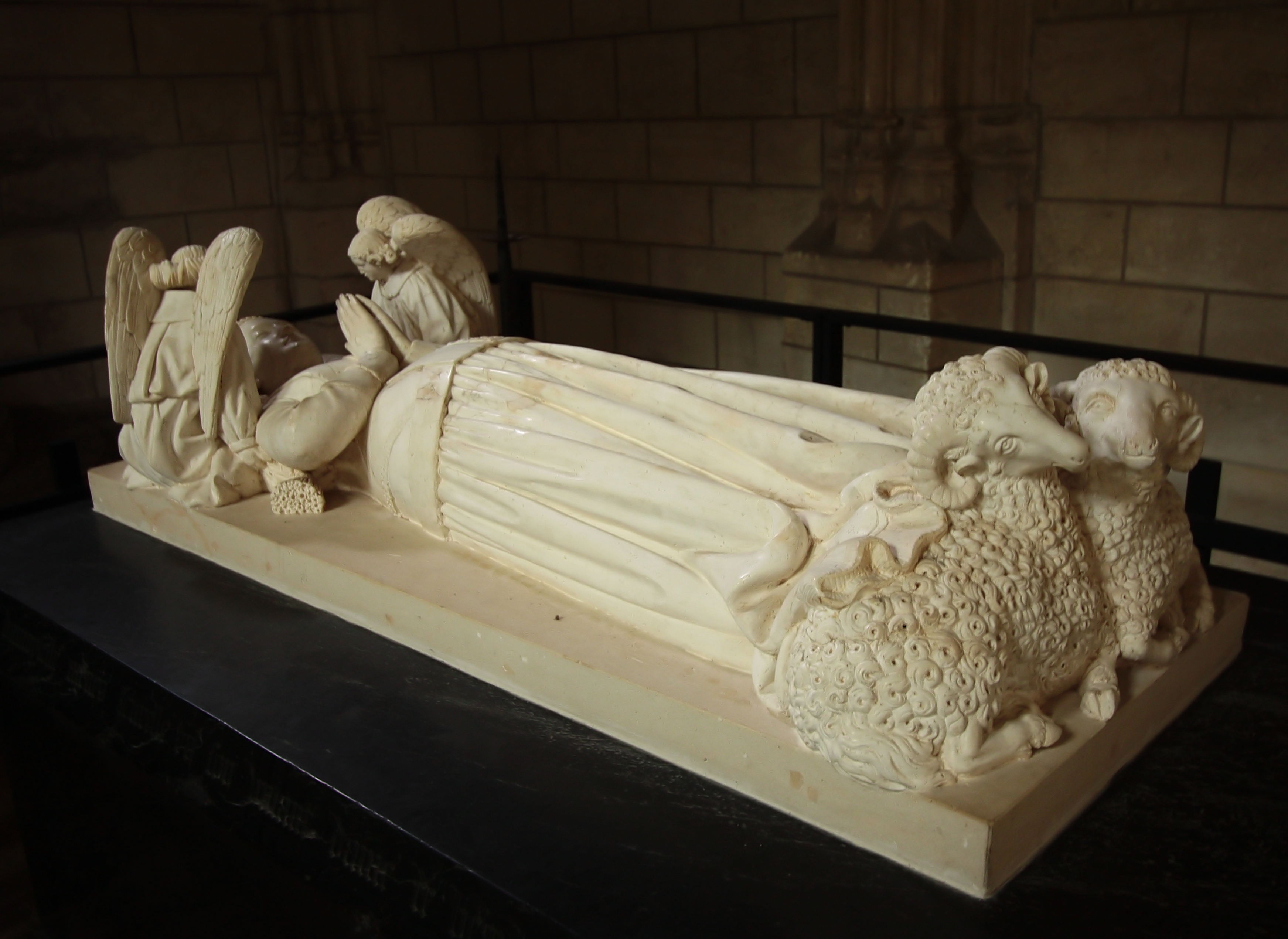
Agnès tomb at Loches (click here to enlarge)

French books I read about Agnès Sorel:
Other French books I heard about:
English books I found after some research:
Agnès Sorel's death always seemed suspicious and if many looked at the Dauphin as the main suspect, nothing could be ever proved. And several other people had as many reasons to eliminate the royal mistress as the king's son...

In 2004 a team of French scientists decided to examine Agnès skeleton who survived all those centuries of church renovations and grave robbing. They could not prove if she was murdered or not, but one thing was sure, her body contained very high levels of mercury who was a perfect poison. The same product was also used for worms treatment those days. A dosage accident is considered but her doctor was one of the most renowned of the realm. Accident or murder? We'll never know...

Considered by many of her contemporaries as the most beautiful woman in the world, Agnès Sorel continues to fascinate. I for instance would love to see more of her in historical fiction.