Tuesday, November 30, 2010

Susanna Kearsley Week - An Interview

Today we are lucky enough to have an interview with Susanna Kearsley for you to enjoy! She is the author of numerous novels including The Winter Sea, Marianna, Splendour Falls, and Named of the Dragon. Here are some of her thoughts on things that we at Historical Tapestry were wondering.


Photo by Ashleigh Bonang
What is it about the UK, specifically places like Scotland and Cornwall that provide such good settings for novels?

For me, it’s the layers of history they give me to play with. Because I like to interweave the past and present in my books, I’m drawn to places where the history stretches back a little further than it does in my own part of Canada. Here, we consider a house to be ancient if it’s from the mid-1800s. In Britain, that’s practically modern! Besides which, the history itself is so interesting. And there are parts of the UK – especially some of the more remote areas along the coastlines – that lend themselves more easily to stories of suspense, because they’re already so far removed from everything that’s commonplace, and have a certain magic all their own; a certain atmosphere.

As one of our two Canadian HTer’s Kelly specifically would like to know do you have any plans to write anything set in Canada?

Actually, in spite of what I’ve said above, I do have an idea for a story set in Canada, in one of the few places in this country where the history does stretch back into the mists, and hasn’t all been well-recorded. But since I’m not sure how long it will be before I get around to writing it, the best that I can offer Kelly is my thriller Every Secret Thing, which is set partly in Toronto and around it, in the present and the past, and has a few scenes at the secret wartime training camp for spies, Camp X, that lies not far away from where I live.

I have seen you mention that one of your major influences is Mary Stewart. Can you tell us a little bit about her influence, and your favourite books by her? What other books would you consider your ‘Books of a Lifetime’, books that have shaped you as a reader and a writer?

My mother and I often joke that it’s her fault I’m such a great fan of Mary Stewart, because my mother was reading This Rough Magic (newly published, in those days) while she was pregnant with me, so we figure my love of Mary Stewart’s writing must have seeped in at some elemental level while my brain was being formed. Either that, or else genetic memory was at play and I inherited my mother’s taste in writers. Whatever the reason, Mary Stewart did turn out to be my very favourite author, and This Rough Magic remains my favourite of her books, followed closely by Touch Not the Cat, The Moonspinners, Wildfire at Midnight, Nine Coaches Waiting, Madam, Will You Talk?, The Ivy Tree, My Brother Michael, and The Gabriel Hounds, though their order as my favourites sometimes shifts around depending on my mood.

As for her influence on me as a writer, well, I think it’s probably self-evident. One of the kindest compliments anyone can pay me is to say that my novels remind them in any way of hers, although I’ve never consciously set out to imitate her storytelling style. I did, however, grow up wanting to be a Mary Stewart heroine, imagining I, too, was one of those wonderfully resourceful, intelligent, ordinary women who travelled alone to the islands of Greece, where while sipping my wine in an outdoor cafĂ© I’d be suddenly caught up in some unexpected adventure. It sounded so marvellous.

But other authors helped shape my imagination, too. The major books, I think, that had the most effect on me as both a reader and a writer would be A.A. Milne’s Winnie the Pooh & The House at Pooh Corner, the Little House series by Laura Ingalls Wilder, Little Women by Louisa May Alcott, The Lion, the Witch and the Wardrobe by C.S. Lewis, all the stories of Gregory Clark, Nevil Shute’s A Town Like Alice, and Bride of the MacHugh and My Lord Monleigh by Jan Cox Speas. There have, of course, been countless other books I’ve read and loved, and many that I still re-read and treasure, but the ones that I’ve listed above lodged more deeply, I think, in my heart, and I don’t think I’d be the same person I am now if I’d never read them.

How do you feel about your books finally being published for a wider audience?

In a word, I feel fortunate. Luck, not only good but bad, plays such a large part in a writer’s life, and certainly I’ve had my share of both, but through my whole career I have been carried by the kindness and encouragement of readers who have taken time to write and tell me they enjoy my books, and I have had my friends and family there to anchor my priorities and see that I don’t lose my sense of balance, and my agents in the UK and America have worked to find me editors and publishers who seem to share their faith in me. So as I say, I’m very, very fortunate.

One of the interesting things about your work is the backgrounds you give your contemporary characters. For example, in The Shadowy Horses, Verity is an archeologist with an interest in Legion IX and in The Winter Sea, Carrie is an author researching the Jacobite rebellions. How much research does it require for you as an author to make these roles feel real to the reader?

Well, Carrie was easier than most, because I simply let her do what I do. But for the others, I did do a lot of research. It’s important that my heroines be independent women, and their jobs are often central to the plot, so I do try my best to get the details right. In Verity’s case, that meant having a real archaeologist be my advisor and lead me through the daily tasks that Verity, as finds supervisor on a dig, would really be doing. And when I wrote Season of Storms, with a young stage actress as my central character, I contacted an actress here in Canada who’s known for both her work in television and on stage, and she sat down with me and shared the inner workings of rehearsals and the staging of a play.

I don’t do this only for heroines, I do it for any character who does a job I’ve never done before myself. I’ve talked to fishermen and artists, former spies from World War II and, for my latest novel, rose growers. I’ve found most people, if politely asked, will very generously answer any question I might throw at them, and many of them, afterwards, will take the time to proofread sections of the book before it goes to print.
Finding these people, talking to them, sometimes even meeting them in person, is a fun part of my research.

Due to the timeslip aspect of your novels, and also with the contemporary strands of your story, you have to write more than one leading man. What are the key elements required to make a convincing leading man?

It all starts, for me, with the name. I like plain, solid names for a man, not only when it comes to the historical heroes, where plain, solid names were the norm, but in my modern-day men as well. David and Richard and John – these are names of the men I might meet on the street every day, and that makes them more real to me.

I also like it when a hero isn’t perfect, since real men always have their imperfections and their blind spots, though that doesn’t stop us loving them. And physical perfection isn’t necessary, either. Because I write in the first person, when a hero in one of my books is described as being handsome, we’re seeing him through eyes of the heroine, so while to her he might be the most handsome man she’s ever met, that doesn’t mean he has movie-star looks, only that he fits her own definition of what makes a good-looking man. We all have different views, on that count.

I can only draw from men I’ve known in my own life: my grandfathers, my father, and my husband and my friends, all different men, and yet with certain commonalities. If my heroes tend to be quieter men, it’s because the real men I know don’t go emoting all over the place – as a rule, they don’t talk much at all (though to be fair, I talk so much myself it may just be that they can’t get a word in edgewise). They don’t always say the right things, but they’re there, really there, when you need them the most. They’re dependable, trustworthy, decent, intelligent, honourable men with a good sense of humour. So I give these traits to my own leading men.

You also have written crime novels under the name Emma Cole. How does writing a crime novel differ from writing a historical novel, and do you think that your writing style changes depending on which kind of novel you are writing?

I’ve actually only written one and a half crime novels, of what I hope will one day be a trilogy, and the Emma Cole name seems to have fallen by the wayside now, since my UK publisher has re-issued the first thriller as a Susanna Kearsley title. But the process of writing the thrillers is definitely different.

For one thing, they take a lot longer to write! The first took me four years to finish, and the sequel to it is taking even longer. Which is rather ironic, because with a thriller I have to make the book move faster, be much more aware of pace, and cut from scene to scene instead of making the more leisurely transitions that I’m used to. Because of this, I have to make an outline for the crime novels, instead of simply sitting down and letting my subconscious lead me where it will.

But when I get the characters in motion on the page, the writing feels the same, to me. As for the voice, I confess that I honestly don’t see a difference, to me it’s the same voice I always tell stories in, but I do know that some readers have commented otherwise.

Can you give us a sneak peek about what you are working on next?

I have a new book, The Rose Garden – a time travel story set on the Cornish coast – that’s coming out this spring (though not till autumn in the States), and right now I’m working on a book that continues the story of the eighteenth-century characters from The Winter Sea, characters I grew to love so much I wasn’t ready to let go of them.

Monday, November 29, 2010

The Shadowy Horses by Susanna Kearsley

Impulse has brought Verity Grey to remote Eyemouth, Scotland from her home in England. Verity's friend and ex-lover Adrian Sutton-Clarke has tempted her with an archaeological mystery. What it is, exactly, he won't tell her until she gets to Eyemouth. By then, the impetuous museum worker is intrigued enough to stay.

At the estate known as Rosehill, Verity meets her boss, Peter Quinnell. People say Peter is quite mad, but the eccentric old man believes he has found the site of the lost Ninth Legion of Rome. With the help of a young boy with second sight, Peter intends to unearth the remains of the Roman camp. Verity's job would be cataloguing and drawing the artifacts that are found- but she isn't convinced of the site's authenticity.

While at Rosehill, Verity also meets David Fortune, an archaeologist working with Quinnell. What starts out as a working relationship builds into a romantic attraction as the two find themselves embroiled in a mystery that dates back to ancient Rome.
Ana Says:

I have had this book in the TBR pile for a while now. I added it because my blog colleagues were raving about how good Kearsley was; any author/book they recommend is bound to be a winner so how could I resist?
The main character is an archeologist, that fact alone is enough for me to be interested, but she is also a very likeable and sensible woman. Her name is Verity Grey and she is the character we get to know better because the story is written in the first person.

Verity is invited by a former lover to join an excavation in Scotland. He doesn’t tell her what they are digging up but she is curious enough to join them a day early. On the way she meets David Fortune, another archeologist involved in the excavation but it’s only after she meets the head of the team – Peter Quinnell - once a renowned archaeologist but now considered a bit mad due to his theories on the Legio XI Hispana, the famous lost 9th Legion of the Roman Empire.

Verity is at first very dubious about the evidence of such a thing as the fate of the 9th is almost the subject of legend; but she can’t help liking Peter and it is a well payed job so she decides to stay. However she soon starts to feel that not everything is at it seems and once she meets Robbie, a young boy known to have The Sight, she realizes that there is someone else walking the fields at night. Someone who might have a clue about what they are digging up but that also feels that there is danger lurking around.

I think Kearsley did a wonderful job at creating a very suspenseful atmosphere. We get to know the characters through Verity’s eyes; we see her doubts about some of them, her attraction to David and her curiosity about Robbie’s abilities and what he can help with. She creates a wonderful atmosphere with her description and her dialect and we never feel like it is too much. Instead it feels wonderfully evocative and the supernatural elements are perfect addictions to the suspense.

I do love contemporary books with a bit of history thrown in and this one is a perfect example. By coincidence I read a lot about the 9th Legion last year after finding 2 movies about it and while I wouldn’t say the solution here is the perfect one, there’s no doubt that Susanna Kearsley’s writing whets our appetite for more about them and for more books by her.

Grade: 4.5/5

Kailana Says:

This was my second foray into Susanna Kearsley. This was another great blend of history, suspense, and the contemporary world. She does things very seamlessly. The history was something that I was very interested in. I had heard about the 9th Legion, but this was the first time I had really seen an author tackle the mystery. While it might not have actually happened that way, I was impressed by her creativity. She pulls it off very well. I really enjoy books about archeology, so that was a big draw for me. Reading about Verity was really great. She was a strong, captivating character that interacted with other great characters during the course of the book.

I really enjoyed that this book was set in Scotland. I hadn't read a lot of books set there until recently and I am starting to really enjoy it for a setting. It makes me really want to go there, but at least until that is possible I can travel there through the pages in the books I am reading. There is a lot going on in this book, but that seems to be Kearsley's trademark. When you try to explain it to someone it sounds almost like too much, but she always manages to get everything to work out in the end. She never forgets about the subplots and she develops the secondary characters so that you feel like you know them almost as well as the main one. You always find yourself caught up in them and what they bring to each book.

I actually enjoyed the addition of Robbie in this book. He is a young boy who is gifted with the Sight. It is he that creates the mystery because he has abilities to see things that no one else working on the dig can. It might be rather silly to some people, but I think she pulls it off really well. She has this ability to make even the slightly strange seem natural. I really like that about her books.

While I didn't love this as much as The Winter Sea, I still really enjoyed this book and recommend it strongly! I look forward to rereading it at some point because it is easily a book you can visit over and over again.

Marg says:

Originally published in 1998, The Shadowy Horses has recently been re released in the UK by Allison & Busby. After first discovering Susanna Kearsley when I read and adored The Winter Sea, I promptly set out on a quest to read my way through her back list. I had read and thoroughly enjoyed Mariana and this was the next book I picked up.


When I started it, I was expecting something a little paranormal, most likely some time travel, a somewhat romantic storyline, and a darned good read. Whilst I did get most of these elements - this was more a ghost story than time travel - there was a also a suspense filled plot. Once again I was lost in the world that this author has created.

Verity Grey is an archaeologist who lives in London. She is looking for a change in her life, and so when she is invited to participate in a dig at a property on the Scottish coast, she is tempted by the offer. The only thing is that she isn't told very much about either the dig or her prospective boss when she heads up to the small fishing village of Eyemouth to take a look around at the invitation of her former boyfriend Adrian, who also works on the dig.

On the way to her destination she meets David Fortune, part time archaeologist and part time university lecturer, and a man who is very protective of Peter Quinlan, the man who would be Verity's boss. Quinlan's life long passion has been to find evidence to help solve the mystery of what happened to the lost Ninth Roman Legion. Within the archaeological world, Quinlan has a reputation of being somewhat eccentric, and to a degree is shunned, and that isn't likely to change given that his dig at the location is based purely on the experiences of a young boy, Robbie, who has 'the sight' and who believes that he can see the ghost of a legionnaire, known as the Sentinel.

Verity accepts the job knowing that she can't stay away from the dig, from Scotland and increasingly from the somewhat distant David Fortune, but when things start going wrong at the dig, it appears that someone is trying to sabotage it. Could it be Adrian, could it be other archaeologists, or could there be something else at play? And why does the Sentinel seem determined to protect Verity from some unknown danger?

Verity must work out if her boss is a little mad, or if maybe, just maybe, he has finally found what he has been working for all these years, find out what actually happened to the Sentinel, and work through her feelings for David, all the while knowing that someone is becoming increasingly desperate to stop the dig from going any further.

For all the archaeological focus of the novel, the author did a fantastic job of keeping the technical jargon accessible, but without dumbing it down too much.

Once again I opened up the pages of a Susanna Kearsley and found myself immersed in the world that she has created. I did ask her at one point if she could maybe create me a hero who works in Human Resources/Payroll, because all of her leading men so far have been very dreamy characters. Not sure how she is going with that request though!

Whenever I see Susanna Kearsley compared to another author, it tends to be Mary Stewart. I haven't read any Mary Stewart, but if she writes anything like Susanna Kearsley then I know that I am guaranteed some good reads.

Grade: 5/5

Sunday, November 28, 2010

Susanna Kearsley Week: The Winter Sea discussion

In honour of Susanna Kearsley Week Kelly, Marg and Alex discuss The Winter Sea, a book that they all loved!

~~~~~~~~~~~~~~~~~~~~~~

Marg: When I first read a review of The Winter Sea, I added it to my list thinking I would read it one day. When I finally had read it, I regretted not having done so earlier. It had lots of elements that I love - some gothic elements, set in Scotland, time travel! Kelly and Alex, what prompted you to want to read it?


Kelly: I have to admit that my first reaction to this book was that I probably wouldn’t like it. It just didn’t seem to be my sort of book. I read a few enthusiastic reviews of it, though, including yours Marg, and I thought maybe I should ‘think outside the box.’

Marg: I told you you would like it! lol

Kelly: Well, the first time I brought it home from the library I couldn’t get beyond the first chapter. I think I was just worried I wasn’t going to like it and that point I really wanted to! So, I took it back and got it again about a month later. That time I loved it! It flowed very the beginning. I actually recommended it to a friend and when I was talking to her the other day she said she had just read the first chapter online and loved the book all ready!

Marg: That’s exactly how it was for me! A couple of pages, and I just KNEW I was going to love it. It was just a case of whether that feeling would last to the end of the book. I am trying to think of the right description - maybe like I was thirsty and that this book was the book that could quench my thirst fully!

Kelly: That’s a good way of looking at it! There is just something about Kearsley’s writing that draws you in and makes you feel comfortable. She has a very readable style and can capture characters and setting in such a way that you easily get drawn into the world she is spinning.

Alex: Last year I decided to visit Scotland and I have this habit of taking with me books set in the country I’m visiting. This time I decided to travel with The Winter Sea, especially after reading Marg’s raving review. From the first pages I knew I was going to love it! I remember being in the middle of the story and I was so curious that I decided to make a little break during my visit to the Edinburgh Castle. I just sat in a bench, enjoyed the sun and read a few pages. This is one of my best memories of this trip!

Marg: Alex, I love that you read books set in the countries you are visiting. So awesome! And I am a little bit jealous that you got to go to Scotland so recently. I haven’t been there for years.

Kelly: Well, I have never been to Scotland, so I am jealous period! I think it is great that you have books to tie in with your trips. That would really add to it!

Marg: This book has been published under different titles in the US and the UK - The Winter Sea and Sophia’s Secret. Which one do you think fits the story better?

Kelly: I like The Winter Sea better myself. It might be because I live near the sea, but I really liked the mystery to the title. It is more in keeping with her other books. She tends to find something briefly mentioned in the book, but still important, for her title. Sophia’s Secret is a strange title for her because it reveals more about the plot. It is still mysterious, but maybe The Winter Sea is a more atmospheric title... I might think differently if I had read a copy with the title Sophia’s Secret because I would have connected with the title because I loved the book so much. It is really hard to say.

Alex: I read the UK edition, Sophia’s Secret, and to be honest, I find the name The Winter Sea more poetic and more suitable to this story. The sea is an omnipresent element and when I look at Sophia’s Secret cover, I think of a garden and Spring.

Kelly: Yes, I agree about that, Alex.

Marg: Clean sweep of preferences for The Winter Sea as a title because that is my favoured title as well. I am glad that the new US edition has maintained that as the title, given that the sea was a key element in the story.

Kelly: One of the things I really like about this book is the mixture of different things that are happening in it, but managing to work together. There is a bit of science-fiction, romance, historical fiction, small-town charm, etc. What are your thoughts?

Marg: There is a bit of everything! I love the idea of being drawn to a specific place, like a falling down castle in Scotland, and ending up being in the right place to achieve so much, even if you aren’t sure that that is the right place when you first get there. The town, and the castle in particular, were so important to the storyline, almost to the point of being a character.

One thing that I really loved was the fact that the past storyline revolves around a little known incident during the Jacobite Rebellions. Having read quite a few books about the events around Culloden, I was surprised to find out that there were these other events that are so little known now.

Alex: I think that’s the reason why the story is so wonderful! Susanna Kearsley gets everything perfectly balanced. The Winter Sea will certainly please to someone who enjoys historical fiction, but also to those who are more into romance or even mystery.

Kelly: I liked that it was natural. When you read about everything that is happening in the book, you might think it sounds a bit far-fetched or hard to pull off, but it wasn’t like that at all. When I was trying to describe it to my friend I almost didn’t know what to call it because I didn’t want to limit it in such a way she wouldn’t want to read it.

Marg: By very definition, timeslip novels are really a bit far-fetched, but some are definitely better done than other. Over the years, I have seen various techniques used to facilitate the time travel, from drugs to hypnotism to dreams and more, but the technique that Kearsley chose to use felt very organic.

Kelly: Yes. I just worry that the moment ‘timeslip’ leaves my mouth that someone will not read the book because they are worried it is going to be science-fiction. The funny thing is that I thought this was a romance novel, and it does have romance in it, but if I had heard timeslip from the very beginning I would probably have read this book faster!

Alex: That’s the thing, I was really not into those kind of “timeslip” novels and I avoided them as much as I could. This book not only taught me that I should step out of my comfort zone more often, but that I do like one kind of “timeslip” novels: the ones written by Susanna Kearsley (just read Marianna and it was fantastic!).;-)

Marg: When I read this time slip type of novel, I generally prefer one strand of the story over the other, and I spend my time wishing we could get back to my favourite part. That didn’t happen here because whilst I liked reading about Sophia, I also couldn’t wait to see what happened next for Carrie! I have to ask you both, which strand of the story did you enjoy most? Past or present?

Kelly: That’s a hard one! I was captivated by both storylines, so I am not sure that I could pick a favourite. Sometimes when I read there are parts of a book that I am not so excited about, or characters I am not so interested in learning more about, but everything interested me about this book. There was no disappointment. I found myself savouring every word and I wish that happened more often!

Alex: I’m much like you, Marg, I was cheering up for both girls! I immediately fell in love with Carrie. The first scene when we met her is simply magical and I could perfectly imagine her looking at that impressive fallen castle and being interrupted by a mysterious handsome stranger. She is very down to earth and a very warm person, so it’s impossible not to like her. Sophia is more mysterious, but also quite attaching. For me the answer is easy: Past and Present.

Marg: Kelly, you aren’t a romance fan as such. How did you feel about the romantic aspects of this book?

Kelly: Well, like I say above, I thought this was a romance novel. I didn’t really look into it a lot in the beginning, so that was all I knew about it. When there is romance in a novel it has to be done really well. I need a story to keep my interest. If it is just a bunch of romantic scenes then I am not usually very interested. In this book, it was a story. There was romance involved, but there was so much more offered that it didn’t really seem like a problem for me. I actually found myself liking it, and for me, that takes some really good writing! It is not a very large number of books that are technically romance novels that I can safely say that I loved!

Marg: Our fellow HT’ers Teddy and Ana have not yet read The Winter Sea (to which I say “What are you waiting for?”) What one thing would you both say to them to convince them, and our readers, to pick this up and read it?

Kelly: I would probably say that I have yet to see a negative review of this book, really. I think it is a book that if you take a chance on it, you are pretty much guaranteed to enjoy the experience.

Alex: Kelly is not into romance and I was definitely not into “timeslip” stories and this book became one of our all time favourites. For me, The Winter Sea is one of those beautifully weaved stories who will please to anyone who enjoys the genres mentioned previously.

Marg: Just talking about this book again during this discussion makes me want to put down the book I am reading now and pick this one up for a reread despite the fact that I only rarely reread a book! It is a book I can see myself rereading again and again in the future! And watch out if you ask me for a reading recommendation because there is every chance that this book will be one that I mention!

Kelly: I know! A mark of a favourite book, for me, is that when I finish it I want to start it all over again. There haven’t been a lot of reads like that for me this year, but this is definitely one of the few! I can see myself rereading it, too, but I always say that and then never seem to do so! I plan to buy a copy of it for myself for Christmas, though, so I don’t have to rely on the library.

Alex: Absolutely! Two friends of mine are so curious about this novel after listening to me talking about Carrie and Sophia (oh well and all those yummy heroes of Kearsley’s novels!) that I’m planning to give them a copy of The Winter Sea.

You can actually read the first chapter of this book on her website if you are interested in learning more!

Susanna Kearsley Week - An Introduction

When you really love an author a day to celebrate them really will not do! Alex, Marg, and Kelly have all become very big fans of Kearsley over the last couple years, so in tribute to her, and in honour of the U.S. release of The Winter Sea, we have dedicated a week to her.
Over the next week there will be reviews, an interview with Susanna Kearsley, a guest post, and a give-aways! We hope that everyone enjoys learning more about Susanna Kearsley and her body of work.We are also hoping that Ana and Teddy will be inspired by this week and read The Winter Sea, too!
To get things started, though, I am going to announce the give-away. We are giving away 2 U.S. copies and 1 International copy of The Winter Sea. To enter simply clink on the link below to take you to the entry form!

The contest ends on December 3, 2010

Thursday, November 25, 2010

Deborah Swift: Character Study of Richard Wheeler from The Lady's Slipper **Includes Giveaway**

We are very pleased today to welcome back Deborah Swift to Historical Tapestry. A few months ago, Deborah wrote an awesome guest post for us title Why I Love Shoes. If you haven't read it yet, please click on the link and enjoy it now! Today, Deborah has done a character study for us of Richard Wheeler, one of the main characters from The Lady's Slipper. Scroll down to the bottom of the post for details of the giveaway we are announcing today!


Richard Wheeler – the strong and silent type

One of the main characters in my new novel The Lady’s Slipper is Richard Wheeler.

Like all my favourite heroes he is handsome, strong and capable, but unlike most other heroes when the novel opens he has just become a “seeker after Truth” or a Quaker. Today we tend to view the Quakers as quite conservative, but in the 1650’s when the movement began they were seen as dangerous, radical, even insane. Through the latter half of the 17th century and beyond they were persecuted for their beliefs which were seen as challenging the stranglehold supremacy of the church. Even when they fled to the New World, the persecution continued.


Richard Wheeler was brought up as the wealthy son of a landowner, but his life changed when he followed Cromwell and his parliamentary troops in the War against the King. Richard saw this as a battle for the common man and democracy, so that ordinary people could have more control over their land and property. During The Civil War the English nation tore at its own throat and the battle of brother against brother claimed thousands of lives.

Oliver Cromwell at the Storming of Basing House by Ernest Crofts RA
Basing House was attacked by Parliamentary troops on three occasions. The final assault came in August 1645 when 800 men took up position around the walls. Between forty and a hundred people were killed. Parliamentary troops were given leave to pillage the house and a fire finally destroyed the building.


Richard fought for Cromwell against his own ruling class, but the horrific bloodshed he witnessed made him vow never to take up arms again, and led him to join the fledgling Quaker movement which had made a pledge for peace. Quaker meetings are a “sitting in silence” - but the restless man-of-action Richard finds the silent reflection both refreshing and difficult. He remembers his part in the atrocities of war and wrestles with his conscience, particularly as he finds he is falling for Alice, his artist neighbour. Not only does she have radically different views from his own, but also she is a married woman.

Giving up his fine things to live a simpler life – leaving behind his luxurious lifestyle and fine clothes, is not nearly as easy as Richard anticipates, but harder still for an active man is the idea of “turning the other cheek” when threatened or challenged. The seventeenth century was a violent and bloodthirsty period, a period in which hangings and burnings were commonplace entertainment, and Richard is trained as a swordsman in an era where to be manly is to be able to handle oneself well in a fight.


So what happens when Richard becomes locked in a bitter battle against his former childhood friend, and worse, when the life of the woman he loves is in danger? Will Richard fight to defend her, or will he stick to his Quaker vow of non-violence?

My research for Richard Wheeler took me to fields where the Civil War was fought, to the Armouries Museum at Leeds, and to libraries where I looked at Quaker journals and George Fox’s diary. Richard Wheeler’s House was based on Townend in Troutbeck, Cumbria which was built in 1645.


The Lady’s Slipper is out on 23rd November published by St. Martin’s Press. To find out more about the book and the author, visit her website at DeborahSwift.co.uk

To celebrate the US release of The Lady's Slipper by Deborah Swift, we are pleased to have a copy of the book to giveaway thanks to St Martin's Press.

To win, just leave a comment.
 
  • open for US/Canada residents only
  • contest closes the 2/12/10 at midnight GMT
  • one entry per household

Wednesday, November 24, 2010

Helen Hollick's Books of a Lifetime (includes a giveaway)

We are very pleased to welcome Helen Hollick to Historical Tapestry today to share her Books of a Lifetime! Read to the end of the post for details on how you can win one of two copies of her new book The Forever Queen. 

The first book has to be the Little Grey Rabbit by Alison Uttley. I have a clear image in my mind of leaving the children's library clutching one of her little books, thrilled because I had not “read” it. I was about 3½.

I don’t remember a time when I wasn’t absorbed in a book. I was a lonely child, very shy, and without many friends. My friends were all characters in books, especially the characters I could identify with. Like the one I met on my 10th birthday (I am now 57) I liked books, but assuming the one given as a present was going to be boring, I unwrapped the parcel rather half-heartedly. To my delight it was a pony story. I so wanted a pony of my own, but would not get one until I was 16. Ruby Fergusson’s Jill’s Gymkhana filled the gap. I still have the book, and I still enjoy reading it. Black Beauty and Monica Edwards’ Summer of the Great Secret and Wish for a Pony, were also special favourites.

From reading about ponies, I started writing my own pony stories when I was about 13. So that birthday present is, indeed, an inspirational treasure.

In my teenage years and early twenties fantasy influenced me a lot. Escapism, a way to blot out the loneliness and low self esteem. Characters in books are always there when you need them. They never let you down, call you names or make fun of you. The world of Imagination was a better place and the characters who lived there were my best friends. Many of them still are.

Susan Cooper’s Dark Is Rising remains a firm favourite. It is the second of a series, and best of the five I think. I was reading it late at night. At about 1 a.m. I finally turned out the light. Lay there wondering what happened next. Gave up. Put the light on again and read it all the way through. Anne McCaffrey’s Dragonflight was another book I read straight through, non stop.

The first character I fell totally in love with was Sharon Penman’s Llewelyn ap Fawr in Here Be Dragons. I was searching for novels about King Arthur in my local library - I was trying to write my own novel about Guinevere at the time, and I noticed the spine had a sword on it. Ah, Arthurian, I thought. It wasn’t, but I read it anyway. Wow! What a read – what a man!

Sharon completely captivated me and I knew from reading her book that I wanted to write like she did.

A contrary book that I did not get on with was Marion Zimmer Bradley’s Mists of Avalon, yet I owe it a great debt of gratitude. While it was a good read, I couldn’t stand her portrayal of Guinevere. I had been attempting to write about King Arthur since reading Mary Stewart’s Hollow Hills and Crystal Cave, but most of my scribblings ended up in the bin (well before the days of a delete button on a computer!) Bradley’s Guinevere irritated me. I just did not see Gwenhwyfar, as I called her, to be like that. Reading one scene I became so frustrated that I threw the book across the room. That was it, I decided. I will write my own. The Kingmaking, the first of my Pendragon’s Banner Trilogy was the result.

A close second to Llewelyn is Elizabeth Chadwick’s William Marshal in the Greatest Knight – boy is he a character to leap into a fictional bed with!

My overall author heroine, however, is Rosemary Sutcliff. If I can write half as good as her best fiction I will be content. Eagle of the Ninth. Frontier Wolf, Sun Horse, Moon Horse. I cannot read Mark of the Horse Lord without crying at the end – no matter how many times I read it. I have a letter from Rosemary written in her own hand, wishing me luck with my Arthurian series (I’d written to her to say how much I loved Sword at Sunset, her own Arthurian novel.) That letter is a treasured possession. When we had a fire in my home, several years ago, the first thing I checked were the pets. The second, my daughter’s very expensive saddles (yes horses are still important in my life) the third was Rosemary’s letter. I cherish it.

Do historical characters become so real in novels because their spirits linger here with us, waiting for their lives to be retold? Is that why they remain great men and women, I wonder?

And do the made-up characters exist in another, parallel world? One which we can occasionally access and which we rather quaintly call “Imagination”?

I think so.

*****************

THE FOREVER QUEEN BY HELEN HOLLICK – IN STORES NOVEMBER 2010

What kind of woman becomes the wife of two kings, and the mother of two more?

Saxon England, 1002. Not only is Æthelred a failure as King, but his young bride, Emma of Normandy, soon discovers he is even worse as a husband. When the Danish Vikings, led by Swein Forkbeard and his son, Cnut, cause a maelstrom of chaos, Emma, as Queen, must take control if the Kingdom—and her crown—are to be salvaged. Smarter than history remembers, and stronger than the foreign invaders who threaten England’s shores, Emma risks everything on a gamble that could either fulfill her ambitions and dreams or destroy her completely.

Emma, the Queen of Saxon England, comes to life through the exquisite writing of Helen Hollick, who shows in this epic tale how one of the most compelling and vivid heroines in English history stood tall through a turbulent fifty-year reign of proud determination, tragic despair, and triumph over treachery.

ABOUT THE AUTHOR

Helen Hollick lives in northeast London with her husband, daughter and a variety of pets, which include several horses, cats and two dogs. She has two major interests: Roman / Saxon Britain and the Golden Age of Piracy--the early eighteenth century. Sourcebooks Landmark will release the next chapter on Helen’s 1066 saga, I Am the Chosen King, in Spring 2011. For more information, please visit http://www.helenhollick.net/.

Giveaway Details

Thanks to Sourcebooks we have two copies of The Forever Queen to giveaway. The contest will close on 1 December

Rules

Giveaway open to US/Canada addresses only
One entry per person.
To enter leave a comment, including your email address so we can contact the winner.

Sunday, November 21, 2010

Winner of Selene of Alexandria


Thank you to everyone who entered our giveaway of Selene of Alexandria. We are pleased to announce that the winner is:

Elysium

Congratulations! Could you please email your postal details to us at historical.tapestryatgmaildotcom and we will get your prize on it's way to you.

Saturday, November 20, 2010

HT News

We'll start today with some Historical Tapestry HT News! We still have a giveaway going for Selene of Alexandria by Faith L Justice (which can be entered here)and coming up during this week we have two other giveaways, as well as the start of a very special author week next weekend, which will have yet more giveaways! If you want to win a book, then keep on visiting us here at Historical Tapestry because there are loads of chances coming up to do just that!

This weekend Velvet from vvb32 is hosting her second Pemberley Ball. The idea is that you time travel to a regency ball hosted at Pemberley. For all the details, head over the announcement page.

On Monday evening from 7pm-9pm EST (US), you can participate in a chat with author Helen Hollick about her book, The Forever Queen. The chat is being hosted at The Bibliophilic Book Blog as part of the Sourcebooks Fall Reading Club.

Arleigh from Historical-Fiction.com has an awesome giveaway running at the moment. There will be four winners. Two will win complete sets of India Edghill's books and another two will win paperback copies of her latest book, Delilah. And there is also provision for international winners, which we love!

The inaugural edition of Alt Hist is now available. Alt Hist "is the new magazine of Historical Fiction and Alternate History. Lovers of historical fiction for too long have been denied outlets for short pieces of fiction, as the number of print and online magazines for historical short fiction is very limited compared to the popularity of fiction set in past times. Alt Hist’s mission is to provide readers with entertaining and well-written short stories with a historical setting, whether portraying actual events or events that could have happened. If you read and enjoy historical fiction, alternate history or historical fantasy then we think you will like Alt Hist."

Other giveaways:

The White Queen by Philippa Gregory at xo.Sorcha.ox
The King's Daughter by Christie Dickason (3 copies) at Passages to the Past
The Last Prince of the Mexican Empire by C M Mayo at Book Drunkard

Thursday, November 18, 2010

The Passionate Brood by Margaret Campbell Barnes

In this compelling novel of love, loyalty, and lost chances, Margaret Campbell Barnes gives readers a new perspective on Richard the Lionheart's triumphs and tragedies. Drawing on folklore, Barnes explores what might have happened if King Richard's foster brother were none other than Robin Hood, a legendary figure more vibrant than most in authentic history. Thick as thieves as Richard builds a kingdom and marshals a crusade, the two clash when Robin Hood so provokes the king's white hot temper that Richard banishes him. The Passionate Brood is a tale of a man driven to win back the Holy Land, beset by the guilt of casting out his childhood friend, and shouldering the burden of being the lionhearted leader of the Plantagenets.

 
The last book I read from Margaret Campbell Barnes was Within the Hollow Crown, which was about Richard II, and was quite slow and plodding and laborious to read. Leaving out the fact that this book is about another Richard, this time Richard I, I would not use any of these words to describe The Passionate Brood: A Novel of Richard the Lionheart and the Man who Became Robin Hood. Instead words like romanticised and idealised, fast paced, adventurous and over the top come to mind.

First, a note about the subtitle of this novel. To my mind it is a little misleading to suggest that the reader is going to find out more about Robin Hood because whilst there is a Robin in the novel, and there is an explanation for his outlaw status, there is precious little page time spent exploring the actions of the man who has achieved such legendary status over the years.

The male leading character for the drama that unfolds in these pages is undoubtedly Richard II, who history knows as Richard the Lionheart. As a character he dominates the pages. He is a man who is passionate, quick tempered, driven, pious and so much more. As king, Richard spent barely any time in England, but rather spent much of his time away on Crusade, coming close to reaching Jerusalem, but not close enough.

There is one character in particular who does manage to steal a little of the limelight from Richard where she is given page time, and that is his sister Joanna. I would love to read something about her at some point. Let's face it, most of the time I would be happy to read about any of this fascinating family. At one stage this book was released under the title Like Us, They Lived. I definitely think The Passionate Brood fits so much better!

We follow Richard as a young man, engaged to Anne of France whom he dislikes intensely (this young woman has sometimes been referred to as Alais in other novels ) and we travel with him as he journeys to Navarre where he meets the beautiful Berengaria who captures his heart. We join both Richard and his young bride as they go on Crusade, as he shows the military leadership for which he is still famous, the fighting with the other leaders, most notably Phillip of France, and then on his ill fated journey home where he is kidnapped and the country of England is nearly impoverished trying to raise the required ransom.

For a king who spent very little time in England, and whose wife didn't set foot in the country whilst she was Queen, Richard is still remembered with much fondness now. There is plenty of speculation about him, particularly in relation to his sexuality, but there is none of that in this novel. The Richard we find within the pages of this book is painted in broad strokes, not necessarily glossing over some of his less than stellar moments, but certainly presented in a highly romanticised fashion.
Reading this book has certainly piqued my interest, in particular for the next Sharon Kay Penman book which is telling Richard's story.
Over the years I have read a number of Margaret Campbell Barnes novels and for the most part I have liked them. This book is however my new favourite book from this author. It was a rollicking good read.

Rating 4.5/5

Many thanks to Sourcebooks for sending me a copy of this book or review purposes

Originally posted at Adventures of an Intrepid Reader

Tuesday, November 16, 2010

Challenge: The Alphabet in Historical Fiction

It's time for a new letter in The Alphabet in Historical Fiction but first let's take a look at our entries for the letter V:

1. Cat (Tell me a Story) - V is for Venice

2. Marg (The Adventures of an Intrepid Reader) - V is for Various Flavors of Coffee

3. Sarah (Reading the Past) - V is for Victoria Hislop

4. Carrie C.(Opalescent Essence) - V is for Vreeland

5. Heather (Epoch Tales) - V is for Voyageurs

6. Teddy (So Many Precious Books) - V is for Vincent Van Gogh 


And now it's time to remember the rules and introduce the new letter!

Each fortnight you have to write a blog post about an historical fiction book of your choice (it might even be something you already read before), but it MUST be related to the letter of the fortnight.

You have several possibilities:

- the first letter of the title
- the first letter of the author's first name or surname
- the first letter of a character's first name or surname
- the first letter of a place where an historical event took place

You just have to choose one of them and participate.
Please check our blog each 1st and 15th of the month to find out our new letter, and then link your post (not your blog) back to our page through Mr Linky (see below). Then come and check to see who else has posted and visit their blog to find out all the details of the book they were reading.

You'll have until November 30th to complete your mission, the next letter will be published on December 1st and it is the letter W:


Cover Story: The Land of the Painted Caves by Jean Auel

So here it is, the cover for the sixth and final book in the Earth's Children series by Jean Auel.


As we discussed when we did a Spotlight on the series not too long ago, it's been a long wait since the last book came out.

What do you think of the cover? Are you going to read it? Are you planning on rereading any of the earlier books first?

Monday, November 15, 2010

Winners of The Mischief of the Mistletoe giveaway


Thank you to everyone who entered our giveaway of The Mischief of the Mistletoe. We am pleased to announce that the winners are:


and


Congratulations! If the winners could please email their postal details to us at historical.tapestryatgmaildotcom we will pass your details on and get your prize on it's way to you.

Sunday, November 14, 2010

HT News

Lots and lots of giveaways to tell you about in today's HT News post:

The Forever Queen by Helen Hollick at Tanzanite's Castle Full of Books
The Swan Thieves (3 copies) by Elizabeth Kostova at Jo-Jo Loves to Read 
Child of the Northern Spring by Persia Woolley at The Maidens Court
The Imperial Cruise by James Bradley (3 copies) at Laura's Reviews
Louisa May Alcott: The Woman Behind Little Women by Harriet Riesen at Amused by Books and at Hist-Fic Chick
The Beloved Dead by Tony Hays at Passages to the Past
The Rage of Achilles by Terence Hawkins and The War that Killed Achilles by Caroline Alexander at Passages to the Past
The Last Prince of the Mexican Empire by C M Mayo at Jenn's Bookshelves
The Dressmaker by Posie Graeme-Evans at Red Headed Bookchild
Revolution by Jennifer Donnelly (5 copies) at Novel Novice

Selene of Alexandria by Faith L. Justice *GIVEAWAY*

 
Set in AD 412 Alexandria, Egypt and based on historical events, this story of ambition, love and murder brings to life colorful characters and an exotic time and place. SELENE is bright, impulsive, stubborn, and a little spoiled by her father, a city councilor. Since her mother’s death, she longs to forgo the privileges of her class to become a physician—an impossible dream for rich Christian girls who never engage in a profession. But Selene perseveres and gains a powerful champion—HYPATIA, the renowned mathematician and Lady Philosopher of Alexandria.
The old Christian Patriarch dies and the city splits in support of two candidates. After days of rioting, the Patriarch’s nephew CYRIL is proclaimed Patriarch and sets about consolidating the Christian sects and purging Alexandria of pagans and Jews. ORESTES, the new Augustal Prefect, struggles to keep the peace and also seeks the advice of Hypatia. He finds her a woman of enormous personal charm and astute political insight and places her first among his advisors, to the humiliation of the new Patriarch. These events set the stage for a contest of wills between Church and Empire.
Selene struggles in her new life. Under Hypatia's guidance, she takes classes and apprentices in medicine. She gives up security and the love of a young man for the danger of poor neighborhoods and the hostility of her classmates. It's not long before Selene is unwittingly drawn into the deadly rivalry between Cyril and Orestes. She comes of age amidst riot, plague and political intrigue . But will Selene survive the consequences of her own ambitions and impulsive actions?
Last year, after watching Agora, a movie about Hypatia of Alexandria, and despite the liberties taken to tell this story, I was captivated by the main character. The fact that the talented Rachel Weisz was playing the leading role made everything even better. I left the movie theatre craving for some more films and books set during the same historical period! When Faith. L. Justice kindly offered us a copy of her Selene of Alexandria I couldn't possibly resist.
 
After reading about Selene's exploits in sports and her preference for running all around town with her brother and their best friend, I was expecting a real tomboy. If the young girl seems independent and sometimes a bit unconventional compared to other young ladies of her age and station, she is not less concerned by her appearance and femininity, especially after the arrival of the charismatic Orestes, the new Prefect. Despite her social background and her education, Selene wants something different for her, something normally out of reach for a woman and an aristocrat. She wants to be a physician.
 
The young woman fears the reaction of her family who have some more traditional plans for her, and while her father's concerns for her future are obvious, the fact that he admires Hypatia and her work clearly make the situation easier. We can feel that he accepts his daughter's choice out of love but remains realistic and worried about her situation. Just like any other father with his daughter.
 
This story is not only about Selene's life but also her friends: Hypatia, the renowned mathematician and philosopher who represented the Old World and a threat for many in Alexandria. I appreciated the fact that the author stayed close to the historical sources about Hypatia and didn't romanticized her death.
 
The other secondary characters are also extremely captivating and I kept waiting for more passages about the mysterious Orestes or even Selene's servant and friend, Rebecca. The bishop Cyril can be sometimes a little excessive, but it makes sense with the growing tensions in town between the different communities. 
Which brings me to something quite important in this novel: I never felt any judgements from the author about the story and the religious confrontations. We have all the different points of view of the situation seen through the eyes of the different characters and while we might not agree with some of them, we can see the motives behind their actions.
 
Alexandria's dailylife descriptions are vibrant and richly colored. I particulary enjoyed Selene's expeditions to Mother Nut while she was her apprentice. The old woman is a character larger than life, each scene was a true delicious moment.
 
From the first pages, Selene of Alexandria captured all my attention and I knew right away that I was going to have a fantastic ride. Faith L. Justice weaved a wonderful story that only increased my curiosity for this time period and the charismatic Hypatia.
 
Grade: A very strong 4/5
 
 
Related post: You can read Faith L. Justice guest post: Why I Love... Strong Women.
 
 
GIVEAWAY:
 
To win a gently read signed copy of Selene of Alexandria, just leave a comment.
 
  • open worldwide
  • contest closes the 20/11/10 at midnight GMT
  • one entry per household

 Good luck !

Friday, November 12, 2010

The Darcys Give a Ball by Elizabeth Newark

While Jane and Lizzie plan a lavish ball at Pemberley, the Darcys' second son falls in love with the Collins' daughter, first-born Juliet Darcy is almost lured into an elopement, and Georgiana's timid daughter Lucy is the new target of Miss Caroline Bingley's meddling.


The Darcys Give a Ball is a charming and very amusing imagining of the next generation of Jane Austen's beloved characters from Pride and Prejudice and other novels, where all the young people come together for a surprising and altogether satisfying ending. Sons and daughters share the physical and personality traits of their parents, but of course have minds of their own, and as Lizzie says to Jane: "The romantic attachments of one's children are a constant distraction."


As usual I picked this one up with a mix of great expectations and dread. The first because it is always nice to revisit the characters of our favourite stories, and the second because sometimes these sequels totally ruin them. Although that doesn't happen here I guess it's more because this novel is more about the Collins family than Elizabeth and Darcy.


The story takes place about twenty five years after the end of Pride and Prejudice. The Darcys, the Bingleys and the Collinses - not to mention the Brandons, the Wentworths and other Austen characters - now have adult children who are making their way into society.

The beginning of the story tells us about the life Charlotte Lucas has been leading since she married Mr. Collins. She produced a number of children, has made the best of her situation and has kept in touch with Elizabeth Darcy although they are not regular visitors of each other’s house for obvious reasons.

When an invitation arrives for a ball at Pemberley, Charlotte is naturally ecstatic for this opportunity to revisit an old friend and Mr. Collins is even more so. Never having been invited before this seems like a dream come true but unfortunately an illness prevents him from attending. That's how Charlotte finds herself a guest at Pemberley with her two children - Jonathon and Eliza. The two youngest Collins are the main characters of this story, at Pemberley they meet Elizabeth's offspring, namely her son William and her daughter Juliet. Eliza and William immediately strike up a friendship but Juliet seems, sadly, like a really disagreeable young girl.

The second half of the story is about the ball and all the events surrounding it. The guests include a lot more Austenesque characters but we don't really get to know them well as the plot centers around the Collins and Darcy children and their romantic attachments. It's a light and fun read perfect to spend an afternoon with!

Grade: 4/5

Wednesday, November 10, 2010

The Suspicions of Mr Whicher by Kate Summerscale


The fascinating story of a famous Victorian murder case - and the notorious detective who solved it It is a summer’s night in 1860. In an elegant detached Georgian house in the village of Road, Wiltshire, all is quiet. Behind shuttered windows the Kent family lies sound asleep. At some point after midnight a dog barks.

The family wakes the next morning to a horrific discovery: an unimaginably gruesome murder has taken place in their home. The household reverberates with shock, not least because the guilty party is surely still among them. Jack Whicher of Scotland Yard, the most celebrated detective of his day, reaches Road Hill House a fortnight later. He faces an unenviable task: to solve a case in which the grieving family are the suspects.

The murder provokes national hysteria. The thought of what might be festering behind the closed doors of respectable middle-class homes – scheming servants, rebellious children, insanity, jealousy, loneliness and loathing – arouses fear and a kind of excitement. But when Whicher reaches his shocking conclusion there is uproar and bewilderment.

I was very curious about this book. I enjoy historical mysteries very much and that this one about a true crime seemed perfect to my tastes. Unfortunately that was not so... I found it very interesting in terms of analysis of the Victorian mind, in terms of early detective work but I ended up finding it a bit dry and too cluttered with information that while important to the real investigation dragged the story.

The crime in question is the murder of three year old Saville Kent. In 1860, in the middle of night and in a locked house someone removed him from his bed, took him to an outside privy and slashed his throat. The first suspects are his family and their servants. The local police couldn't come up with answers and the Scotland Yard sends one of their best detectives, Mr. Jonathan Whicher.

Whicher arrives two weeks after the crime and some of the evidence is already lost. But careful analysis of what he could find and the family history led him to the conclusion that one of the family members was indeed guilty but the evidence was not conclusive and the case almost brought him to ruin.

I thought, from what I had read about it, that the book would be about his investigation, finding the clues and analysing them to reach a conclusion. Instead it ended up being more about the family relations, class system and mental illness. Which is also very interesting but it doesn't make for a fluid reading when it is described with as great detail as it is here.

One interesting aspect is when Summerscale mentions how Mr. Whicher influenced the detective fiction of the time and the works of writers such as Wilkie Collins and Charles Dickens. Readers who enjoyed The Moonstone or Bleak House will find this a very interesting read. Other shocking murders of the time are also mentioned, some with motivations more material and, to me, easier to understand than this one.
In the end it is clear that the author did a great deal of research about the Saville Kent murder and her explanation of what might have happened to the two Mrs. Kent sounds like a plausible one but I think that is terms of resolution, despite the fact that Mr. Whicher's suspect confessed half way through the book, we are still left with many questions.
This book is very interesting for people wanting to find out about the family life in the Victorian world, about the crimes of the time, the motivations and the beginning of the forensics methods that led some of the criminals to justice. As for people wanting to find out just about this murder, the information is there but you need to filter through all the other details provided.

Grade: 3.5/5

Monday, November 8, 2010

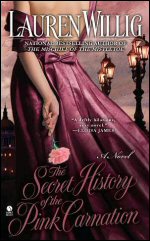
Cover story: Pink Carnation series by Lauren Willig

With only a couple of days left in our current giveaway of the latest instalment of the Pink Carnation series, Mischief of the Mistletoe, and a gorgeous Christmas ornament, it seemed like a good time to do a cover story of the series! To me, this series has a really strong identity through its covers, particularly through the first 6 books. I understand that the covers are changing now, which I understand from a marketing point of view but do think is a shame, especially if you have been collecting them for a while.

I am not all that keen on the first UK covers, but do like the second and third ones, and personally I am not a big fan of the cover for the next book either.

Don't forget to go and enter our giveaway after you have finished looking at all this eye candy! And if you like, revisit the Why I Love post that Lauren Willig did for us a while ago on why she loves Men in Black Masks

The Secret History of the Pink Carnation


Right to Left: US Hardcover, UK Hardcover, UK paperback, Australian hardcover, US paperback.


The Masque of the Black Tulip


L to R: Paperback, Hardcover, UK Paperback

The Deception of the Emerald Ring


L to R: UK paperback, hardcover

The Seduction of the Crimson Rose


The Temptation of the Night Jasmine


The Betrayal of the Blood Lily


The Mischief of the Mistletoe


The Orchid Affair (release date January 2011)