Showing posts with label Richard III. Show all posts

Tuesday, February 12, 2013

Anne Easter Smith on Richard III


Today I am pleased to welcome Anne Easter Smith to Historical Tapestry as part of her Royal Mistress/Richard III blog tour that has been organised by Amy at Historical Fiction Virtual Blog Tours! 

I have had a soft spot for Richard III since I read Sharon Kay Penman's spectacular Sunne in Splendour, which then lead me on a journey to books I loved like Daughter of Time by Josephine Tey and Anne Easter Smith's A Rose for the Crown. It has been a while since I read a book about Richard III, but I do have a couple coming up soon!

With the news that Richard's body has been found and identified, I was happy to get the opportunity to ask Anne Easter Smith a few questions.


~~~~~~~~~~~~~~~~~


M: It has been big news over the last week that the body of Richard III has been found. I had heard that Richard III was the last English king killed in battle and the only one since William the Conqueror who didn't have an official tomb. What difference do you think the fact that there is a body and that it will be buried at Leicester will make?

AES: Thanks for hosting me today! As far as this question is concerned, I think most Ricardians are just happy to be able to have a place to go and pay our respects. A plaque has been in place near the carpark in Leicester for quite some time (paid for by the Richard III Society), but it was a guess that his remains were still somewhere around there! The best part of all this excitement over the discovery is that it will revive interest in this much-maligned king, and perhaps new scholarship will help unblacken his name.

M: Do you think that Leicester is the right place for his tomb to be located?

AES: To be honest, I was not fanatical about one location over another. York certainly has every right to lobby for the burial there as Richard spent so much of his life in the north, but as it was the University of Leicester that worked so hard to uncover the bones, and somehow in all the redevelopment over the centuries the grave was still intact, I am quite happy for Leicester Cathedral to house Richard’s remains now. However, re-interment in another place is not unheard of in Richard’s family. His father, Richard duke of York and brother, Edmund, were removed from their original burial ground in Pontefract, near where they were killed in the battle of Wakefield in 1460, and moved with great pomp down to the York family seat of Fotheringhay and re-buried in July of 1476. I set a scene in “Queen By Right” during those elaborate ceremonies. I thought that if York and Leicester couldn’t come to terms, that perhaps Richard should be taken back to his birthplace and laid with his mum and dad and brother!

M: Richard III is a very divisive figure in history. There are lots of very passionate people who believe that he had bad PR at the hands of the Tudors and can not have been as bad as he has been portrayed and yet there are others who are equally as passionate that he was a murderer and all round bad guy. Why is he still so divisive all these years later?

AES: If you are a Tudor fan, you can’t love Richard! That’s a very simplistic answer to a very complex question. But from the media of the winner of the battle of Bosworth (and his descendants), i.e. Tudor chroniclers, historians and Mr. Shakespeare, a very black picture of Richard III was painted and people believed it. Shakespeare’s play, in particular, is all wrong chronologically and factually. We now know that Richard had scoliosis, but so does Usain Bolt. It looks as though Richard’s right shoulder was higher than his left because of it, but that does not make him a hideous hunchback with a withered arm (in fact the skeleton showed no abnormality to the arm). I would guess he had to compensate for the pain he must have had from his back by building up his sword arm, because we know he was a formidable soldier, and even the Tudors do not dispute, his prowess on the battlefield. The murders laid at his door by Shakespeare should mostly be laid at his brother Edward’s. And the playwright had Richard killing the duke of Somerset at the Battle of St. Alban’s when Richard was only two! I think that if the princes in the Tower had not disappeared so mysteriously, Richard would not have garnered such controversy over the centuries. People love a mystery--just look at the theories about Jack the Ripper!

M: How did you come to be fascinated by Richard III?

In my early 20s, my Ricardian godmother gave me a copy of Josephine Tey’s “The Daughter of Time,” and I have been obsessed by him since then! (My mother was relieved as the last obsession I’d had was in the my teens when I adored Ricky Nelson! “Much quieter, dear,” was her response to Richard. She had quite a sense of humor, my mum!)


Tour Details

Schedule
Anne Easter Smith's Website
Anne Easter Smith on Facebook


Articles on Richard III

BBC news: DNA confirms Richard III is found
New York Times: Bones under parking lot belonged to Richard III
Facial reconstruction: How Richard may have appeared, as reported by BBC

About the book

Publication Date: May 7, 2013
Publisher: Touchstone
Hardcover; 512p

From the author of A Rose for the Crown and Daughter of York comes another engrossing historical novel of the York family in the Wars of the Roses, telling the fascinating story of the rise and fall of the final and favorite mistress of Edward IV.

Jane Lambert, the quick-witted and alluring daughter of a silk merchant, is twenty-two and still unmarried. When Jane’s father finally finds her a match, she’s married off to the dull, older silk merchant William Shore—but her heart belongs to another. Marriage doesn’t stop Jane Shore from flirtation, however, and when the king’s chamberlain and friend, Will Hastings, comes to her husband’s shop, Will knows his King will find her irresistible.

Edward IV has everything: power, majestic bearing, superior military leadership, a sensual nature, and charisma. And with Jane as his mistress, he also finds true happiness. But when his hedonistic tendencies get in the way of being the strong leader England needs, his life, as well as that of Jane Shore and Will Hastings, hang in the balance.

This dramatic tale has been an inspiration to poets and playwrights for 500 years, and told through the unique perspective of a woman plucked from obscurity and thrust into a life of notoriety, Royal Mistress is sure to enthrall today’s historical fiction lovers as well.


Wednesday, November 4, 2009

The Tudor Rose by Margaret Campbell Barnes

One woman holds the key to England's most glorious empire

Elizabeth of York, the only living descendant of Edward IV, possesses the most precious thing in all of England - a legitimate claim to the crown. Two princes meet to determine a country's destiny: whoever wins will take Britain's most rightful heir as his bride and her kingdom for his own. On one side is her uncle Richard, the last Plantagenet King, whom she fears to be the murderer of her two brother's the would-be kings. On the other hand is Henry Tudor, the exiled king. Can he save her from a horrifying marriage to a cuthroat soldier.


Marg's Thoughts

Her mother was the beautiful woman who secretly captured a king's heart. Her father was a charismatic and handsome king whose brother was a loyal general, but who took the throne for his own. Her younger brothers disappeared in one of the enduring mysteries of the ages.

There are times when a book has a main character who just can't carry a story on their own, and for me, this book is one of those. Whilst Elizabeth of York was very important in her time, particularly as a marriageable young princess, she must have been a bit difficult to write about because in some ways it seem as though the interesting things happened around her instead of her being an active participant. Her story is interesting given the events that happened to people around her and her early life, but certainly her marriage appeared very much to be one of duty and is portrayed as being very lonely, despite the attempts from Henry's mother to welcome her into the family. Henry's mother is portrayed as a loving mother-in-law when everything else I have read about her suggests that she was controlling and overbearing. Elizabeth's own mother, Elizabeth Woodville doesn't come out of this portrayal too badly given the reputation that has carried through the ages.

Much of the content of the book revolves around what happened to the Princes in the Tower, as well as the two pretenders. One of the positives of this book for me is the way that the story of Perkin Warbeck is told. My interest has certainly been piqued, and I am definitely looking for more to read about him, and his life.

The other dominating character in the novel is that of Richard III - a love him or hate him kind of guy if ever there was such a thing! Many people are either strongly pro or strongly anti Richard, and there are many novels where you can clearly see the author's personal bias in the characterisation that they choose. In this novel it is almost as though Barnes tried to be even handed when it came to Richard III but instead comes off as inconsistent.

As we follow Elizabeth through her life we get brief glimpses of her children, the ill fated heir, Arthur and the dashingly sporty and handsome Henry but for me the book ends at a very strange point, very abruptly, and I think that this has flavoured my final rating of the book.

I received an ARC of this book from Sourcebooks. I have no idea if the blurb above ended up being the blurb on the final book but I really hope not! I am pretty sure that Elizabeth's sisters were living descendants of Edward IV, and I don't think Henry Tudor was an 'exiled king' when she married him.

Over the last couple of years I have been lucky enough to read a couple of Margaret Campbell Barnes' books that have been being republished by Sourcebooks. This was an okay read, but not as good as either Brief Gaudy Hour (about Anne Boleyn) or My Lady of Cleves (about Anne of Cleves). I am on the lookout for The King's Fool though, and if I can find them, will definitely read more from this author. I believe that another of the author's books is due to be rereleased next year.

I was interested to see on Fantastic Fiction that they have grouped Brief Gaudy Hour and My Lady of Cleves together with this book as part of a trilogy called Shadows of the Crown. Whilst the Tudor connection was obvious, I hadn't actually seen this title for the group of books before.

I'm glad that I have read this, but if I was asked to recommend a book by this author, I would start with one of the others.

Rating 3.5/5

Teddy's Thoughts

Elizabeth is daughter of Edward IV and niece to Richard III. When her father dies, it is her brother who is to take the crown. However, Richard III decides that the only one suitable to be King is himself. He sends both of Elizabeth's brothers to the tower to be held. Richard has his coronation and all of a sudden Elizabeth's brothers go missing and are presumed dead.

Many think that Richard III ordered their disposal . Now Elisabeth is the only living descendent to Edward IV and should be the rightful Queen. Elizabeth is horrified when Richard III proposes marriage to her. Not only is she convinced that he murdered her brothers but he is her uncle, after all!

There is much plotting and it is decided that she must marry Henry Tudor and that he must fight Richard III for the crown. The first attempt fails but eventually Richard III is killed and Henry Tudor becomes Henry VII. However, he doesn't hold up his end of the bargain to marry Elizabeth and give her a coronation to become queen of England. Eventually, due to public and private pressure he makes good and marries Elisabeth. However, he does not make her queen until after she has their first son.

The marriage itself, is loveless. Elizabeth has romantic notions that they would grow to love each other and have a passionate one. Henry doesn't seem to know what romance is and seems incapable of love. He couples with her only to produce heirs. Poor Elizabeth longs for more out of life.

This book was first published in 1953. Sourcebooks has re-published it and it is due out in the United States on October 1, 2009. I'm glad they did. Barnes has a way with words and I love some of her descriptions of the time and place. I must admit, that there are a few places that I would nod off to sleep while reading it. Some of the time that Elizabeth interacted with her mother seemed boring to me. It took me a good 50 pages to finally get drawn into the story.

That said, I am glad I stuck with it. I learned more about the period and really enjoyed it, once it got going. If you like historical fiction and are interested in this important period in English history, you will enjoy this book.

4/5

Saturday, October 3, 2009

The Tudor Rose: A Novel of Elizabeth of York by Margaret Campbell Barnes


Elizabeth is daughter of Edward IV and niece to Richard III. When her father dies, it is her brother who is to take the crown. However, Richard III decides that the only one suitable to be King is himself. He sends both of Elizabeth's brothers to the tower to be held. Richard has his coronation and all of a sudden Elizabeth's brothers go missing and are presumed dead.

Many think that Richard III ordered their disposal . Now Elisabeth is the only living descendent to Edward IV and should be the rightful Queen. Elizabeth is horrified when Richard III proposes marriage to her. Not only is she convinced that he murdered her brothers but he is her uncle, after all!

There is much plotting and it is decided that she must marry Henry Tudor and that he must fight Richard III for the crown. The first attempt fails but eventually Richard III is killed and Henry Tudor becomes Henry VII. However, he doesn't hold up his end of the bargain to marry Elizabeth and give her a coronation to become queen of England. Eventually, due to public and private pressure he makes good and marries Elisabeth. However, he does not make her queen until after she has their first son.

The marriage itself, is loveless. Elizabeth has romantic notions that they would grow to love each other and have a passionate one. Henry doesn't seem to know what romance is and seems incapable of love. He couples with her only to produce heirs. Poor Elizabeth longs for more out of life.

This book was first published in 1953. Sourcebooks has re-published it and it is due out in the United States on October 1, 2009. I'm glad they did. Barnes has a way with words and I love some of her descriptions of the time and place. I must admit, that there are a few places that I would nod off to sleep while reading it. Some of the time that Elizabeth interacted with her mother seemed boring to me. It took me a good 50 pages to finally get drawn into the story.

That said, I am glad I stuck with it. I learned more about the period and really enjoyed it, once it got going. If you like historical fiction and are interested in this important period in English history, you will enjoy this book.

4/5

Wednesday, December 5, 2007

Daughter of Time by Josephine Tey

Scotland Yard Inspector Alan Grant lies in a hospital bed with a broken leg. To alleviate his boredom, a friend brings him a pile of pictures: photographs, prints, engravings, and clippings. Among the more engrossing images is the portrait of King Richard III. Studying the benign face, he asks himself how such a sensitive-appearing soul could have been the infamous murderer of his own nephews. With the help of the British Museum and an American scholar, Grant reconsiders 500-year-old evidence pertaining to one of the most intriguing murder mysteries of all time. Josephine Tey's answer to who really killed the two princes in the Tower of London has provoked controversy ever since its publication in 1951.
This review was originally posted on my personal blog in August 2006


The Daughter of Time is actually the fifth book in a series of six mysteries that feature Inspector Grant. Normally the fact that I was reading a book from a series out of order would really freak me out, however, it didn't this time, mainly because I didn't find out until after I finished it!

With the first book in the series being published in 1929 and this one published in 1951, it is actually a pretty old book, and yet for the most part it does not feel dated at all. There are the occasional things which are, for example the Inspector smoking in his hospital bed, a little bit of the language (calling gangsters wideboys)...oh, and the fact that there was no internet to assist with the research, but overall the story is so well written that it holds up for today's reader without too many problems.

The story is that Inspector Grant is stuck in hospital after falling through a trap door with a broken leg (presumably in the book before this), and so he is in hospital laying flat on his back for weeks (Okay...so maybe it is a little dated. My sister recently broke her kneecap and was out of hospital in two days). Nearly driven round the twist with boredom, one of his friends goes and gets some portraits of historical figures that are connected to unsolved mysteries of the past to see whether that kind of mental exercise will help cheer him up. After discarding some pretty famous names like Perkin Warbeck and Lucrezia Borgia, Grant spies a portrait of Richard III. Priding himself as a man who is able to be a good judge of character based solely on a face, Grant finds himself wondering how a man who looks like Richard III has been portrayed through the years as one of the most evil kings of England ever.

So Grant, with the able assistance of a young American researcher by the name of Brent Carradine, sets out to track down contemporary accounts of Richard III to try and found out what the man was really liked. Having discovered that most of the famous accounts were either hearsay or written by Richard's enemies, Grant decides to use the skills that he has gained at Scotland Yard to in effect investigate Richard and see whether he could possibly be guilty of the things that he has been accused of doing over the years, including murdering his own two nephews in order to gain the crown for himself.

He starts with a series of questions. For example, where was Richard when he found out that his older brother King Edward IV had died? What did he do when he heard? Were his actions consistent with those of a man who had gaining the throne for himself as his foremost concern? Using the same approach for many of the other key figures, by following through some of the key events from history and investigating logically, Grant comes up with some quite interesting theories as to what really happened all those years ago.

I have to admit that I am quite partial to a story about Richard III. This interest started when I read Sunne in Splendour by Sharon Penman, and has continued through The Seventh Son by Reay Tannahill, and most recently, A Rose for the Crown. For some reason I do always end up reading novels that are very pro Richard, and this one is no exception, although this one does come up with a different answer to that age old question - if Richard didn't kill the princes in the tower...then who did!

In terms of the style of the novel, it is an interesting mix - more like a case study than your traditional historical fiction novel. Whilst I would guess that the book would qualify as a historical mystery, it is interesting to note that the author didn't take us back in time, and feel the need to share the smells, dresses and rituals of the time, but rather gives us an analytical look back at a particular character, and a particular series of events that were pretty crucial to English history. It is an unusual way of writing the book, but it works.

One interesting thing that I found, was that Miss Tey put a reference to the Inspector going to watch one of the plays that she had written under her other pen name of Gordon Taviot. Normally when I read that kind of thing, for example when an author writes themselves into the story, I find it kind of jarring. It did amuse me to think that kind of thing was happening all those years ago as well. There is nothing new under the sun...apparently!!

A very entertaining read of a book that is probably as close to a historical fiction classic that you can get, and well worth trying to get hold of! I have every intention of reading more from this author.

Rating 4.5/5

Sunday, December 2, 2007

A Rose for the Crown by Anne Easter Smith


AN UNFORGETTABLE HEROINE,

A KING MISUNDERSTOOD BY HISTORY,

A LOVE STORY THAT HAS NEVER BEEN TOLD

In A Rose for the Crown, we meet one of history's alleged villains through the eyes of a captivating new heroine -- the woman who was the mother of his illegitimate children, a woman who loved him for who he really was, no matter what the cost to herself.

As Kate Haute moves from her peasant roots to the luxurious palaces of England, her path is inextricably intertwined with that of Richard, Duke of Gloucester, later King Richard III. Although they could never marry, their young passion grows into a love that sustains them through war, personal tragedy, and the dangerous heights of political triumph.

Anne Easter Smith's impeccable research provides the backbone of an engrossing and vibrant debut from a major new historical novelist.

Marg says:

Richard III is known as one of the most villainous kings of England, mainly because whilst in his care the two princes in the Tower, his nephews, disappeared without a trace. He was the last Plantagenet king, and had his throne taken from him by the first of the Tudor kings, Henry VII. He was portrayed in a negative way ever since the time of the Tudors, with Shakespeare especially getting in on the act. There are quite a few people out there who believe that this reputation is undeserved, and that he is a king that has had bad PR over the years. The author of this book is a member of the Richard III society and it is therefore inevitable that she would portray him in a mostly positive light, but hers is not the only one out there that portrays him in this way. One of the best books I have read with Richard III as subject is Sunne in Splendour by Sharon Kay Penman...awesome book!

Before we come to know Richard, we firstly meet a young lady by the name of Kate Bywood, who is a lovely looking country lass, with the very bad habits of telling everyone what she thinks, and asking too many questions. We follow Kate for many years, getting to know her as she lives both at her family home, and then when she is given the opportunity to travel to Ightham Mote to become companion to a member of her family. She is married at quite a young age to a much older man, and widowed a short time later, making her an independent woman, with a regular income. Along the way we also meet some of the people that will become incredibly important to her, including Margaret Howard, wife of John Howard...a man on the rise within royal circles, and who eventually played a huge role in the reign of Richard III.

When it comes to be time for Kate to marry again she is delighted when she is to be married to George Haute, a very handsome young man, who is in service with the Howards. However, it becomes very clear early on that whilst Kate thinks she loves George, George's reasons for marriage are less honourable. Kate is resigned to another marriage that is less than fulfilling. Into her unhappy life comes the youngest brother of Edward IV, Richard of Gloucester, and there is an instant connection between them. As their paths occasionally cross, everything is building up to their inevitable relationship.

Young Richard of Gloucester is portrayed as a man who values loyalty more than anything, and who is valued for his own loyalty by his brother, something that is not always forthcoming in royal families (their brother, Duke of Clarence was executed for treason against Edward IV). For Richard and Kate, they cannot often be together, but when they are the time spent is precious, and even more so when Kate bears him two children. Richard is, however, a man of honour, and so when the time comes for him to marry for duty, they agree that their time as lovers has to end, but not before Kate once again finds herself with child.

Following the death of Edward, Richard is first appointed as regent to the young King Edward V, and then eventually is declared King in his own right. Kate's two older children are acknowledged by Richard and even taken into his own household by him and his wife Queen Anne, and Kate is separated by the social chasm between them as they begin their lives as young royals. She is not however ever separated from them emotionally.

The connection between Kate and Richard is a strong and loving one, and as Richard deals with the difficulties of being king, Kate is able to provide him with support in a way that no one else can, especially when his two young nephews are taken care of! She is also able to help out some of her closer friends and relatives as a result of her own influence with him.

So, what basis in fact is there? What is known is that Richard has at least two illegitimate children before his marriage that he acknowledged and had living in his own household. On the eve of his death it is thought that he acknowledged a third child as well. As to the identity of the mother(s), that is not known, so the author has taken some information found in the history records and woven her story around them. She suppposes that given that Richard was quite unusual in that he was completely faithful to his wife (quite the opposite of his older brother!), that it was likely that Richard had had such a loving relationship with someone that he was fulfilled in a way that no mistresses could compete with. How true that supposition is .... who knows, but it does make for a very solid and compelling read.

The author takes the facts that are known, along with details of daily lives across a cross section of society, and weaves them into a narrative that is compelling without being dry as some historical fiction can occasionally be.

An extremely satisfying and enjoyable read, and a recommended read to anyone interested in reading about the English royal history before Tudor times.

Rating 4.5/5


Kailana says:


The advantage of having exchange students is lots of trips to the airport. The book store housed there has many staff members that read historical fiction, so there are always displays of them and more often than not, they are books I haven't seen anywhere else. This is where I found A Rose for the Crown. I ended up buying it from amazon, but I might never have done that if it wasn't for the bookstore.

I was very excited to read this novel. I had planned to start it a while ago, but something always came up and I never got around to it. I was worried that this book would destroy Richard for me. I know that he was supposed to be this vile man, but history is told through the eyes of the winners, and that makes me think the Tudors just destroyed his name when they came into power. I like to think that he was a good guy, and since I will never meet him, it is not something that can ever be fully proved.

This book starts when Kate Haue is very young and still living with her parents. We get a good idea of what she is like before Richard even enters the novel. He is shown in some background scenes, like when his brother is crowned king, but he never becomes a main character until Kate is in her teens. Kate has a slightly lower class early life. Her father is a farmer, and they live very basically. Then, one day a friend of Kate's mother comes to the farm house and her life is changed forever. She is taken to the house to be a playmate and sister to their daughter, and while she never essentially changes her place in society, more oppurtunities are open to her.

By the time she meets Richard she has been married to a man that is a considerable amount older to her, he has died, and she has moved on to a man that she thinks she loves. Until she gets to know him better. When Richard comes along, she is very unhappy in her marriage, and if it wasn't for the love that she feels for her husband George's family, life would be very bad indeed. She longs to feel love and be the mother of a child, but George would have that denied to her. It is one day when she is wandering in the woods that her life is changed forever.

So much happens in the book. It is not just about Richard and Kate, it is not just a romance novel. Kate's life is explained in detail to the backdrop of Edward, Richard's brother, and then Richard himself. You enjoy the moments where Richard and Kate are in love, but you also enjoy all the friends that Kate picks up along the way. The ways that Smith has taken historical characters and intertwined their lives with Kate. You can really believe that Richard loved her and that he enjoyed his time with her.

I loved this book, when I finished it I was sad because there is not any more to the story. You really get into the story, feeling the emotions that Kate feels and being saddened by the events in the novel. It is at its core a forbidden love story, and when Richard has to marry Anne Neville it is a very sad goodbye. This book is up there with Penman. Penman concentrates on the professional side of being a king, while Smith concentrates on the lower classes and the personal life of a king. You will fall in love with Kate and your heart will go out to Richard.

I am very excited to say: 5/5

Wednesday, November 21, 2007

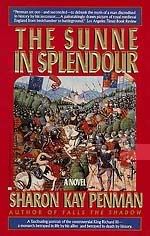
The Sunne In Splendour - Sharon Kay Penman

Photo Sharing and Video Hosting at PhotobucketSharon Kay Penman's biography of Richard III is one of my favorite books of all time. I have hesitated in writing this review for quite a while because I'm not sure I can do it justice.

There are many things to enjoy. Her construction of the characters, how we slowly get to know them, their motivations and fears. Her description of the political backgroung of that complicated period that was 15th century England. And how she brings Richard III to life in a way that is totally convincing and very human.

The book follows Richard from a young age when he is still in the shadow of his brother till the powerful Earl he becomes under Edward IV reign and finally his rise to throne and his death. Her writing is full of historical detail, she gives us the historical background but also those little everyday happenings that make the story and the characters come alive.

It is inevitable that what stands out more when speaking of this book is her defense of Richard regarding the death of his nephews. She makes a compelling and believable case presenting other suspects and exonerating Richard from the dark legend Shakespeare made known.

Highly recommended!!

Wednesday, July 25, 2007

The Seventh Son by Reay Tannahill

Ana says:

I was first introduced to the story of Richard III and the different opinions about him after reading Sharon Kay Penman’s The Sunne In Splendour. When I picked up this book I had no idea it was about Richard III, I decided to read it just because I had heard so many good things about Reay Tannahill and had never came across one of her books.

Reay Tannahill's enthralling new novel is a family saga in the grand tradition....

At the heart of it all is the dangerous, complex human being known to history as Richard III, a king whose reign is forever darkened by the murder of the young Princes in the Tower, but who also found a touching love with the woman he married, and possessed immense physical courage. Here, brought vividly to life in this most moving novel, is a man who inspired loyalty and hatred in almost equal measure, until at last the implacable enmity of one woman brought about his downfall.


I found this book to have a more rational, less emotional approach to the story thank the Penman book even if we will never know the actual truth.

Tannahill chose to portray the adult Richard. An austere man, with a strong moral sense, he believes in doing the right thing even when that’s difficult and dangerous. He marries Anne Neville for political and economical gain, even if they are showed here as loving each other deeply.

His life is first dominated by his loyalty and respect for his brother Edward IV and then dominated by his need to do what he believes is right, by duty. He is sometimes ruthless in the pursuit of that objective and I found that in context with the period he lived in even if he did seem very intolerant at times. However there isn’t much character development and we hardly ever know what the characters are thinking. The episode of the death of the princes in the tower is approached only briefly which I found a bit odd since it’s what is usually mentioned with connection with Richard’s life and deeds.

Although I actually liked Tannahill’s approach to the story I think I would have liked a bit more characterization, a few more insights into the characters. She does that a lot better with Francis Lovell, Anne and Constantia than with Richard. Since this is an historical fiction novel I think I would have liked a bit more fiction.

Grade: B

Marg says:

It's interesting to read Ana's thoughts now, because it has been several years since I read this book (and it was pre blogging days so I don't have anything written down about it). Like Ana, I picked this one up after having read Penman's Sunne in Splendour. I'm pretty sure I would have been disappointed with whichever book I read about Richard III after the fantastic Penman, but I do remember really struggling with this book.

Of the things that Ana mention, my memories of this book are probably most associated with Francis Lovell. Other than that I can't remember getting completely immersed in this book at all.

I do realise that it is probably very unfair of me to compare this book to Sunne in Splendour, but given the time frame and the characters...I can't help myself. I have since read other books on Richard III and enjoyed them, but there was a significant time lapse.

Rating: 3/5