Monday, December 31, 2007

The End is Here


As I think can become clear through the majority of my reviews this year, because I read a lot of fantasy, I read a lot of series and trilogies. They believe that this sells better, so it is very rare to pick up a book and have it stand-alone. This means that I always have several series on the go, and I am hardly ever caught up in any of them. I could only read fantasy all this year and still not catch up on all the series I want to read. Frankly, more often than not, if I really like a series or trilogy the last book will sit on the shelf looking all pretty until I am reading to say good-bye to the characters properly. I hate to rush it because you can revisit, but you will never have that first read moment again. So, the last book is often the saddest moment for me, especially if I am really enjoying the experience.

Yesterday, I finished off what has quickly become one of my favourite young adult trilogies, and I had a real battle. Sometimes I wanted to fly through it to see what was going to happen next, and other times I just put it down because once I reached the end, there would be no more. One of the more interesting things about waiting for the final book in a series is that you get to think about what could happen next, and then you find yourself writing some of the scenes that you would like to see in your head. I really hope I am not the only one that does that! Yesterday saw the conclusion of Libba Bray's Gemma Doyle trilogy. There are other young adult books that I have enjoyed, but from the moment that I sat down with A Great and Terrible Beauty last year, I knew it was love. I loved all three books in this trilogy, which rarely happens for me. When it does, you know I am even sadder to see it end, because writing a strong second book in a trilogy is really hard to do. So, I was very sad to close the pages on The Sweet Far Thing.
IT HAS BEEN A YEAR OF CHANGE since Gemma Doyle arrived at the foreboding Spence Academy. Her mother murdered, her father a
laudanum addict, Gemma has relied on an unsuspected strength and has discovered an ability to travel to an enchanted world called the realms, where dark magic runs wild. Despite certain peril, Gemma has bound the magic to herself and forged unlikely new alliances. Now, as Gemma approaches her London debut, the time has come to test these bonds.

The Order - the mysterious group her mother was once part of - is grappling for control of the realms, as is the Rakshana. Spence's burned East Wing is being rebuilt, but why now? Gemma and her friends see Pippa, but she is not the same. And their friendship faces its gravest trial as Gemma must decide once and for all what role she is meant for.
The biggest problem with gulping down this book was that even if she were to write something else, I am going to have to wait two years to see what it is! It was a chunkster, coming in at about 800 pages. I had intended to read short books, where I was so close to my goal of reading 200 books, but when I picked this book up, I knew I was going to have to read it. I had been waiting a year to see what was going to happen next, so I just had to know. Did everything happen as I thought it would? Not exactly, but I still enjoyed the read. There were a couple things that I had wished would play out differently, that is for sure. Part of me is still wondering if I liked the ending, because it did not end like I was hoping it would end, but at the same time the ending did not surprise me. It was not a terrible ending, just not what I wanted. So, I suppose I should stop whinning and just accept it.

This book follows Gemma Doyle in her last year at Spence Academy. The years have been rough for her since arriving there about a year ago. Her mother died, and it was her wish that if something happened to her, Gemma would be sent to Spence. This did not put a cheerful frame on the events that occurred for her. She did make friends, though. The headstrong Felicity, the meek and quiet Anne, and the lovely Pippa. To these girls, Gemma opened up a whole new world that had previously been closed to them and showed them that their dreams were possible. This book is sort of a coming of age tale, but, more importantly, it is about a young girl battling the forces of evil. Gemma can be a bit annoying at times. Her age and immaturity make appearances throughout the novel, but then it is hard to say what people will do when they are faced with something unusual like magical powers.

I think this book does a very good job tidying up the loose ends. You see more from characters than you have in previous books. Some of this might even surprise you. I found the book a page-turner for the most part, probably because I really liked the trilogy and I was really curious how Bray was going to end it. There was also probably a tiny hope that she would leave it open for a fourth book, but while I think there could be another one, I do not think there is a plan for another. Characters from the other two books will reappear. There are actually very few new characters in this novel. Bray is very good about closing everything up, even little storylines that could have got lost in the larger ones. Overall, I think she did a fantastic job and for the moment, this is my favourite young adult trilogy.

You should read it!

Wednesday, December 26, 2007

Rebel Angels by Libba Bray


This is the sequel to A Great and Terrible Beauty.

From Random House: (too lazy to type the flap)

Gemma Doyle is looking forward to a holiday from Spence Academy—spending time with her friends in the city, attending balls in fancy gowns with plunging necklines, and dallying with the handsome Lord Denby. Yet amid these distractions, her visions intensify—visions of three girls dressed in white, to whom something horrific has happened that only the realms can explain.

The lure is strong, and soon Gemma, Felicity, and Ann are turning flowers into butterflies in the enchanted world that Gemma takes them to. To the girls' great joy, their beloved Pippa is there as well, eager to complete their circle of friendship.

But all is not well in the realms—or out. Kartik is back, desperately insisting to Gemma that she must bind the magic, lest colossal disaster befall her. Gemma is willing to comply, for this would bring her face-to-face with her late mother's greatest friend, now Gemma's foe—Circe. Until Circe is destroyed, Gemma cannot live out her destiny. But finding Circe proves a most perilous task. . . .

Th
is sumptuous companion to A Great and Terrible Beauty teems with Victorian thrills and chills that play out against the rich backdrop of 1895 London, a place of shadows and light . . . where inside great beauty can lie a rebel angel.


They call it on the book a companion to A Great and Terrible Beauty, but it really takes place 2 months after the events from the previous book, so I think it is better termed as a sequel. And there better be another sequel because I really enjoyed this book!

A lot happens in this novel. It is a bit longer than the first book, which I found great because it was more to enjoy. The same characters are present: Gemma, Felicity, and Ann are still attending Spence and dealing with being teenagers, as they are sixteen years old when this book takes place. They come from different lives and different backgrounds, which makes their interactions more interesting. Gemma lost her mother in the first book and her father is dealing with sustance abuse. Her grandmother wants what is best for her, but can be rather uptight, and her brother is rather shallow. Felicity's mother was in France for the first book, but is back around. We also meet her beloved father in this book, but looks can be deceiving. And then there is Ann, totally alone in the world and living on the charity of others. She begins to gain confidence in this book and really shine.

Pippa and Kartik are back. Pippa got left behind in the realms in book one, so she is a different character than she was in the first book. You are never really sure what to make of her, and what has happened to her really bothers Gemma. Kartrik is one of my favourite characters. Gemma is upper-class and can treat him rather badly, but I like him. I think he adds an interesting aspect to the books. In this one, Gemma has to figure out where he stands in her circle.

It was a very well-written book, that just grabbed you. I could not put it down after I get a bit of a ways into it, and when I did, I was thinking about when I would be able to read it again. I read most of it today while I should have been doing a million other things, but anyways. It was too good to put down. In the last book, Gemma had to destroy the things that held the magic in the realms, and now it is causing problems that she is the only one that can fix. It is really a novel where she has to figure out who she can trust, who her real friends are, and what she is truly capable of. All the girls begin to really grow up and find themselves in this book.

I think everyone that likes a good, slightly fantastic novel should read this book. It will hold you until the very last page.

For more information, go here: Random House.

5/5 (a rare thing from me for a young adult book, and no idea what I will do if I like book 3 even more!)

Marg says:

Having read and enjoyed A Great and Terrible Beauty last year, I have been patiently waiting for this book to come into the library, and so was very excited when finally, not too long ago, it finally came onto the library catalogue.

So, after all that anticipation, was it worth the wait? Well yes, and no.

The school year is coming to an end for all of the young women at Spence Boarding school, and Gemma and her friends are looking forward to spending Christmas in London - after all what girl wouldn't love all the balls and the opera and all those tea times. Even young Anne manages to get an invite to London, only by making up an incredible story about her identity, but all three girls eventually find themselves in London.

Gemma's visit to London starts really well when she meets the deliciously eligible and dashing Simon Middleton - a member of one of the best families in London. Simon has taken a liking to Gemma, and she to him, but she must not allow herself to get too distracted - after all she still has to track down the mysterious Circe, bind the power in the realms and keep up all the necessary appearances of a very proper young Victorian lady.

One of the benefits of moving the setting away from Spence for most of the book is that there are a wide variety more settings that are available to the author - from the dingy parts of London where no proper young lady would ever go, to the opera, to Bedlam, to shopping in strange little book shops. There is also more scope with interaction with other characters such as the families of the girls, where some time was spent on some quite sensitive issues including but not limited to addiction.

Within the realms as well the story was expanded during this book. When the white door opens to Gemma and her friends they do find themselves in the part of the realm that they are familiar with, including Pippa, their friend who was left behind - but are things really the same. Gemma has found a young girl in Bedlam who has some knowledge of the realms and she and others are constantly warning Gemma to find the Temple and bind the magic, but to be careful of who she trusts, particularly as everything in the realms is out of balance at the moment. As the girls travel further into the realms they find more and more interesting tribes, some of whom are more interesting than others, and some who are far more dangerous than others. Can Gemma and her friends find the temple and bind the power before Circe does, and if they do, who should they bind the power in the name of . Is the Order to be trusted, is there another one who should be holding the power, or perhaps should it be shared.

Along the way Gemma needs to figure out who she can trust. Can she trust Simon to love her no matter what her strange powers may be? Can she trust Kartik, or is his first loyalty to others? And can she trust herself with the power that she has, or will it overwhelm her?

I think that this book was more fast paced than the first one, with lots more situations where Gemma and her friends could have found themselves in danger. In particular they spent a lot more time in the Realms in this book. In my opinion the book was less balanced than the first one was and in some way I think that this affected my concentration. To be honest, I think that once again this was more about my frame of mind as opposed to the book, but that's what I felt so therefore that is what I am basing my review and rating on!

I did enjoy it, but not quite as much as I enjoyed the first one. I am however just as eager to get hold of the new book, The Sweet Far Thing, which is due out in September.

Rating 4/5

A Great and Terrible Beauty by Libba Bray


A young adult, soon to be, trilogy that I have wanted to read for a while, this enters the marks as one of the better books I have read this year. Young adult books are much better than they were when I was a young adult, I know that much.

From the back of the book:

Gemma Doyle isn't like other girls. Girls with impeccable manners, who speak when spoken to, who remember their station, and who will lie back and think of England when it's required of them.

No, sixteen-year-old Gemma is an island unto herself, sent to the Spence Academy in London after tragedy strikes her family in India. Lonely, guilt-ridden, and prone to visions of the future that have an uncomfortable habit of coming true, Gemma finds a chilly reception. But she's not completely alone... she's followed by a mysterious young man, who warns her to close her mind against her visions.

For it's at Spence that Gemma's power to attract the supernatural unfolds; there she becomes entangled with the school's most powerful girls and discovers her mother's connection to a shadowy group called the Order. It's there that her destiny waits... if only she can believe in it.

A GREAT AND TERRIBLE BEAUTY is a curl-up-under-the-covers kind of book... a vast canvs of rustling skirts and dancing shadows and things that go bump in the night. It's a vividly drawn portrait of the Victorian age, when girls were groomed for lives as rich men's wives... and the story of a girl who saw another way.


I regret that it took me so long to discover this book. I had heard of it, but it never grabbed my attention enough to buy it until recently. Now, I can't wait to read the next one and I hope it will be equally good. Young adult novels have come a long way, some of them are even better than novels marketed at adults.

This novel was attractive to me because people were saying it had fantasy elements to it. I enjoy fantasy novels, so I decided to see what these fantasy elements were. This book takes place in the later part of the 19th-century. The main character, Gemma Doyle, is dealing with being a sixteen-year-old. Teenage years are never easy, and with the last few months has brought a very difficult daughter for Gemma's mother. They used to get along, but now Gemma has it stuck in her head that she absolutely has to go to London. Her mother doesn't agree, and this causes lots of conflict between mother and daughter.

Then one day, everything changes for good. While in the marketplace, Gemma says a horrible thing to her mother and the next thing she knows, her mother is not around anymore to argue with. Gemma blames herself, and is racked with guilt for quite some time. She is her most annoying at this part of the book, while she deals with the loss of her mother. But then, she discovers she has an amazing gift that results in a whole other world for her. A young man, who you will find an interesting member of the cast of characters, follows Gemma to London where Gemma is attending Spence Academy.

When Gemma first arrives in London, she wonders why she ever really wanted to go there in the first place, but then she starts to make friends and lets her powers work, and a whole new world is open to her, a world of adventure and danger. She is in a school where girls are supposed to be learning how to be good wives, they are more interested in pleasing their men folk than doing anything for themselves. Gemma soon learns this is not the way that she wants to spend her life.

I hope I am not making this novel sound silly, it is anything but. I was glued to my seat while I was reading this, waiting to see what adventures would happen to the quartet next. As Gemma is not alone when she has her adventures, most times she has her three female friends with her. They are an interesting group, but they each have something to bring to the novel as a whole.

I can't wait to read the sequel!

4.5/5


Marg says:

When Gemma's mother dies after there were harsh words spoken between them, Gemma finds herself at Spence, an English boarding school whose main aim is to produce young ladies who will be prized catches during the season, and find worth husbands. Feeling incredibly lonely and ostracized, Gemma struggles to make friends and to make sense of the strange visions that she has had. As events spiral out of control, can Gemma and her friends make the correct decisions to maintain both their friendship, and their lives.

I wish I could remember where I first saw this book, so that I could thank the person who bought it to my attention. What a little gem of a book! With a tone that is moody and atmospheric, almost gothic and so fitting! The last book that I remember reading that conveyed this kind of sense of impending events was the Australian classic "Picnic at Hanging Rock".

With interesting locales (both in India and then at Spence school), the world that Gemma (and the reader) is introduced to following the tragic death of her mother is one where anything can happen, both good and bad, and is an interesting look at the consequences of getting what you think you want.

And yet, as gloomy as that may sound, there were sections of fun, delight fantasy and growing friendship between the girls. In some ways this book could be a gothic/fantasy/historical version of the Sisterhood of the Travelling Pants books. Both explore friendship and a growing sense of self, and are marketed as Young Adult books, although I was a little surprised at a couple of the scenes that were in this one, as I felt that it might be pushing the YA label a bit far!

The sequel to this book is already out - called "Rebel Angels", I will definitely be looking out for it to continue the adventures of Gemma and her friends.

Rating 4.5/5

Today Is the Day!


One of my favourite young adult authors is the wonderful Libba Bray. I read A Great and Terrible Beauty and Rebel Angels by her last year. I loved both of them, so I am thrilled that today is the day when book three is released everywhere but here. The stores here are closed today, so I have to wait until tomorrow. Tomorrow will be the busiest shopping day... It will be interesting, but I want to see what happens next, so I will be braving the crowds for The Sweet Far Thing.
IT HAS BEEN A YEAR OF CHANGE since Gemma Doyle arrived at the foreboding Spence Academy. Her mother murdered, her father a
laudanum addict, Gemma has relied on an unsuspected strength and has discovered an ability to travel to an enchanted world called the realms, where dark magic runs wild. Despite certain peril, Gemma has bound the magic to herself and forged unlikely new alliances. Now, as Gemma approaches her London debut, the time has come to test these bonds.

The Order - the mysterious group her mother was once part of - is grappling for control of the realms, as is the Rakshana. Spence's burned East Wing is being rebuilt, but why now? Gemma and her friends see Pippa, but she is not the same. And their friendship faces its gravest trial as Gemma must decide once and for all what role she is meant for.
I hope this book is as good as the first two! For me, this trilogy is much better than Stephenie Meyer's series, but that is just me. I might repost my reviews of A Great and Terrible Beauty and Rebel Angels in the next couple days. Hopefully if I can get her new book tomorrow I will have a review up of that as well!

Tuesday, December 18, 2007

A Christmas Carol - Charles Dickens


This story is without a doubt my favorite Christmas story. I love to follow Scrooge as he makes his journey from being a money grabbing and mean man who hates Christmas to a nice and pleasant business man who tries to help others just from the goodness of his heart. How he is redeemed by seeing what was his past, what is his present and what will be the future if he continues being an old miser.

There's something just magic, for me, in people changing for the best and when we add the good feelings of the season and the christmas traditions all the better. It's an interesting thing that Dickens chooses to portray the true spirit of Christmas more connected to the good and moral feelings of kindness, good will and charity than on a strict religious level. In it's time the book was also a voice against poor working conditions, poverty and social problems and injustice. One of things Scrooge has to face is how poverty will affect the life of his employee Bob Cratchit and how he could change that so easily. By creating the character of Tiny Tim, who is such a loving child despite his health problems, he calls attention to the problems poor children faced and it's highly emotional when he finds out Tiny Tim will not live if things continue as they are.

I think the beliefs we see in this A Christmas Carol are pretty much the same we still have in out contemporary world and that's probably one of the reasons why the story is so beloved even today.

Highly recommended!

Sunday, December 16, 2007

Pope Joan by Donna Woolfolk Cross

Brilliant and talented, young Joan rebels against the medieval social strictures forbidding women to learn to read and write. When her older brother is killed during a Viking attack, Joan takes up his cloak and identity, goes to the monastery of Fulda, and is initiated into the brotherhood in his place. As Brother John Anglicus, Joan distinguishes herself as a great Christian scholar. Eventually she is drawn to Rome, where she becomes enmeshed in a dangerous web of love, passion, and politics. Triumphing over appalling odds, she finally attains the highest throne in Christendom. Pope Joan is a sweeping historical drama set against the turbulent events of the ninth century - the Saracen sacking of St. Peter's; the famous fire in the Borgo that destroyed over three quarters of the Vatican; and the Battle of Fontenoy, arguably the bloodiest and most terrible of medieval conflicts. The novel is a fascinating, vivid record of what life was really like during the so-called Dark Ages, a masterwork of suspense and passion that has as its center an unforgettable woman, reminiscent of Dorothea in George Eliot's Middlemarch, Jane Austen's Emma, and other heroines who struggle against restrictions their souls will not accept.


In a bid to try and catch up (which I am pretty sure will never happen now) I had been trying to do one review of a newly completed book, and then a review of a book that I had finished ages ago. As a process this was working fine, until I got to this book....and I stopped! If I knew why I stopped it would be good because I have some idea of what I wanted to say, but just couldn't seem to do so. So, if this review makes no sense, blame my lack of inspiration!

This book is one of those books that I have had on my TBR list for years. Right from when I first heard about it I wanted to read it and I really wanted to love it when I did read it! As a subject it sounded really interesting. Is it possible that during the Dark Ages that there was a female pope? The author certainly puts her case forward with plenty of persuasiveness, convinced that the only reason that we don't know more about Pope Joan is that there has been a cover up within the Vatican to keep this information from the general public. If you look at the time frames suggested there certainly doesn't seem to be much scope for a female Pope, but it certainly wouldn't be that difficult to slightly amend the date of death for one pope and the date of consecration for the next to hide a short gap.

As for the story itself, young Joan shows an early aptitude for scholarly pursuits, much to her father's disgust. He is a church man, an English Canon who despite Church rules forbidding marriage is married to Joan's mother who was a heathen Saxon, and is convinced that his daughter should not be educated. Her eldest brother secretly teaches Joan to begin to read, but when he dies, her father tries to push Joan's other brother into a life of learning but he has no aptitude at all. Joan is saved from a life of subservience by a priest who Joan's father is trying to convince should tutor her brother. The priest agrees, but only so as to be able to teach Joan who shows a remarkable aptitude for learning, thus providing Joan with one of the most nurturing and pivotal relationships in her life.

This early learning provides the basis for the direction that Joan's life goes in. She is sent to a school under the tutelage of the priest where she again excels at learning, but where she is basically a social outcast, considered something of a freak because of her astounding intellect (which is seen only as a male attribute) in a female body. Only in the home of Gerold does she feel at all comfortable, and it isn't long before Joan and Gerold fall in love - which is a bit of a problem for his scheming wife! With Gerold away in service to his liege lord, his village is attacked , with most of the villagers killed or kidnapped, and Gerold returns to find his world destroyed and Joan missing. Joan's brother John is one of those that was murdered and in order to escape Joan takes on his identity as John, and makes her way to Rome where her astounding intellect and knowledge of healing herbs quickly make her one of the papal favourites. Joan leaves her female identity behind and basically lives as a man, and probably would have continued to do so, until a series of remarkable coincidences within the narrative unexpectedly reunite her with Gerold.

With plenty of focus on the scheming maneuvering and somewhat base nature of the political scene in the Vatican, and lots of detail regarding church life in the Dark Ages, this book was obviously a labour of love for the author and was almost a great read. I say almost because there were some issues for me in terms of the plotting. The use of coincidence time and time again to provide turning points was overdone, and the fact that Joan was saved repeatedly throughout the narrative meant that many of the main points throughout the novel were overly melodramatic.

The author certainly presents a sound case for the existence of Joan as a pope. I guess that it is really hard to prove some 1200 years later, especially if all documentation has been hidden or destroyed.

I certainly don't regret reading this work, and for the most part enjoyed it. The writing style was certainly quite flowing considering the detailed use of liturgical practices and herbal knowledge. I have no idea if the author is working on new material or not, but I'd certainly give it a go.

Overall, an interesting read, but not the fantastic read that I was hoping for.

Rating 4/5

Thursday, December 13, 2007

The Persimmon Tree by Bryce Courtenay


The Persimmon Tree is unashamedly a love story. I've always wanted to write one but until now have been afraid to do so. The reason is simple enough: most men in my experience have very little idea of what really goes on in a woman's heart or head. Now, at the age of 74, I just might know enough and have sufficient courage to write on the subject - the way of a man with a woman, of a woman with a man.

My story is set in the Pacific, although not in the paradise we've always been led to believe exists there. It is 1942 in Java and the Japanese are invading the islands like a swarm of locusts.

I have tried to capture the essence of love - how in a world gone mad with malice and hate, it has the ability to forgive and to heal. As it is in this story, love is always hard earned but, in the end, a most wonderful and necessary emotion. Without love, life for most of us would lack true meaning.

Sincerely,


Bryce Courtenay


Normally I make a fairly concerted effort to avoid too many spoilers in my reviews but the things that I want to talk about about this book, I don't think I am going to be able to do this. So, in case you don't want to read the spoilers, I will start with my summary!

Despite all that I am about to say below about this book, it was a cracking read. In some ways it reminded me of the books that I used to love by Noel Barber. A love story set against the dramatic theatre war - in this case - the Pacific front of World War II. I also learnt a fair bit about a few things that I thought that I should probably have already known about. For example, whilst I knew that Indonesia had a Dutch colonial past, I didn't really KNOW it, and I really didn't know that Jakarta used to be called Batavia, and that the name of the country and the cities were only changed as little ago as the end of WWII. It also provided fascinating details about the role of Coastwatchers in the islands during the war. These were men who basically went into the jungle by themselves and then relayed information about Japanese troop movements to the Allies, providing crucial information for such decisive battles as those held in Guadalcanal and other places. Reading this has certainly piqued my interest a little. Bryce Courtenay is a bit hit and miss for me, but this was definitely a hit!

And now for the spoilers!!!


The three things that I wanted to talk about in terms of this book are first of all the use of mixed tenses, info dump, and the love story aspect of this story.

The book is basically divided into three parts. The first is written from Nick Duncans, the main male character, point of view in first person, as is the third part of the book. It is the second part of the book where I had issues. It focuses on the main female character Annas experiences, but is told in third person, current tense...most of the time, but every now and again a comment will be put in by Nick in the first person, but almost as if he is telling the story of what happened now, and therefore is looking back and so is in past tense. Things like saying that as we know now, this is what was actually happening elsewhere in the world on such and such a day. There is nothing at the beginning of the book to suggest that the book is being written looking back in time, so it is just every now and again that this aspect is dropped into the text, and it really took me out of the flow of the story when it did happen.

Secondly, there were quite a few times when I felt as though the author had learnt about something that he thought was interesting, and therefore that he felt that he needed to then tell us about it. For example, there was lots of info about sailing boats, butterflies, Japanese language and also Kinbaku - a kind of Japanese sexual torture involving hemp ropes. All of these things fitted within the story, but occasionally there was just too much. At 700 plus pages this was already a big story without having a little too much padding in there!

The third, and to me quite interesting, point I wanted to make about this book is the love story aspect. In the Inside Cover Copy, Bryce Courtenay clearly states that this is 'unashamedly a love story'. It is very interesting to see what a 72 year old man thinks is a love story.

Our main male character is Nick Duncan. When we first meet him, he is about to turn 18 years of age, about to join up and go off to war. He is quite a tall, well built, handsome young man (boy). He meets Anna, who is a half Javanese, half Dutch girl of 16 and basically the two of them fall instantly in love, and promise that when they escape to Australia they are going to be together forever, and this is where the main love story comes from in the story. Notice I say main, because Nick sails off to Australia with a reluctant shipmate, less than four weeks later he arrives in Perth and meets Marg, who then he also loves, and who introduces him to manhood (and yes, he will always be grateful for that!). Next, off to Melbourne where he meets Mary, who won't let him go below the chin, but he has a relationship with her as well. Basically, nearly every woman that Nick meets during the course of the story falls in love with him, and even at the end of the book he talks about not living celibately in the islands for the five years between the end of the war and when he finds Anna again. Don't get me wrong...I've pretty much fallen for him too! He's a great guy, but I think there was only one character who got a fair amount of page time who didn't fall for him...and that was only because she was practically engaged to an Air Force man! The only thing easier for Nick than getting women, is winning military honours!

As for Anna, after Nick sails off, Anna is meant to leave Java with her family, but it turns out that the boat can't leave and so she is stuck in Java during the Japanese occupation. She captures the eye of the Japanese commander and basically becomes trained in Japanese, and in some of the arts of a geisha. Most particularly she is trained in the art of Kinbaku, which I mentioned earlier. Later, she is almost raped, becomes a drug addict as a result of something the Japanese did to her. After the war ends, she basically becomes a brothel owner, and yet.....she manages to keep her pearl intact, and yes by that I do mean that she somehow still managed to be a virgin!

It was interesting to me that the great love story is between people who spent only two weeks together at the beginning of the book. I am sure that that is how it has happened for some people so that's not my main point, but basically the fact that every woman he met loved Nick and yet, Anna remained a virgin for him, was a bit revealing to me!


Rating 4/5

Sunday, December 9, 2007

A Christmas Journey - Anne Perry


Readers of Anne Perry’s bestselling suspense novels revel in a world that is all their own, sharing the privileged existence of Britain’s wealthy and powerful elite in West End mansions and great country houses. It is also a world in which danger bides in unsuspected places and the line between good and evil can be razor thin. This new novel features Lady Vespasia Cumming-Gould–one of the most memorable characters from the Thomas Pitt series–who appears here as a lively young woman, the ultimate aristocrat who can trace her blood to half the royal houses of Europe.

It’s Christmas and the Berkshire countryside lies wrapped in winter chill. But the well-born guests who have gathered at Applecross for a delicious weekend of innocent intrigue and passionate romance are warmed by roaring fires and candlelight, holly and mistletoe, good wine and gorgeously wrapped gifts. It’s scarcely the setting for misfortune, and no one–not even that clever young aristocrat and budding sleuth Vespasia Cumming-Gould–anticipates the tragedy that is to darken this light-hearted holiday house party. But soon one young woman lies dead, a suicide, and another is ostracized, held partly responsible for the shocking turn of events.

To expiate her guilt, Gwendolen Kilmuir sets out for the Scottish Highlands, hoping to explain to the dead girl’s mother the circumstances surrounding the sorrowful act–and to bring her back to England for the funeral. Gwendolen’s sole companion on this nightmarish journey is Vespasia. As Vespasia learns more about the victim and the ugly forces that shaped her desperate deed, she understands the heartbreaking truth of the tragedy.


I found this book a really interesting read.It is set as usual in the Victorian period. Lady Vespasia Cumming-Gould attends a house Party with some friends, there is some gossip and some less than friendly emotions going round and when one of the guests - Isobel Alvie - makes a cruel remark to another that will apparently lead to the suicide of the latter.

As Isobel is shunned and condemned by all except Vespasia the owner of the house has the idea of proposing an expiation journey for Isobel - to take the dead woman's last letter to her mother who leaves in the highland of Scotland - and if she is sucessful everyone will abide by a pact of silence of not speaking of it again nor condemning her socially.

I found the idea of the expiation of a crime very interesting and found myself wanting to know more about it. As Vespasia and Isobel start their journey to find Gwendolen's mother not only is the journey dangerous but is also an emotional dificult one as Isobel will have to tell her part in the tragic events. Vespasia is the character we get to know better, she is a sensible and kind woman (sometimes a bit too kind to be real) of her time who will gain a better knowledge of herself with this journey. And as the journey progresses not only is Isobel's behaviour analysed but they also start suspecting that more things may have been tormenting Guendolen.

If I have a complaint about this story is how short it was, a bigger story would have allowed for more analysis on the character's feelings and the burden of guilt that most of them seem to carry.

Wednesday, December 5, 2007

Daughter of Time by Josephine Tey

Scotland Yard Inspector Alan Grant lies in a hospital bed with a broken leg. To alleviate his boredom, a friend brings him a pile of pictures: photographs, prints, engravings, and clippings. Among the more engrossing images is the portrait of King Richard III. Studying the benign face, he asks himself how such a sensitive-appearing soul could have been the infamous murderer of his own nephews. With the help of the British Museum and an American scholar, Grant reconsiders 500-year-old evidence pertaining to one of the most intriguing murder mysteries of all time. Josephine Tey's answer to who really killed the two princes in the Tower of London has provoked controversy ever since its publication in 1951.
This review was originally posted on my personal blog in August 2006


The Daughter of Time is actually the fifth book in a series of six mysteries that feature Inspector Grant. Normally the fact that I was reading a book from a series out of order would really freak me out, however, it didn't this time, mainly because I didn't find out until after I finished it!

With the first book in the series being published in 1929 and this one published in 1951, it is actually a pretty old book, and yet for the most part it does not feel dated at all. There are the occasional things which are, for example the Inspector smoking in his hospital bed, a little bit of the language (calling gangsters wideboys)...oh, and the fact that there was no internet to assist with the research, but overall the story is so well written that it holds up for today's reader without too many problems.

The story is that Inspector Grant is stuck in hospital after falling through a trap door with a broken leg (presumably in the book before this), and so he is in hospital laying flat on his back for weeks (Okay...so maybe it is a little dated. My sister recently broke her kneecap and was out of hospital in two days). Nearly driven round the twist with boredom, one of his friends goes and gets some portraits of historical figures that are connected to unsolved mysteries of the past to see whether that kind of mental exercise will help cheer him up. After discarding some pretty famous names like Perkin Warbeck and Lucrezia Borgia, Grant spies a portrait of Richard III. Priding himself as a man who is able to be a good judge of character based solely on a face, Grant finds himself wondering how a man who looks like Richard III has been portrayed through the years as one of the most evil kings of England ever.

So Grant, with the able assistance of a young American researcher by the name of Brent Carradine, sets out to track down contemporary accounts of Richard III to try and found out what the man was really liked. Having discovered that most of the famous accounts were either hearsay or written by Richard's enemies, Grant decides to use the skills that he has gained at Scotland Yard to in effect investigate Richard and see whether he could possibly be guilty of the things that he has been accused of doing over the years, including murdering his own two nephews in order to gain the crown for himself.

He starts with a series of questions. For example, where was Richard when he found out that his older brother King Edward IV had died? What did he do when he heard? Were his actions consistent with those of a man who had gaining the throne for himself as his foremost concern? Using the same approach for many of the other key figures, by following through some of the key events from history and investigating logically, Grant comes up with some quite interesting theories as to what really happened all those years ago.

I have to admit that I am quite partial to a story about Richard III. This interest started when I read Sunne in Splendour by Sharon Penman, and has continued through The Seventh Son by Reay Tannahill, and most recently, A Rose for the Crown. For some reason I do always end up reading novels that are very pro Richard, and this one is no exception, although this one does come up with a different answer to that age old question - if Richard didn't kill the princes in the tower...then who did!

In terms of the style of the novel, it is an interesting mix - more like a case study than your traditional historical fiction novel. Whilst I would guess that the book would qualify as a historical mystery, it is interesting to note that the author didn't take us back in time, and feel the need to share the smells, dresses and rituals of the time, but rather gives us an analytical look back at a particular character, and a particular series of events that were pretty crucial to English history. It is an unusual way of writing the book, but it works.

One interesting thing that I found, was that Miss Tey put a reference to the Inspector going to watch one of the plays that she had written under her other pen name of Gordon Taviot. Normally when I read that kind of thing, for example when an author writes themselves into the story, I find it kind of jarring. It did amuse me to think that kind of thing was happening all those years ago as well. There is nothing new under the sun...apparently!!

A very entertaining read of a book that is probably as close to a historical fiction classic that you can get, and well worth trying to get hold of! I have every intention of reading more from this author.

Rating 4.5/5

Tuesday, December 4, 2007

The Deception of the Emerald Ring by Lauren Willig

Emerald rings aren't all they are cracked up to be....

Eloise Kelly has gotten into quite a bit of trouble since she's been spying on the Pink Carnation and the Black Tulip - two of the deadliest spies to saunter the streets of nineteenth-century England and France. Not only has been unearthing secrets that will change the course of history, she's been dallying with Colin Selwick - great-nephew of Mrs Selwick-Alderly, the keeper of important hidden documents - looking for a romantic adventure of her own.

Little does she know there's another fierce heroine running headlong into history...

It's 1803 England, and Letty Alsworthy awakens in the middle of the night to discover that her sister, Mary, is about to make the very grave mistake of eloping with Geoffrey Pinchingdale-Snipe (second in command of the League of the Purple Gentian). In an attempt to save the family name, Letty tries to break up the midnight assignation - only to find herself accidentally carried off in her sister's place. The ensuing scandal forces Letty and Geoff into a hasty marriage - and just as hastily, Geoff disappears on their wedding night, under orders to hurry to Ireland and help the Pink Carnation squash a ring of Irish rebels led by the Black Tulip. Not to be outdone by her husband, Letty steals away on a ship bound for the Emerald Isle, armed and ready to fight for her integrity, and learn a thing or two about espionage - never imagining that she might learn a few things about love on the way...


After the intensity of the last couple of reads, something a bit light was in order, and one of the Pink Carnation books by Lauren Willig fitted the bill perfectly....that and the fact that it was due back at the library!!

The first two books in the series, The Secret History of the Pink Carnation and The Masque of the Black Tulip very much set the tone for this book, which really continues two stories in two different time lines.

In the first time line we have a chick lit style story where young American Eloise Kelly is living in London, whilst she is working on her dissertation which proposes that in addition to the more well known Scarlet Pimpernel and Purple Gentian, there was another spy called the Pink Carnation. For the chapters that focus on Eloise, the main topic is her love life, and more specifically her infatuation, for want of a better word, with Colin Selwick.

The book is stronger when the narrative concentrates on the events of the past. This time, the Pink Carnation has been sent to Ireland to quash a rebellion that is brewing which appears to be backed by old enemy Napoleon. After a botched elopement where Geoffrey Pinchingdale-Snipe ends up engaged to the wrong Alsworthy sister, and a hasty wedding, he too is off to Ireland. Unfortunately for his new bride, Letty, he chose to run off on their wedding night, choosing to believe that she has manipulated matters to try and destroy his happiness. Letty has never one to let sleeping dogs lie (case in point - interrupting the elopement in the first place), and so she follows her errant husband to Ireland, very nearly causing the mission to fail.

For the most part I enjoyed the relationship between Geoffrey and Letty. In many ways Geoffrey was a reluctant spy/hero. Whilst he loved his work in the league and the War Office, he would have been content to do his desk job instead of actually being out in the field - especially when his wife keeps on getting in the way! I did, however, think that the relationship between Letty and Geoffrey didn't really build up all that well - there was lots of angst and then it seemed all too suddenly they were in love, and then the book was over!

So whilst this one probably wasn't as good as the first two books in the series, there were still lots of fun elements in this book in both time settings, and I will definitely read the next book in the series.

Rating 3.5/5


The Secret History of the Pink Carnation
The Masque of the Black Tulip
The Deception of the Emerald Ring
The Seduction of the Crimson Rose (out January 2008)

Sunday, December 2, 2007

A Rose for the Crown by Anne Easter Smith


AN UNFORGETTABLE HEROINE,

A KING MISUNDERSTOOD BY HISTORY,

A LOVE STORY THAT HAS NEVER BEEN TOLD

In A Rose for the Crown, we meet one of history's alleged villains through the eyes of a captivating new heroine -- the woman who was the mother of his illegitimate children, a woman who loved him for who he really was, no matter what the cost to herself.

As Kate Haute moves from her peasant roots to the luxurious palaces of England, her path is inextricably intertwined with that of Richard, Duke of Gloucester, later King Richard III. Although they could never marry, their young passion grows into a love that sustains them through war, personal tragedy, and the dangerous heights of political triumph.

Anne Easter Smith's impeccable research provides the backbone of an engrossing and vibrant debut from a major new historical novelist.

Marg says:

Richard III is known as one of the most villainous kings of England, mainly because whilst in his care the two princes in the Tower, his nephews, disappeared without a trace. He was the last Plantagenet king, and had his throne taken from him by the first of the Tudor kings, Henry VII. He was portrayed in a negative way ever since the time of the Tudors, with Shakespeare especially getting in on the act. There are quite a few people out there who believe that this reputation is undeserved, and that he is a king that has had bad PR over the years. The author of this book is a member of the Richard III society and it is therefore inevitable that she would portray him in a mostly positive light, but hers is not the only one out there that portrays him in this way. One of the best books I have read with Richard III as subject is Sunne in Splendour by Sharon Kay Penman...awesome book!

Before we come to know Richard, we firstly meet a young lady by the name of Kate Bywood, who is a lovely looking country lass, with the very bad habits of telling everyone what she thinks, and asking too many questions. We follow Kate for many years, getting to know her as she lives both at her family home, and then when she is given the opportunity to travel to Ightham Mote to become companion to a member of her family. She is married at quite a young age to a much older man, and widowed a short time later, making her an independent woman, with a regular income. Along the way we also meet some of the people that will become incredibly important to her, including Margaret Howard, wife of John Howard...a man on the rise within royal circles, and who eventually played a huge role in the reign of Richard III.

When it comes to be time for Kate to marry again she is delighted when she is to be married to George Haute, a very handsome young man, who is in service with the Howards. However, it becomes very clear early on that whilst Kate thinks she loves George, George's reasons for marriage are less honourable. Kate is resigned to another marriage that is less than fulfilling. Into her unhappy life comes the youngest brother of Edward IV, Richard of Gloucester, and there is an instant connection between them. As their paths occasionally cross, everything is building up to their inevitable relationship.

Young Richard of Gloucester is portrayed as a man who values loyalty more than anything, and who is valued for his own loyalty by his brother, something that is not always forthcoming in royal families (their brother, Duke of Clarence was executed for treason against Edward IV). For Richard and Kate, they cannot often be together, but when they are the time spent is precious, and even more so when Kate bears him two children. Richard is, however, a man of honour, and so when the time comes for him to marry for duty, they agree that their time as lovers has to end, but not before Kate once again finds herself with child.

Following the death of Edward, Richard is first appointed as regent to the young King Edward V, and then eventually is declared King in his own right. Kate's two older children are acknowledged by Richard and even taken into his own household by him and his wife Queen Anne, and Kate is separated by the social chasm between them as they begin their lives as young royals. She is not however ever separated from them emotionally.

The connection between Kate and Richard is a strong and loving one, and as Richard deals with the difficulties of being king, Kate is able to provide him with support in a way that no one else can, especially when his two young nephews are taken care of! She is also able to help out some of her closer friends and relatives as a result of her own influence with him.

So, what basis in fact is there? What is known is that Richard has at least two illegitimate children before his marriage that he acknowledged and had living in his own household. On the eve of his death it is thought that he acknowledged a third child as well. As to the identity of the mother(s), that is not known, so the author has taken some information found in the history records and woven her story around them. She suppposes that given that Richard was quite unusual in that he was completely faithful to his wife (quite the opposite of his older brother!), that it was likely that Richard had had such a loving relationship with someone that he was fulfilled in a way that no mistresses could compete with. How true that supposition is .... who knows, but it does make for a very solid and compelling read.

The author takes the facts that are known, along with details of daily lives across a cross section of society, and weaves them into a narrative that is compelling without being dry as some historical fiction can occasionally be.

An extremely satisfying and enjoyable read, and a recommended read to anyone interested in reading about the English royal history before Tudor times.

Rating 4.5/5


Kailana says:


The advantage of having exchange students is lots of trips to the airport. The book store housed there has many staff members that read historical fiction, so there are always displays of them and more often than not, they are books I haven't seen anywhere else. This is where I found A Rose for the Crown. I ended up buying it from amazon, but I might never have done that if it wasn't for the bookstore.

I was very excited to read this novel. I had planned to start it a while ago, but something always came up and I never got around to it. I was worried that this book would destroy Richard for me. I know that he was supposed to be this vile man, but history is told through the eyes of the winners, and that makes me think the Tudors just destroyed his name when they came into power. I like to think that he was a good guy, and since I will never meet him, it is not something that can ever be fully proved.

This book starts when Kate Haue is very young and still living with her parents. We get a good idea of what she is like before Richard even enters the novel. He is shown in some background scenes, like when his brother is crowned king, but he never becomes a main character until Kate is in her teens. Kate has a slightly lower class early life. Her father is a farmer, and they live very basically. Then, one day a friend of Kate's mother comes to the farm house and her life is changed forever. She is taken to the house to be a playmate and sister to their daughter, and while she never essentially changes her place in society, more oppurtunities are open to her.

By the time she meets Richard she has been married to a man that is a considerable amount older to her, he has died, and she has moved on to a man that she thinks she loves. Until she gets to know him better. When Richard comes along, she is very unhappy in her marriage, and if it wasn't for the love that she feels for her husband George's family, life would be very bad indeed. She longs to feel love and be the mother of a child, but George would have that denied to her. It is one day when she is wandering in the woods that her life is changed forever.

So much happens in the book. It is not just about Richard and Kate, it is not just a romance novel. Kate's life is explained in detail to the backdrop of Edward, Richard's brother, and then Richard himself. You enjoy the moments where Richard and Kate are in love, but you also enjoy all the friends that Kate picks up along the way. The ways that Smith has taken historical characters and intertwined their lives with Kate. You can really believe that Richard loved her and that he enjoyed his time with her.

I loved this book, when I finished it I was sad because there is not any more to the story. You really get into the story, feeling the emotions that Kate feels and being saddened by the events in the novel. It is at its core a forbidden love story, and when Richard has to marry Anne Neville it is a very sad goodbye. This book is up there with Penman. Penman concentrates on the professional side of being a king, while Smith concentrates on the lower classes and the personal life of a king. You will fall in love with Kate and your heart will go out to Richard.

I am very excited to say: 5/5

Saturday, December 1, 2007

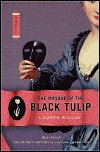
The Masque of the Black Tulip by Lauren Willig

Finding True Love Was Never So Dangerous

Two hundred years ago, secret documents so sensitive they could alter the course of history were stolen from a courier with the London War Office. A the scene of the crime, the victim was left with a curious note containing only a small black symbol pinned to his chest. Authorities were baffled. It took two centuries for a young American history student, Eloise Kelly, to uncover the missing pieces of the puzzle...

As Eloise reads from an old codebook, she discovers that the Black Tulip, the deadliest spy in Napoleon's arsenal, has returned to England with a terrifying mission. Only a pair of star-crossed lovers stand in the way of the Black Tulip. But will stopping the Black Tulip's secret mission cost them their lives or, even worse, their love?

This review was originally written in June 2006.

It's funny you know...when I was rereading what I wrote about Secret History, it struck me as quite ironic that I wrote that the back cover blurb wasn't really accurate for that book, as I have to say the same thing again. Reading the blurb above, it makes it seem as though the missing documents were a key part of the story, and that Eloise was the first person to discover the true identity of the Black Tulip...which isn't exactly the way the book pans out.

Our hero from the previous book (Lord Richard Selwick aka ThePurple Gentian) has had to retire from active spy service given that his cover was blown. That actually suits him as he is now settled into married bliss with Amy. He is, however, keeping his hand in by running a spy school from his home.

The Pink Carnation is still plying her trade in Paris, obtaining secret information and sending it home to England using a series of chatty letters to Lady Henrietta Selwick (sister of Lord Richard). What looks like gossip is in fact a complex series of codes that Henrietta then passes onto The War Office.

Miles Dorrington was a close personal friend of Richard (in fact has basically been a member of the family since he was a very young boy) and also employed at The War Office.

When the news comes through that there is a deadly new spy who has made their way to London, both Miles and Henrietta decide that they will track down the deadly Black Tulip.

There is a small problem though. All of a sudden they are both finding each other more and more attractive. Whilst Henrietta acknowledges her feelings, Miles is somewhat slower...very concerned about the fact that he is lusting after his best friend's sister, which apparently is just not done.

After both having numerous escapades and false leads, Miles and Henrietta both end up at a special spy weekend (the event is meant to appear as a house party) at her brother's home, where they are training their latest recruits, things don't quite go to plan. When it seems as though the Black Tulip has infiltrated the house, all of the potential spies are required to stay in the grounds of Selwick Hall, and in some ways, it is inevitable that Miles and Henrietta will be caught in a compromising situation.

There were times that I did just wish that Miles and Henrietta would just talk to each other, and things would have been a lot easier for them. As for Eloise, she spends the weekend at Selwick Hall, searching through the archives there for more evidence about The Pink Carnation and The Black Tulip, and the spy school that was convened there, but is she also succumbing to the charms of Colin Selwick? There's been no action on that stage yet, but it is building nicely!

Another fun, light read. The next book comes out later this year and has The Pink Carnation setting off for Ireland. I will definitely be getting hold of it when it comes out!

Rating 4/5


The books in this series in order are:

The Secret History of the Pink Carnation
The Masque of the Black Tulip
The Deception of the Emerald Ring
The Seduction of the Crimson Rose (out January 2008)