Wednesday, March 30, 2011

Snow Flower and the Secret Fan movie trailer

Welcome to a new feature here at Historical Tapestry - From Ink to Screen.

Really it's just a chance for us to post about movies that are coming out soon or we have already seen that are based on historical fiction novels.

First up, Snow Flower and the Secret Fan by Lisa See.

I love Lisa See's books so it was such a thrill to see that a movie is being made of her book. I have to say though, the trailer didn't really do a lot for me, particularly due to the introduction of a modern storyline. I will make an effort to watch it in the hope that it will capture some of the magic of the book.


What do you think of the trailer?

Thursday, March 24, 2011

Books of a Lifetime by Elizabeth K. Mahon

I was born a voracious reader. While other kids loved to play sports, I was happiest sitting under a tree with a book in my hand. The first book that I remember reading was Laura Ingalls Wilder's LITTLE HOUSE IN THE BIG WOODS. I had already worked my way through both of the first grade readers by the end of the first semester as well and Sister Mary Sharon was about to rip off her veil in despair. Fortunately she handed me LITTLE HOUSE.  I was entranced from the moment I saw the Garth Williams illustration on the front cover. Laura was six just like me, a little girl who lived a life so different from my own in this place I had never heard of called Wisconsin. I even made maple syrup candy just like Laura and Mary did in the book. I followed the Ingalls family as they moved from Wisconsin to Plum Creek to South Dakota, I cried when Mary lost her sight, winced as Laura struggled with her first teaching job. The courtship of Laura and Almanzo Wilder was my first romance. I felt so possessive of Laura that I couldn't bear to watch the TV series because they changed so much.

I think I was attracted to John Jake's THE BASTARD, the first book in the Kent Family Chronicles, because of the hot guy on the cover. I still can't believe that my parents didn't blink an eye when I walked up to the cash register with it. Phillipe Charboneau is the illegitimate son of an English nobleman. He travels all the way from France to claim his inheritance and is denied. To escape being murdered by his half-brother, he travels to London and then Boston, where he changes his name to Philip Kent. Along the way he meets the usual suspects, Benjamin Franklin, Sam Adams, has affairs, and participates in the Boston Tea Party. And that's just the first book! I devoured every single book in this series but the first two, THE BASTARD and THE REBEL hold a special place because they're set during the American Revolution, an under represented era in historical fiction as far as I'm concerned.

I devoured Susan Howatch's contemporary gothic novels (The Devil on Lammas Night is a particular favorite of mine) but when I read her first family saga PENMARRIC,  I was in 7th Heaven.  Mark Castallack sees his longed-for inheritance Penmarric, a gothic mansion on the bleak cliffs of Cornwall, and the mysterious, mesmerising Janna, he knows that he will make them his and nothing will stand in his way. Yet when Mark realizes his dreams, Penmarric only brings a legacy of conflict, jealousy, infidelity and betrayal. The novel spans the Victorian era to the Second World War.  Howatch based her characters Mark Castallack, and his bride Janna on Henry II and Eleanor of Aquitaine. This is the English cover for the reissue, isn't it gorgeous? Her next book CASHELMARA, set in 19th century Ireland is the story of an Anglo-English family which reinterprets the story of Edward II, Isabella and Piers Gaveston. I can still remember sitting in Algebra class during high school, with my book bag on my desk, trying surreptitiously to read a few pages.

Of course I read Anya Seton.  I loved all her books, but a particular favorite will always be THE MISTLETOE AND THE SWORD. My friend Jenny found it on a trip to England and loaned it to me. This was the book that introduced me to Boudica, Druids and Stonehenge. The novel is set in Britain circa A.D. 60. Quintus Tullius is a standard bearer with the Ninth Roman Legion, who have come to Britain as part of the empire’s efforts to pacify the rebellious tribes. But he is haunted by his quest for the bones of his grandfather, who died seventeen years before in “the place of the golden tree and the stony circle.”  Quintus ends up falling in love with Regan, the beautiful foster daughter of Boudica. I loved this book so much that I never gave it back to Jenny! The book wasn't available in the States so when I went to London I bought a copy at Foyles to give to her.


It was also my friend Jenny who introduced me to T.H. Whites THE ONCE AND FUTURE KING, starting my obsession with the Arthurian legend that continues to this day.  Well actually it had started with the movie version of the musical CAMELOT, but this was the first Arthurian novel I had ever read. Lancelot in White's imagination was not the hot French guy that you normally see in depictions of the legend, he was actually quite ugly but Guinevere loved him anyway. Marion Zimmer Bradley's THE MISTS OF AVALON, and Rosalind Miles Guinevere and Tristan and Isolde trilogy are books that are on my keeper shelf.


I can't forget the late great Eleanor Hibbert who wrote as Philippa Carr, Victoria Holt and Jean Plaidy.  I was tempted to include MY ENEMY THE QUEEN which is about the rivalry between Elizabeth I and her cousin Lettice Knollys (why hasn't this ever been made into a TV movie? Sienna Miller would be awesome as Lettice) but Philippa Carr's THE LION TRIUMPHANT, the second in her Daughters of England series is one of my favorites as well.  Picture it: Elizabethan England, a beautiful fiery-tempered heroine called Cat. meets the arrogant, lusty Captain Jake Penlyon. It is hate at first sight, Cat is already in love with her childhood friend Carey but they are forbidden to marry. Jake is beyond determined to marry her and blackmails her into agreeing to a betrothal. Of course she is kidnapped by a band of Spanish pirates. Cat is certain she has seen the last of Jake Pennlyon, but she is not one to give up. Not ever!!

___________________________________________
 
Elizabeth Kerri Mahon is a professional actress and amateur history geek. Her blog Scandalous Women (scandalouswoman.blogspot.com) was named one of the 50 Top History Blogs by Zen College Life. A native New Yorker, she still calls Manhattan home. Her book Scandalous Women: The Lives and Loves of History's Most Notorious Women was released March 1.
 

Wednesday, March 23, 2011

Coughing it up in Delhi - A Guest Post by Elle Newmark

Coughing it up in Delhi
By Elle Newmark

We visited a huge mosque where I was asked to don a long-sleeve cotton gown that went from neck to ankles. It was actually rather flattering to be asked to cover up my 60 something year-old body lest I inspire unbridled lust, but I also had to wash my feet and cover my head, which was less flattering.

Our twig-thin, barefoot guide in a diaper and turban, Gunga Khan, had a bright white smile, twinkling brown eyes, and a small white beard; he reminded me of a goat. He spoke no English, but he was a master of sign language, holding forth eloquently with hands and feet and facial gymnastics. He pointed and signed and grinned and gave me an approving thumbs-up whenever I understood something, which made me feel dumb and smart at the same time.

Gunga offered to take a picture of my husband and me, and he produced a photo-op-ready white skullcap, which he plunked on my husband’s head for the occasion. Gunga knew his way around a digital camera too, framing up the shot, checking the position of the sun, asking us to move slightly to the right, and encouraging our smiles with what was possibly his only English word: Cheese.

He showed us the beautiful marble mosque, explaining everything by pointing and miming and generally pissing off all the scowling, bearded Muslims who were there for serious worship. At the end, I turned in my modest chador, and put my shoes back on, and I gave Gunga a 500 rupee tip (about $10, which is three days wages for a laborer). Gunga took it with a big smile, eyed my wallet and motioned for more—the hand waving in a “Come on” gesture, the big, big smile. I was so surprised by his hutzpah (which I shouldn’t have been by then) I stupidly give him another 500—and still he wanted more! Astonished at his audacity, I laughingly refused and he laughingly walked away with a week’s wages. I bet he owes that mosque.

Later, I stopped to buy a slice of fresh coconut from a street vendor. He said, “One slice, 10 rupee. Three slice, 20 rupee.” When I said, “I’ll have one,” he looked disappointed, but handed it over wrapped in newspaper. I didn’t have change, so I gave him a 100 rupee note he gave me 80 back, then quickly handed me two more slices of coconut saying, “No charge.”

ELLE NEWMARK is the author of The Chef's Apprentice and the newly released The Sandalwood Tree. To learn more about her and her novels, visit her official blog.

Monday, March 21, 2011

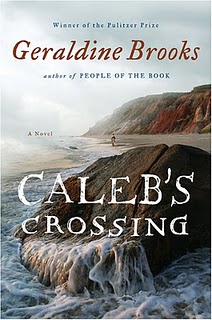
Upcoming Release: Caleb's Crossing by Geraldine Brooks

At the moment over at my blog (Adventures of an Intrepid Reader) I am giving away two galley copies of the upcoming release from Geraldine Brooks, Caleb's Crossing. Following is a Q and A from the author talking about her book! 

Q&A with Geraldine Brooks, author of
CALEB’S CROSSING

Caleb Cheeshahteamauk is an extraordinary figure in Native American history. How did you first discover him? What was involved in learning more about his life?

The Wampanoag Tribe of Gay Head/Aquinnah are proud custodians of their history, and it was in materials prepared by the Tribe that I first learned of its illustrious young scholar.   To find out more about him I talked with tribal members, read translations of early documents in the Wopanaak language, then delved into the archives of Harvard and the Massachusetts Bay Colony, especially the correspondence between colonial leaders and benefactors in England who donated substantial funds for the education and conversion to Christianity of Indians in the 17th century.   There are also writings by members of the Mayhew family, who were prominent missionaries and magistrates on the island, and John Cotton, Jr., who came here as a missionary and kept a detailed journal.

There is little documentation on Caleb’s actual life. What parts of his life did you imagine? Do you feel you know him better after writing this book, or is he still a mystery?

The facts about Caleb are sadly scant.  We know he was the son of a minor sachem from the part of the Vineyard now known as West Chop, and that he left the island to attend prep school, successfully completed the rigorous course of study at Harvard and was living with Thomas Danforth, a noted jurist and colonial leader, when disease claimed his life.  Everything else about him in my novel is imagined.  The real young man—what he thought and felt—remains an enigma.

Bethia Mayfield is truly a woman ahead of her time. If she were alive today, what would she be doing? What would her life be like with no restrictions?

There were more than a few 17th century women like Bethia, who thirsted for education and for a voice in a society that demanded their silence.  You can find some of them being dragged to the meeting house to confess their “sins” or defending their unconventional views in court.   If Bethia was alive today she would probably be president of Harvard or Brown, Princeton or UPenn.

The novel is told through Bethia’s point of view. What is the advantage to telling this story through her eyes? How would the book be different if Caleb were the narrator?

I wanted the novel to be about crossings between cultures.  So as Caleb is drawn into the English world, I wanted to create an English character who would be equally drawn to and compelled by his world.   I prefer to write with a female narrator when I can, and I wanted to explore issues of marginalization in gender as well as race.

Much of the book is set on Martha’s Vineyard, which is also your home. Did you already know about the island’s early history, or did you do additional research?

I was always intrigued by what brought English settlers to the island so early in the colonial period...they settled here in the 1640s.   Living on an island is inconvenient enough even today; what prompted the Mayhews and their followers to put seven miles of treacherous ocean currents between them and the other English—to choose to live in a tiny settlement surrounded by some three thousand Wampanoags?  The answer was unexpected and led me into a deeper exploration of island history

You bring Harvard College to life in vivid, often unpleasant detail. What surprised you most about this prestigious university’s beginnings?

For one thing, I hadn't been aware Harvard was founded so early.  The English had barely landed before they started building a college. And the Indian College—a substantial building—went up not long after, signifying an attitude of mind that alas did not prevail for very long.  It was fun to learn how very different early Harvard was from the well endowed institution of today.  Life was hand to mouth, all conversation was in Latin, the boys (only boys) were often quite young when they matriculated.   But the course of study was surprisingly broad and rigorous—a true exploration of liberal arts, languages, and literature that went far beyond my stereotype of what Puritans might have considered fit subjects for scholarship.

As with your previous books, you’ve managed to capture the voice of the period. You get the idiom, dialect, and cadence of the language of the day on paper. How did you do your research?

I find the best way to get a feel for language and period is to read first person accounts—journals, letters, court transcripts.  Eventually you start to hear voices in your head: patterns of speech, a different manner of thinking.  My son once said, Mom talks to ghosts.  And in a way I do.

May 2011, Tiffany Smalley will follow in Caleb’s footsteps and become only the second Vineyard Wampanoag to graduate from Harvard. Do you know if this will be celebrated?

In May Tiffany Smalley will become the first Vineyard Wampanoag since Caleb to receive an undergrad degree from Harvard College.  (Others have received advanced degrees from the university’s Kennedy school etc.)  I’m not sure what Harvard has decided to do at this year's commencement, but I am hoping they will use the occasion to honor Caleb’s fellow Wampanoag classmate, Joel Iacoomis, who completed the work for his degree but was murdered before he could attended the 1665 commencement ceremony.

Saturday, March 19, 2011

We have a winner!

Just a quick post to announce the winner of the awesome Elizabeth I handmade pocket mirror AND a signed copy of The Tudor Secret by CW Gortner, as pictured above!


Our winner is


An email is on it's way to Dizzy C, and assuming we have her details within 3 days her prize will be making it's way to her. Otherwise we will announce a further winner.

Thanks to CW Gortner for his generous prize, and to everyone who entered the contest or participated during British History week in any way.

Why I Love The Age of Victoria by Carol Carr

I’d rather read about the past than the present.  I saw a t-shirt the other day that perfectly reflects my attitude.  “History buff,” it read, “I’d be more interested in you if you were dead.”  One of my interests is the England of Victoria, specifically the period from 1870 to the turn of the century.  It’s difficult for me to remember when I became fascinated with this era, but I can at least explain why:  we are very much like the Victorians, so much so that I feel right at home with them. 

During the Victorian period, the world enjoyed the benefits of Pax Britannica (“British Peace”).  I don’t say that with any sarcasm; I think it’s a fairly accepted view in the world of international relations that the world benefits when a strong country or group of countries cooperate to keep sea lanes open and local despots on their toes.  We’re living in the age of Pax Americana now, though how long that will last is anyone’s guess.  The Victorians certainly had more experience acting as the world’s policeman; we Americans really didn’t get into the business until the Cold War.  Countries choose to play this role, and it often leads to attacks upon their motives and methods (some of which are merited).  Great Britain ruled the waves during the Victorian era, much as the United States is the pre-eminent military power today.  The Victorians fought numerous wars to protect their interests in far-flung areas of the world, including the Middle East and Afghanistan.  Sounds familiar doesn’t it?  It’s really quite instructive to read about the issues the Victorians encountered playing this role, and those that confront America.

The Victorians were an oddly divided society, just as we are.  On the one hand, there was great faith in the notion that scientific progress and the application of reason would solve social problems.  On the other, many Victorians were deeply religious and committed to good works, including actively supporting or staffing overseas missions.  America seems to share that division of ideas, adopting a secular, social science approach to tackling issues of poverty and education, while maintaining a strong tradition of religious belief and service to the needy.  I once heard a specialist in foreign policy say that one of the least understood means of transmitting American views was the missionary work of evangelical churches overseas.   I’m not debating the merits of these views, merely pointing out how similar our society is in some ways to that of the Victorians.

Victorian Britain and America today share something else:  a belief that our societies are unique, endowed with the best forms of government, a deep respect for individual human rights, and strong civil societies and legal systems.  Both societies share a belief that the rest of the world would benefit if they adopted our practices and customs.  This isn’t an academic study of the similarities between two societies.  No doubt there are plenty of examples illustrating the differences between Victorian England and present-day America.  However, I’ve found the resemblance strong enough to provoke some thoughtful examination.  Digging into the past is a fascinating way to understand our present.

After a career as a lawyer and corporate executive, Carol K. Carr turned to writing. India Black is her firstg book. She lives in the Missouri Ozarks with her husband and two German Shepherds.

To learn more about Carol and India Black, visit Carol K. Carr.

Friday, March 18, 2011

Why I think the Plantagenets Trump the Tudors by Anne Easter Smith

A bit of background before we get to the post proper! A few days ago, C W Gortner posted for us on Why We Love the Tudors. On Facebook, Anne Easter Smith mentioned that she would like to offer up an alternate view! Of course, having loved her first book, and having a really soft spot for the Plantagenets myself, I wasn't going to say no!


~~~~~~~


Aren’t we sick of the Tudors yet? Of course, when I say that I run the risk of offending many readers and author colleagues, including my friend C.W. Gortner! But, let’s face it, how many versions of Henry VIII and his wives, beheadings and burning of the monasteries, or the Virgin Queen’s penchant for handsome young earls, naval heroes and white powder does it take to say “Enough, already!” I know I said it long before Philippa Gregory saw the error of her ways. Much to my dismay, she cast her eye upon the 15th century Plantagenets, whose crown the first Tudor king snatched from Richard III’s head, and when she got a contract to write about a series about “my” characters, including Queen Elizabeth Woodville, Margaret Beaufort and Jacquetta of Bedford, I found myself whingeing: “What a cheek, she’s coming into my period.” When I complained to our mutual editor at Simon & Schuster, Trish Todd, she wisely admoninshed me: “A rising tide floats all boats, Anne. If Philippa’s readers fall in love with your period through her, they’ll find your books, too.” So, thank you Philippa for joining our 15th century ranks: Sandra Worth, Vanora Bennett, Susan Higginbotham take heart!

From the political machinations that made up Henry II’s reign (the first Plantagenet) and his life with his always readable Eleanor of Aquitaine (see Sharon Kay Penman’s masterful Time and Chance), to Edward II, whose fling with Piers Gaveston almost brought down the monarchy and did cause his untimely and rather grisly end (Susan Higgingbotham’s The Traitor’s Wife), and Edward III whose mistress, Alice Perrers, has been the subject of many a novel (Emma Campion’s comes to mind), and on to flamboyant Richard II, who almost went the same way as his ancestor Ted II, and not forgetting Harry V of Agincourt fame, and on to Richard III who did not murder those adorable little nephews in the Tower (IMHO--see my A Rose for the Crown), the Plantagenets have given us 330 years of fascinating stuff to write and read about. The Tudors? A paltry 118 (and really only 100, because who wants to read about boring Henry VII?)

When I set out to tell Richard III’s story, I thought it would be my one and only book, but once I began researching the Wars of the Roses (the cousins’ war between Lancaster and York, two branches of the Plantagenet family who each thought their claim to the throne better), I became totally engrossed in the period and knew I could not resist telling the whole of the York story once I got started.

My fourth book, which I hope you will consider, is Queen By Right and takes us back to the end of the Hundred Years War (don’t ask!) and right into the Wars of the Roses. Cecily Neville married Richard, duke of York, and bore thirteen children--two of whom became king: Edward IV and Richard III; and a daughter, Margaret, who became the most powerful woman in Europe at the time when she married the duke of Burgundy. One of the most compelling episodes in Cecily’s long life (she lived three weeks past her 80th birthday) was the trial and execution of Joan of Arc. Richard and Cecily of York were in Rouen with King Henry VI’s entourage during the four-month trial. It is probable that Cecily was one of the noble ladies present in the Old Market Place of the Norman capital on May 30, 1431, when Joan was burned at the stake. As the two women were housed in the same castle during the ordeal, I could not resist having them meet briefly. A little dramatic licence is allowed in fiction, isn’t it?

And we must not forget one of the most intriguing of all the Plantagenets: Richard the Lionheart, Henry II and Eleanor’s crusading son, and the subject of Sharon Penman’s next book. I can’t wait!

Have I convinced you to discover a world other than the Tudors’? I do hope so. Try the powerful, passionate world of the Plantagenets for a change; you won’t be sorry.

Anne Easter Smith is the author of four books about the York family during the Wars of the Roses. She is a native of England but makes her home in Newburyport, MA. She is proud to be the aunt of Nick Easter, No. 8 on the England rugby team.

Thursday, March 17, 2011

Chelsea Quinn Yarbro on Why I Love Writing About Women in History


Like many young women, when I became interested in history — I was in third grade as I recall, and it was 1950 — I found it very frustrating: it really was his story the various books in our school library told. There were a few exceptions, such as Joan of Arc and Elizabeth I, but they were just that, exceptions; women in men’s jobs, doing their work among men, leading lives dramatically unlike the lives ordinary women led. So I took it upon my young self to find out more about women in history, a task that continues to this day. And since I was born hard-wired to be a writer, what I find out from studies ends up being written about.

In the 1960s there was the first flurry of books about everyday life in history, and I seized upon them with enthusiasm. By then I was writing short stories, often with women as main characters, though most of the stories were science fiction, fantasy, and mystery, not historical horror; that came along in 1971, when I began work on Hotel Transylvania, and which I kept at sporadically until 1975, when I sent the first half of it to my agent, and he set about selling it.

As I have discussed elsewhere, I had three goals with proposed five novels — one, to push the vampire as far to the positive and still have a recognizable vampire; two, to give some sense of what it was like to live in the setting of the story (to me, setting functions as a tertiary character in any story); and three, to emphasize the lives of women in the times the stories take place. Once I got the hang of the vampire question, it was simply a matter of research to take care of points two and three and I was in business. Luckily, I enjoy research.

For the latter half of the 1970s, I kept looking around for interesting places and times to set the Saint-Germain stories. I kept them in accord with the claims the actual man made as to where he had been and those he had known. In a couple of instances, this turned out to be more daunting than I had anticipated. Path of the Eclipse was a chore to research, but I was fortunate to find an associate who was selling off a portion of his library, which included some fifty books on China during the Mongol invasions, as well as books on foreign trade in that period. I bought them and set to reading them avidly. Finding information on India was a bit trickier, since regionalism was distinct and strong there. By inventing a small kingdom, I was able to select elements from several Indian cultures and make it possible to have a female heir to the throne, which forms the last third of the book. The hardest part of that book was the part set in Tibet: there turned out to be almost no information about the ordinary people, but a little about the lamaseries, so I opted for that setting by default.

In the seven years between the short story collection, The Saint-German Chronicles, and beginning the three Olivia novels, I continued to write about women as main characters in contemporary settings as well as historical ones. The historical fantasy To the High Redoubt was one of the books that came out of that time; it features an unlikely pair of main characters — a disgraced Polish soldier and a blind Tantric adept — and is as much about their efforts to understand one another as about the external trials they face. That was a yummy book to write, and balancing the solider against the adept was an engrossing experience for me. Another non-Saint-Germain historical horror novel that came out of that period is one of my favorites: A Mortal Glamour. The bulk of the action takes place in a convent in southern France in the latter part of the fourteenth century. Those nuns who have survived the three Black Plague epidemics and constitute the majority of the characters are in pretty rough emotional shape, and are constrained not only by religion but by the Medieval mind-set that personal change is the result of intervention in the life by God or Satan. Into this hothouse setting comes an incubus/succubus demon. This one wasn’t yummy to write, it was creepy, just as it should be. I loved all the characters, including the villains, as I do all my characters.

When I returned to Saint-Germain in the Madelaine de Montalia book, Out of the House of Life, although the story is hers, there are extensive footnotes in the form of letters from Saint-Germain that tell of his experiences in Pharaohnic Egypt for the eight hundred years he lived there. When I turned the book in, I told my editor that if I ever proposed to take on eight hundred years of a dead civilization again, to shoot me. Not that I didn’t find it fascinating, but there was so much of it, and so many conflicting opinions among many Egyptologists, that finding a way through the experience was truly amazing. One of the strengths of that book, at least from my point of view, was the contrast that the nineteenth century Madelaine provided to the various women of ancient Egypt with whom Saint-Germain interacts. I wish I had had another fifty thousand words to expand the ancient Egyptian portions of the book, but that was discouraged by Tor, and since I wanted to sell them more books, I kept the length down.

Almost all the women in the now-twenty-five-books-long series are outsiders, women who are unable or unwilling to lead the lives most women do, and because of that, are inclined to accept the intimacy Saint-Germain offers them. Randegonda in Better in the Dark and Tulsi Kil in A Feast in Exile come to mind as being at the extreme of those living beyond the usual women’s lives of the cultures. Rowena Saxon, in Writ in Blood and Midnight Harvest is a woman who has turned away from the comfortable world of privilege for the less certain but more rewarding life as an artist. In An Embarrassment of Riches, there are three women of Konige Kunigunde’s Court, each of whom handles her situation in accordance with her character and her culture.

It is always exciting to discover new characters and to coax their stories out of them, often including revelations about the time in which they exist. This often sets me hastening to my history books in pursuit of those telling details that bring a period and culture to life. I find that taking on someone with another way of understanding her/his own experience is one of the most enjoyable parts of this strange thing I do for a living. Having embraced feminism at an early age, I’ve found writing about women in history illuminating in many ways, and I expect that to continue as an intrinsic part of my story-telling. Oh, and one last thing: the Saint-Germain, Olivia, and Madelaine books are called historical horror novels not because vampires are horrifying, but because so much of history is.

Tuesday, March 15, 2011

British History Week: Helen Hollick on British History

Why is British History so fascinating to authors and readers" perhaps with a general answer to the question and then more specifically their particular area of interest.

I think the fascination with history is because it is a part of us – each and every one of us has a link to the past through our ancestors. That link goes back, and back and back to the first humans - to Mitochondrial Eve, the first known DNA mother who’s daughters eventually walked out of what is now Africa. The maternal line of DNA is a single unbroken thread for every woman, passing from mother to daughter to mother through thousands of generations.

The DNA that controls breathing and the lungs has barely changed in all those years – so I am breathing virtually the same as my grandmother did back in the year 1066 – and I know I had a grandmother who lived then because I am here now to prove it!

What she did, who she was, where she lived, I have no knowing. Except she had a daughter….. who had a daughter….

I often wonder what draws people to specific periods, though. I have no interest whatsoever in the Tudor or Victorian period, yet my daughter is fascinated by Elizabeth I. My interest is Roman and Anglo Saxon Britain, and seafaring history, especially the early 1700’s.

I think events of the past leave their echo, a sort of energy, that we can still feel – like warmth clings to a sandy beach or to a stone wall. I also think our memories are passed down along with our DNA – how else to explain instinct (how do we, and animals, know to suck milk, to get up and walk?)

For I Am The Chosen King (Harold the King is its UK title) I needed to write something after I had finished my Pendragon’s Banner Trilogy – I chose to write King Harold II’s story because he is a local “hero” to where I live. As Earl of Essex he founded the Abbey at Waltham Abbey a fifteen minute drive from my home, and his common law wife, Edith Swanneck lived a few miles further at Nazeing. He would have ridden and hunted in Epping Forest, where I used to ride, but now walk my dog nearly every day. He would have sailed up the River Lea, where I also walk. Strolling along the riverside path on a tranquil evening it is so easy to imagine a Longship coming upriver….

It was rather nice researching about a man who possibly walked in the same places as I could walk!

I am also interested in writing historical novels along the lines of “what might have really happened”. I was sick and tired of British History in the majority of history books starting at 1066 with the “glorious” Norman Conquest, the general belief that William had the right to be King, and that Harold was a useless commander – all Norman propaganda.

I decided to write about Harold and the Battle of Hastings from the English point of view because I thought it was about time that something nearer the truth was told.

Helen Hollick's latest book I am the Chosen King has just been released in the US by Sourcebooks. It was previously published in the UK under the title Harold the King

Monday, March 14, 2011

British History Week: Elizabeth Chadwick on British History

Many thanks to Marg at Historical Tapestry for inviting me to the blog and asking me this interesting question:

“Why is British History so fascinating to authors and readers? With a general answer to the question and then more specifically Elizabeth’s particular area of interest.”


British history does seem to feature largely in lists of historical fiction outside of the UK, especially in the USA and Australia doesn’t it? Of late there has been a widening out of the road, but it is still incredibly popular.

I think there are several reasons for this. A few hundred years ago, Britain was expanding and developing an empire, and British cultural influences were felt all round the world, much as American ones are today. Both wars and peaceful settlement established colonies of people with British roots around the globe. Even if those colonies broke away, the groundwork was still there, and in some cases it is only recently that such ties have loosened or disconnected. To the Brits themselves, their ‘glorious’ history was taught, fostered and remembered at home, so that it became a thing of pride to be celebrated.

Many British settlers in the USA and Australia had a need to follow their family trees back to their roots to learn about where they came from. The ‘glorious’ history was theirs too, with all its ancient and fascinating stories. American and Australian settler history is still young in comparison to European which is the home soil of the family trees, so it fosters a natural curiosity, and a desire to maintain those roots. Most people want to know about their ancestors and the way they lived, and most people love absorbing stories.

With this deep seated interest in the past and with a natural slant towards Britain, story tellers were always bound to mine that part of history for inspiration and they had an eager audience waiting to listen, to read and later to watch. The Victorians had become deeply and romantically interested in the past and authors such as Walter Scott and novels such as Ivanhoe, were eagerly received and devoured. The pre-Raphaelites were busy producing their romantic jewel-like visions of the past, and wherever the Empire builders went, they carried the words and images of British history with them.

Into the 20th century, British history made a prolific hunting ground for the film industry. We had Robin Hood, Henry VIII, Elizabeth I and they were all fascinating subjects to make films around. Later there were TV series’ too, and here English social life and the country house set made its mark. Jane Austen became an international name. Charlotte Bronte’s Jane Eyre has always been a favourite round the world in book and film. They’re not historical novels in the sense that the authors wrote them about the times in which they lived, but they are historical to us now and with their delicate green and pastoral settings, or windswept moors, they evoke particular images of Britain that have become dear to readers’ hearts. Other British historical series that made their mark round the world included the adaptations of Winston Graham’s Poldark novels and Upstairs Downstairs. British TV has a particular skill in these adaptations and they make readers want to find out more about the period, or dwell in Britain in their minds, a while longer. With this strong background, it has been easy too for the new wave of TV adaptations to come out of America and take on the world by putting a very modern gloss on top of the history and reinvent it sexily - The Tudors for example. It’s historical soap opera writ large and Henry VIII and his 6 wives, already well known in history and legend, have hit super status and increased the wattage of the lamp shining on British history.

I don’t believe that British history is any more fascinating than anyone else’s, even though there are so many fantastic tales. It’s just that it was in a position to garner exposure during the years when reading had become the norm and the world was opening up. Film and TV were a natural progression that fed back into the reading and the interest in the history.

My own interest stems from having been born and raised in Britain (we moved around the country in my formative years before settling in Nottingham, central to the tales of Robin Hood) and from birth having imbibed a rich nourishment of historical tradition. Having said that, I was more interested in ancient Greece and Egypt as a child – because of the fantasy elements of the gods, and the gruesome fascination that most children have for mummies. My pattern of strong interest in the details of my own country came from reading up on the Angevin kings when I was writing my first novel – which had been inspired by a French TV series set in the Holy Land. I started to read about Henry II, Richard and John – the whole Angevin bunch really – and became hooked. As a reader, not a writer, I had also had a flirtation with the Regency period due to the novels of Jane Aiken Hodge.

The bottom line is that I believe past cultural events have conditioned many readers to particularly associate with British history, and that the present continues to mine it by building on foundations laid down by a couple of centuries of media exposure, and those foundations are built on the soil that contains a fertile tangle of roots and imagination. It’s a powerful starting point with a very long reach.

Elizabeth Chadwick has recently been awarded the RNA Historical Novel Prize for To Defy a King in the UK. This book is now available to US readers, having recently been released by Sourcebooks. To see what we here at Historical Tapestry thought of To Defy a King, check out our conversation about the book. (In summary, we loved it!)

Sunday, March 13, 2011

Why We Love the Tudors by C W Gortner

Today we welcome author CW Gortner to talk about why we love the Tudors!

~~~~~~~~~~~~~

It’s been more than four hundred years since Elizabeth I’s death, yet for many of us she—and the rest of her dysfunctional, electrifying family—remain as fascinating as ever. Compare this, with, say, the ten minutes of rapt attention we’d allocate to the latest antic by the latest film actor in need of rehab and you can see that Elizabeth and her clan have lasting star power.

But, why? Why are we so fascinated by them? What is about their drama and upheaval that so entrance us? While impossible to pinpoint for certain, or even to generalize, it’s safe to assume that our obsession with the Tudors reflects the fact that they were, to a certain extent, the 16th century’s equivalent of our modern-day celebrities— physically beautiful; wealthy and powerful, jettisoning from palace to palace, bedecked in jewels and velvet, they strode across the stage of their Renaissance world wreaking havoc in their wake, enthralling, repelling, and entertaining their contemporary audience much as they entertain us today, hundreds of years later.

Few dynasties boast such larger-than-life characters: Henry VII, parsimonious, sour-faced patriarch of the clan, who leapt out of exile to literally snatch the crown from the last Plantagenet king’s head; his golden heir, Henry VIII, the Adonis of his age, who transformed into a grotesque parody of himself and killed two of his six wives, or three, if you count the one whose heart he broke; and his children, tight-lipped and short-lived Edward VI; the Catholic fire-brand, Mary, whose reign of terror earned her the sobriquet of ‘Bloody’; and finally, the enigmatic Elizabeth, whose triumphant accession after years of danger ushered in an era of unparalleled glory, when Shakespeare composed his famous verses and England became a beacon of refuge for those fleeing religious excesses.

And it is Elizabeth, of all of them, who most intrigues. We who live in an era bombarded by commercialized sexual innuendo find it almost impossible to believe that anyone save a nun could live without carnal intimacy yet Elizabeth claimed lifelong virginity. Paradoxically, she surrounded herself with exquisite men who went bankrupt vying for her affections;  not given to female confidences, she terrorized her ladies; she dressed to impress and evaded years of intrigue against her person— she was glamorous, intelligent, and contrary, the perfect amalgam of her father’s might and her mother’s allure. She was, in many ways, the Angelina Jolie of her age: the most coveted and idealized icon of her time. Captured in a hundred portraits from every angle, usually looking far less realistic than a fantasy, styled for our imagination, Elizabeth epitomizes our enduring fascination with the Tudors. She stares at us through those narrow sloe eyes from her confection of pearls and platter-sized ruff and cornucopia wig, and she dares us to pigeonhole her, to reduce her with the banal ease of our modern age. She is the past that evades and entices; she is the muse of our most romantic flights.

This is why we love her and why we love the Tudors. Because despite our culture of facile celebrity, or perhaps because of it, England’s most famous family has earned its time-honored distinction. Luminaries across centuries, they remind us in their own inimitable ways that while movie stars and reality-TV may come or go, kings and queens live forever.  

CW Gortner is the author of The Last Queen and The Confessions of Catherine de Medici. His latest release is a historical mystery set in the court of Elizabeth I, The Tudor Secret, the first book in the Elizabeth I Spymaster Chronicles. The Tudor Secret is available  

Don't forget that we are currently giving away a signed, personalised copy of this book along with a gorgeous Elizabeth I hand mirror. For all the details see our giveaway post here.

Friday, March 11, 2011

HT News: Free Ebook downloads

Did you know that this week was Read an e-book week? To celebrate, Sourcebooks has a number of books that are available for free to download from major online stores including Amazon, Kobo, Books on Board etc and from Sourcebooks own store.

Of those books, a couple are historical (both fiction and non-fiction) including the following books:


The Highest Stakes by Emery Lee

WHAT WOULD YOU WAGER FOR LOVE???
In the high stakes gentleman's world of 18th century horseracing, when the blood of the "desert kings" ruled the English turf, a hero returns from war to claim the girl he has loved since he first spied her riding hell-for-leather over the Doncaster heath. Determined to have her at any cost, he will risk everything.
       

A story of star-crossed lovers and horseracing, THE HIGHEST STAKES transports the reader to 18th century England, an era infamous for corruption, arranged marriages, and high stakes gambling; when racing and breeding became the obsession of the uppermost elite, and a match race might replace a duel in settling a point of honor.
       
Through the fictional love story of Robert Devington and Charlottte Wallace, a tale of drama, danger, thwarted love, and retribution unfurles...

The Immigrants by Howard Fast

In this sweeping journey of love and fortune, master storyteller Howard Fast recounts the rise and fall of a family of roughneck immigrants determined to make their way in America at the turn of the century. Quick to ascend from the tragic depths of the 1906 San Francisco earthquake, Dan Lavette becomes the head of a powerful shipping empire and establishes himself among the city's cultural elite. But when he finds himself caught in a loveless marriage to the daughter of San Francisco's richest family, a scandalous love affair threatens to destroy the empire Dan has built for himself.
The first of a compelling family saga, The Immigrants is a fast-paced, emotional novel that captures the wide range of relationships among immigrant families during the tumultuous events that defined the early twentieth century in America.


 Best Little Stories from the Civil War

The Civil WAR You Never Knew...
Behind the bloody battles, strategic marches, and decorated generals lie more than 100 intensely personal, true stories you haven't heard before. In Best Little Stories from the Civil War, soldiers describe their first experiences in battle, women observe the advances and retreats of armies, spies recount their methods, and leaders reveal the reasoning behind many of their public actions. Fascinating characters come to life, including:

Former U.S. Senator Robert Toombs of Georgia, who warned the Confederate cabinet not to fall for Lincoln's trap by firing on reinforcements, thereby allowing Lincoln to claim the South had fired the first shots of the war at Fort Sumter.

Brig. Gen. Stephen A. Hurlbut, who disbanded the 13th Independent Battery, Ohio Light Artillery, scattered its men, gave its guns to other units, and ordered its officers home, accusing all of cowardly performance in battle.

Thomas N. Conrad, a Confederate spy operating in Washington, who warned Richmond of both the looming Federal Peninsula campaign in the spring of 1863 and the attack at Fredericksburg later that year.

Private Franklin Thomson of Michigan, born as Sarah Emma Edmonds, who fought in uniform for the Union during the war and later was the only female member of the postwar Union Grand Army of the Republic.

Why I Love Bess Blount by Diane Haeger

Historical Tapestry would like to welcome Diane Haegar, author of The Queens Rival.  Without further ado, may we present Diane Haeger:

Delving into the lives of fabulous, powerful and complicated women from history— learning about what made them magnificent, and in some cases what brought about their downfall, then being able to bring those stories to life again... what’s not to love about a job like that? At the moment, what I love the most is the story of Bess Blount. Bringing her story to a new audience in my novel, The Queen’s Rival has been as fun and challenging as it has been inspiring to me personally.

The mother of Henry VIII’s only acknowledged natural son, I found Bess to be so much more than the simple footnote in the history books where she is most often found. And after all, she must have had something pretty extraordinary to have made Henry VIII honor her, and their son, as he did— even for a brief time, contemplate choosing her over Anne Boleyn.

Looking beyond that usually small historical footnote, her story might still seem only a simple coming-of-age tale— one of an idealistic young woman who is won over, and forever changed, by a handsome and very powerful married man who she knows will break her heart, yet one whom she is powerless to resist. But on a deeper level, as I began to write The Queen’s Mistake, and get to know Bess, I found I was dealing with far more complex themes– ones that I think are relevant even by today’s standards: a woman processing the heartbreak of her own lost innocence, and then actually surviving the greatest sacrifice, that of a mother for her child. What could change a woman’s perspective and her heart more than having to surrender her child? As a mother myself, that was the most complicated and emotional part of her life to tell– and trying to do it without getting mired in the tragedy but to fully show her triumphs as well, was a challenge. To me, Bess is the embodiment of an historical author’s dream character: beautiful, complicated, a bit naive in the beginning then— emboldened by heartbreak– ultimately triumphant.

I love Bess Blount also because I believe there is a little of her in all of us.

As Bess was, we women are sometimes faced with monumental choices. Like Bess, we can be wounded by them. Also like Bess Blount, we sometimes cannot help who we love, consequences be damned. But even through the worst chapters of our lives, with determination, we survive, and sometimes even thrive the low points— a little scarred perhaps, battle-weary certainly, but hopefully ultimately, triumphantly, as Bess did. In her story, her attraction to a young, handsome and charming Henry VIII put her on a path that might well have changed the course of English history. It was certainly my goal, and my passion, to show all of that to readers in The Queen’s Rival. No small task.

While Bess is my current love, she was certainly not my first.

My absolute passion for writing about these wonderfully rich characters, began many years (and twelve novels) ago with a very different woman, one who changed the direction of my own life. Quite by accident, I discovered the story of the bold and captivating French mistress of Henri II, Diane de Poitiers hidden in a magazine article about several famous mistresses. I remember thinking to myself, “She is being portrayed in very simple terms as a vixen, but that’s not how she strikes me at all. She certainly had to be far more complex than that.” Two weeks later, literally, I was off to France to learn about her, and I never looked back.

Four years after that, the wonderful adventure I had with Diane and Henri became my first novel, Courtesan. Prior to a few moments with that random magazine article, I was on an entirely different career path, half way through a doctoral program in clinical psychology. I had no idea at all back then that sharing those sorts of stories would one day become not only a vocation but my true passion, and that I would be able to use my clinical experience to flesh out what really made these women tick beneath all of that velvet and silk. I still wonder sometimes if I had not pondered over the way that article had portrayed a woman from history of whom I had never heard, how different my life might be today. Now Bess Blount has done for me what Diane de Poitiers did long ago. This legendary woman swept me up, took me off on an incredible journey to learn about her, and has yet to let go of my heart. Those are all the reasons I love Bess Blount, and I hope readers will agree.

Book Description of The Queen's Rival:

From the author of The Queen's Mistake comes the untold story of King Henry VIII's first well-known mistress.

As the beautiful daughter of courtiers, Elizabeth "Bessie" Blount is overjoyed when she secures a position as maid of honor to Katherine of Aragon. But when she captures the attention of the king himself, there are whispers that the queen ought to be worried for her throne.

When Bess gives birth to a healthy son the whispers become a roar. But soon the infamous Boleyn girls come to court and Henry's love for her begins to fade. Now, Bess must turn to her trusted friend, the illegitimate son of Cardinal Wolsey, to help her move beyond life as the queen's rival...


Diane Haeger is the author of four previous historical novels, including The Ruby Ring and My Dearest Cecilia. She lives in California with her husband and family.

Thursday, March 10, 2011

The Swan Maiden by Jules Watson

Today I was supposed to be reviewing The Raven Queen by Jules Watson as part of a blog tour for that book, but due to the vagaries of the postal system, I haven't actually received the book yet. That left me scratching my head wondering what I should post instead. A quick look at all the half written reviews I have sitting in draft (and yes, there are a lot of them) revealed that I had a review of Jules Watson's previous book that was oh so close to finished, and so I have done the tidying up of what I had written previously and I am posting that instead. I don't know why I didn't finish the review earlier, especially seeing it was one of the few books I rated as 5/5 reads in the year I read it.

It was fair to say though that I already knew I was a fan of Jules Watson after reading her Dalriaida trilogy, which is set in Roman Britain, and features a warrior princess, battles against the Roman invaders, a handsome Irish prince and much more. I have reviewed all three of the books in the trilogy. The first is The White Mare, the second book was called The Dawn Stag and the third book in the trilogy was published in some places as The Boar Stone with an alternative title of Song of the North. Click on the links to read my reviews of the trilogy.

Jules Watson is an Australia author who had been living in Scotland, but has now moved to the US. For more information about Jules, check out this interview we did with her at Historical Tapestry, and also at other stops around her blog tour for The Raven Queen. You can find all the stops here.

I will definitely be reading and reviewing The Raven Queen as soon as I can.


In this lush, romantic retelling of one of the most enduring Irish legends, acclaimed Celtic historical author Jules Watson reignites the tale of Deirdre—the Irish Helen of Troy—in a story that is at once magical, beautiful, and tragic.

She was born with a blessing and a curse: that she would grow into a woman of extraordinary beauty—and bring ruin to the kingdom of Ulster and its ruler, the wily Conor. Ignoring the pleadings of his druid to expel the infant, King Conor secrets the girl child with a poor couple in his province, where no man can covet her. There, under the tutelage of a shamaness, Deirdre comes of age in nature and magic…. And in the season of her awakening, the king is inexorably drawn to her impossible beauty.

But for Deirdre, her fate as a man’s possession is worse than death. And soon the green-eyed girl, at home in waterfall and woods, finds herself at the side of three rebellious young warriors. Among them is the handsome Naisi. His heart charged with bitterness toward the aging king, and growing in love for the defiant girl, Naisi will lead Deirdre far from Ulster—and into a war of wits, swords, and spirit that will take a lifetime to wage.

Brimming with life and its lusts, here is a soaring tale of enchantment and eternal passions—and of a woman who became legend.

I have read and enjoyed Jules Watson's Dalriada trilogy,and so was very much looking forward to reading this book when it came out and I haven't been disappointed!

A retelling of the Celtic tale of Deidre, this tells the story of a young woman who has been separate from society, being specifically raised to be the wife of a king (Conor) and with a strong mystical focus, but she has other ideas and so flees with the assistance and protection of rebel warriors Naisi and his two brothers. As the group struggle to find their place in the world, they can't seem to escape what seems to be their fate especially when it seems it is only a matter of time before Conor finds them.

Where Deidre was not interested at all in Conor, she finds herself attracted to Naisi. I thought the build up in the tension between Deidre and Naisi was great and there was definitely a lot of chemistry between the two of them. The balance between the relationship, the various mystical elements and the story was really well done. These mystical elements were a feature of Watson's earlier books, and I hope that this is something that she continues to explore in her next books.

There are a few signs that make it obvious to me when I am really enjoying a book apart from the feelings it invokes in me as I am reading it. One is when I break my no reading books at lunch time at work, and another is when I am prompted to Google things like locations, or as it was with this book, to find out more about the Irish myths about Deidre which this novel was based on, and both of these things happened with this book,

I was completely immersed in the world that Watson has created, and with the characters. There were a couple of times maybe where the book dragged a little, but by the end of the book I closed the book with a huge sigh of satisfaction.

Cross posted at The Adventures of an Intrepid Reader

Wednesday, March 9, 2011

Announcing British History week!

We are pleased to announce that this week is British History week here at Historical Tapestry. Now given the amount of books out that are set in Britain, in theory you could have a special feature for months and months and months, and still not run out of material, so we thought we would ask some of our favourite authors to answer one question...

What is it about British History that continues to make it so fascinating to authors and readers?

During this week we will have guest posts from Helen Hollick and Elizabeth Chadwick looking at this question from the perspective of British authors, and also we are very pleased to have a post from CW Gortner offering an international perspective on this question, specifically in relation to the Tudors. And that's not all! You too can be involved!

If you have an opinion you would like to share, then please contact us and we can put together some short grabs on whatever it is that fascinates readers later in the week. Just a few sentences along with your blog details will be all we need to be able to share your opinions!

To round out the week, I will also be talking about Jules Watson, who has written books set in Roman Britain, and we will have a guest post from Diane Haegar who is going to tell us why she loves the Bessie Blount.

What's a theme week without a giveaway? Thanks to CW Gortner we have an awesome giveaway!

Etsy store
One lucky reader will win a signed, personalised copy of  The Tudor Secret by CW Gortner, and there will also be an awesome handmade Elizabeth I pocket mirror. To quote CW when he was describing it to me "it's a mirror with the portrait of Princess Elizabeth in the red dress on one side, with a velvet carrying bag. Very pretty and unique, handcrafted in the US."

Please check out the Etsy store that I have linked to under the mirror's image, as they have lots of other gorgeous products that might interest you!

Giveaway rules

- the contest is open to the US/Australia/New Zealand/Europe

- leave a comment and don't forget to include your email address

- one entry per household

- closes March 18 at Midnight GMT

Why I Love the Borgias by Sarah Bower

Today we are pleased to welcome British author Sarah Bower who is currently on a blog tour promoting her book The Sins of the Borgias. This book was previously released in the UK as The Book Of Love, which is an interesting change of title. This is her second novel following The Needle in the Blood.

My love affair with the Borgias goes back a long way, to reading Jean Plaidy’s Madonna of the Seven Hills and Light on Lucrezia in my early teens. It won’t surprise you that a fourteen year old girl fell for Cesare Borgia first – handsome, brilliant and clearly in need of taming by a good woman – a perfect foil for a somewhat solitary and dreamy teenager. He’s the reason why, once I’d finished the Jean Plaidy series, rather than going on to more of her wonderfully entertaining fiction, I set out to read The Prince, for whose lucid and hard-nosed exposition of real politik Cesare was the inspiration, and Rafael Sabatini’s romantic hagiography of the man, written at a time when Cesare was enjoying a brief moment in the sun as a ‘hero’ of the Italian Risorgimento. In the space between the two is a fascinating, enigmatic and contradictory human being, who fought bulls but adored his horses, deserted his wife but was devoted to his mother and sister, wrecked swathes of central Italy and then employed Leonardo da Vinci to plan the rebuilding.

Through Cesare, I got to know the rest of his extraordinary family. As well as giving us the legend of the murderous adulteress, Lucrezia, who inspired Victor Hugo’s play and Donizetti’s opera, the Borgias (or Borjas, as they were known in their native Catalonia) gave us two Popes and a saint, a convicted murderer and the man who built the famous Villa d’Este and its garden. This contrast exists best in microcosm in the life of Lucrezia, whose early years were marked by rumours of adultery, incest, extravagant partying and even lying to a convocation of cardinals about her virginity. Yet by the time of her death, she was a much-loved matriarch, a heroine of resistance who sold all her jewellery to buy artillery to defend her home in Ferrara, and a distinguished patron of the arts.

What it’s easy to forget when you list the achievements of these lives, is how short they were. Cesare and Lucrezia’s father became Pope Alexander VI in 1492. His sudden death in 1503 brought his dynasty crashing down; within twelve months Cesare had lost control of the Papal States and three years later, aged just 31, he was dead. The period of Borgia ascendancy lasted a mere nine years, in an age dominated by the great Italian dynasties such as the Medici, the Orsini and the Visconti. They left no cultural legacy, no great paintings or palazzi, yet their name remains far better known than some of the others.

They didn’t need permanent monuments. They had chutzpah, guts, flair, a glorious and flamboyant disregard for what anyone thought of them as they pursued their high, and ultimately impossible, ambitions. They were gallant and brave in the face of treachery, disease, loss and war. When they had power and wealth, they flaunted it, when they lost it, they set out undaunted to get it back.

I do sometimes wonder if the romance would have tarnished if Cesare and Lucrezia had lived to a ripe old age. You know what they say about an early death, and both these two died in their thirties. Perhaps it’s the brevity of their lives that makes them seem so bright, like shooting stars, there, then gone, invested with magical power. Or perhaps, for the novelist, it’s the fact that for every Borgia legend, there’s an opposite. Cesare was obsessively secretive and committed almost nothing to writing. Lucrezia wrote many of her most important letters in codes which remain undeciphered. Over five hundred years, the fog of secrecy has thickened, and it’s a special pleasure for a fiction writer such as myself to grope around in it for the strange, half-readable shapes, the muffled voices and glimpsed faces which are all these mercurial figures have left behind. I love them because I’ve been able, in my novel, SINS OF THE HOUSE OF BORGIA, to make them my own.

Tuesday, March 8, 2011

HT News: Historical Novel Prize

A huge congratulations to Elizabeth Chadwick who was awarded the Historical Novel Prize by the Romantic Novelists Association in the UK this week for her book To Defy A King.

The other titles that were nominated for this category included:

Trade Winds by Christina Courtenay
The Golden Prince by Rebecca Dean
The Wayward Governess by Joanna Fulford
The Jewel of St. Petersburg by Kate Furnivall
Heart of Stone by Jane Jackson (Severn House)


A quick look through our archives will tell you that several of us here at Historical Tapestry absolutely loved this book, so we all definitely think that the prize is well deserved!

Coincidentally, Elizabeth Chadwick will be guest posting for us in the next few days as part of a special theme week that we have coming up.

And then it isn't too long to wait until the next book is released in the UK! I am counting down already!

Saturday, March 5, 2011

Cover Story: The Rose Garden by Susanna Kearsley

You may have noticed that we are big fans of Susanna Kearsley here at Historical Tapestry. Her upcoming release, The Rose Garden, was selected as one of our most anticipated new releases of 2011, and so I couldn't go past the opportunity to do a cover story on the book as soon as I saw the US cover images.

So here is the UK cover


And here is the US cover


For all that it is a headless woman cover, I do really like the US cover, especially with the tag line "There's no safety among the thorns"

This book will be released in the UK on 11 May 2011, and in the US in fall by Sourcebooks.

If you are interested you can read the first two chapters of the book at Susanna Kearsley's website, however I am not sure that I would recommend this as it just made me more impatient for the day when I can actually read the whole book!

Tuesday, March 1, 2011

The Historical Fiction Challenge-March Reviews

In February, we collectively read 64 books! That makes our total for 2011 so far, 148 book!

There is still time to join the challenge, go to Historical Fiction Reading Challenge to sign up and then come back to leave your links each month.  There is a new post for your links each month.


Please leave your links for your March reviews in Mr. Linky, below or, if you don't have a blog, in the comments below.

*Note: if you missed posting your links last month, please always post "late" links in the current month's Mr. Linky.  For example, if you forgot to post a link in February, please post it on this Mr. Linky in this post.

  © Blogger template 'Neuronic' by Ourblogtemplates.com 2008

Back to TOP