Showing posts with label Reading about.... Show all posts

Tuesday, October 26, 2010

Reading about... Giverny and Monet

“I perhaps owe having become a painter to flowers.” - Claude Monet

I’m currently reading Claude and Camille by Stephanie Cowell and inevitably, the painter’s house at Giverny is mentioned. This reminded me that last year I finally had the opportunity to visit this place. I’m not normally a fan of the Impressionists, except for some particular paintings, but the Nympheas collection by Monet always fascinated me, especially after seeing some of these works at the Musée de l’Orangerie.

Giverny is a small village in Normandy, North of France. To get there from Paris it was quite easy, I took the train to Vernon (about 75 km) and there I had several ways to join the village: by renting a car, taking the bus who stops right next to the train station (but you almost have to fight the crowd during the Spring and Summer season) and finally, my favorite, by bicycle, especially if you have a bunch of friends with you or even your kids. I chose the last one!

It’s not a short ride if you decide to go there by bicycle but the landscape is well worth it and you can always stop at your convenience and enjoy the countryside or any interesting spot you might find (and there are a lot!). After one hour, I arrived at Giverny. I was expecting a small quiet village and definitely less crowed... A modern museum dedicated to the Impressionists was built not far from Monet house and many, many restaurants and cafés use the painter’s image to sell about anything. The several huge buses filled tourists of all nationalities parked just beside the house was a little outputting... But despite all this, it was still a pleasant location and there was a nice atmosphere. After waiting 45 minutes in line, I was finally able to buy my ticket and visit Giverny.

Monet's House

Monet's House

Colorful is the right word for Monet's house. Rose and green in the exterior and a different but tasteful palette in the interior of the house. Everything was simple, but surprisingly cozy! I wasn't allowed to take any photos inside, but I do remember one thing: the rooms were small (except for Monet's atelier transformed later into the studio-sitting room) or maybe there was too many people there... Somehow, I believe it's the latter impression the most correct. 
- the blue sitting room
- the dinning room (another photo)
- kitchen
- Monet's room


While visiting the house, your eyes are often drawn to the gardens and the view was breathtaking. I immediately decided to leave and explore the gardens.

Giverny Gardens

Giverny Gardens

Monet's Garden

Monet's House and his gardens

Monet's Garden

Giverny Gardens

Giverny Gardens

Monet's Garden

I could spend hours walking trough all those flowers, enjoying the sun and all the colors mixed up together in perfect harmony. My favorite spot was the Water Garden. I was eager to see what inspired Monet to paint The Nympheas.
Monet's Japanese Garden

Monet's Japanese Garden

Monet's Japanese Garden

IMG_0175

The Water Lily Pond and a Japanese bridge which inspired several paintings.

Les nymphéas de Monet

Les nymphéas de Monet

In the end, if sometimes you can feel a little bit crowed, visiting Giverny is certainly a must-do for everyone, even those who are not particularly fans of Monet. The gardens alone are a jewel! But one thing is sure, I highly advise you to visit in early Spring (I was there late August) when the gardens are in full bloom and the village is less crowed, or at least it's what I was told.

I hope you enjoyed this small visit as much as I did!
More information about Giverny:

Wednesday, July 14, 2010

Reading about... The French Revolution

Today, France is celebrating the 221 years of La Prise de la Bastille (The Storming of the Bastille, also known as Bastille Day). The Bastille was a famous prison and fortress, a symbol of the despotic governement, so the storming is traditionally seen as the beginning of the Revolution. The 14 July 1789 became one of the most important events in history. This year, Historical Tapestry decided to celebrate this date sharing a small list of books set during this turbulent and captivating period.


- French Revolution series by Sally Gardner
  1. The Red Necklace
  2. The Silver Blade
- Scaramouche series by Rafael Sabatini
  1. Scaramouche
  2. Scaramouche the Kingmaker
- Sir Percy Blakeney series (Scarlet Pimpernel) by Baroness Orczy

  1. The Scarlet Pimpernel
  2. I Will Repay
  3. The Elusive Pimpernel
  4. Eldorado
  5. Lord Tony's Wife
  6. The League of the Scarlet Pimpernel
  7. The First Sir Percy
  8. The Triumph of the Scarlet Pimpernel
  9. Pimpernel and Rosemary
  10. Sir Percy Hits Back
  11. Adventures of the Scarlet Pimpernel
  12. The Scarlet Pimpernel Looks At the World
  13. The Way of the Scarlet Pimpernel
  14. Sir Percy Leads the Band
  15. Mam'zelle Guillotine

- Annette Vallon by James Tipton

- A Place of Greater Safety by Hilary Mantel

- A Tale of Two Cities by Charles Dickens

- The Mistress of the Revolution by Catherine Delors

- The Knight of Maison Rouge by Alexandre Dumas

- The English Heiress by Roberta Gellis

- Ninety-Three by Victor Hugo


A few books about the Royal family (mostly Marie Antoinette):

- French Revolution Series by Jean Plaidy
  1. Louis the Well Beloved
  2. The Road to Compiegne 
  3. Flaunting, Extravagant Queen


- The Fatal Friendship: Marie Antoinette, Count Fersen and the Flight to Varennes by Stanley Loomis

- Marie Antoinette: The Portrait of an Average Woman by Stefan Zweig

- To the Scaffold: The Life of Marie Antoinette by Carolly Erickson

- Queen's Confession by Victoria Holt

- Trianon: A Novel of Royal France by Elena Maria Vidal

- Marie-Therese, Child of Terror: The Fate of Marie Antoinette's Daughter by Susan Nagel

- Abundance, A Novel of Marie Antoinette by Sena Jeter Naslund


If you have any other recommendations, don't hesitate to share. Happy Bastille Day!

Saturday, May 22, 2010

Reading about... Agnès Sorel, la Dame de Beauté

Some years ago, I had the chance to see “La Vierge et l'Enfant entourés d'anges”(The Virgin and the Child surrounded by angels), one of the most known works of Fouquet. I vividly remember being mesmerized by the lady in the portrait. She was like no other Virgin Mary depiction I ever saw before. The colors of the angels surrounding her, her expression and the face, that face I quite never forgot. Weeks later, I found in a bookstore Jeanne Bourdin's book about the lady of the painting: Agnès Sorel, also known as The Lady of Beauty (La Dame de Beauté). I bought it immediately.

Some months ago, I accidentally saw another book about her and I couldn't resist grabbing it right away. This brought back old memories and I couldn't stop thinking about her.


La Vierge et l'Enfant entourés d'anges by Jean Fouquet

Agnès Sorel was the first official royal mistress in France. She created a position that would be coveted by many other women through the centuries. When she meets Charles VII (Joanna d'Arc's king Charles), she's very young and a lady in waiting of Isabella, Duchess of Lorraine. Agnès was an educated, refined and fashionable woman who was very aware of her assets. Charles, in the other hand, was far from handsome and for many years was known for his indecision and lack of charisma. Certainly someone pleasant but far from being a strong leader and powerful king. When he reached his forties, Charles changed and became more sure of himself. Some historians claim it was Agnès doing but other are sure this transformation begin before they met.

Agnès Sorel by Jean Fouquet
A fair and lovely young woman and a newly self assured king. Before they knew it, they were living a passionate love story. But many resented Agnès and her influence over Charles. Her taste for fashion and finery made her the center of mockery and scorn of her peers and even the French people. Her habit of giving strategic positions to her family members and friends didn't help her reputation either. The Dauphin, Louis, hated her fiercely and didn't hide his feelings for her or even for his father's weakness, who he thought manipulated. He wanted to rule and impatiently waited for an opportunity to win the throne.


Charles VII by Jean Fouquet
Pregnant with her fourth child, Agnès decided to travel to be with her lover, away at war in Rouen. In her way home, while staying in a local manor at Jumièges (Normandy), she is seized by violent cramps in her middle section. A few hours later she dies in agonizing pain and her child follows some weeks after. She was twenty-eight years old.

A distressed Charles VII orders two magnificent tombs: one for her heart and the other for her body. And quickly, he replaced her by her cousin, Antoinette Maignelais, also a fair maiden who resembled Agnès...

La Dame de Beauté by Jeanne Bourin (slightly romanticized version of Agnès life)
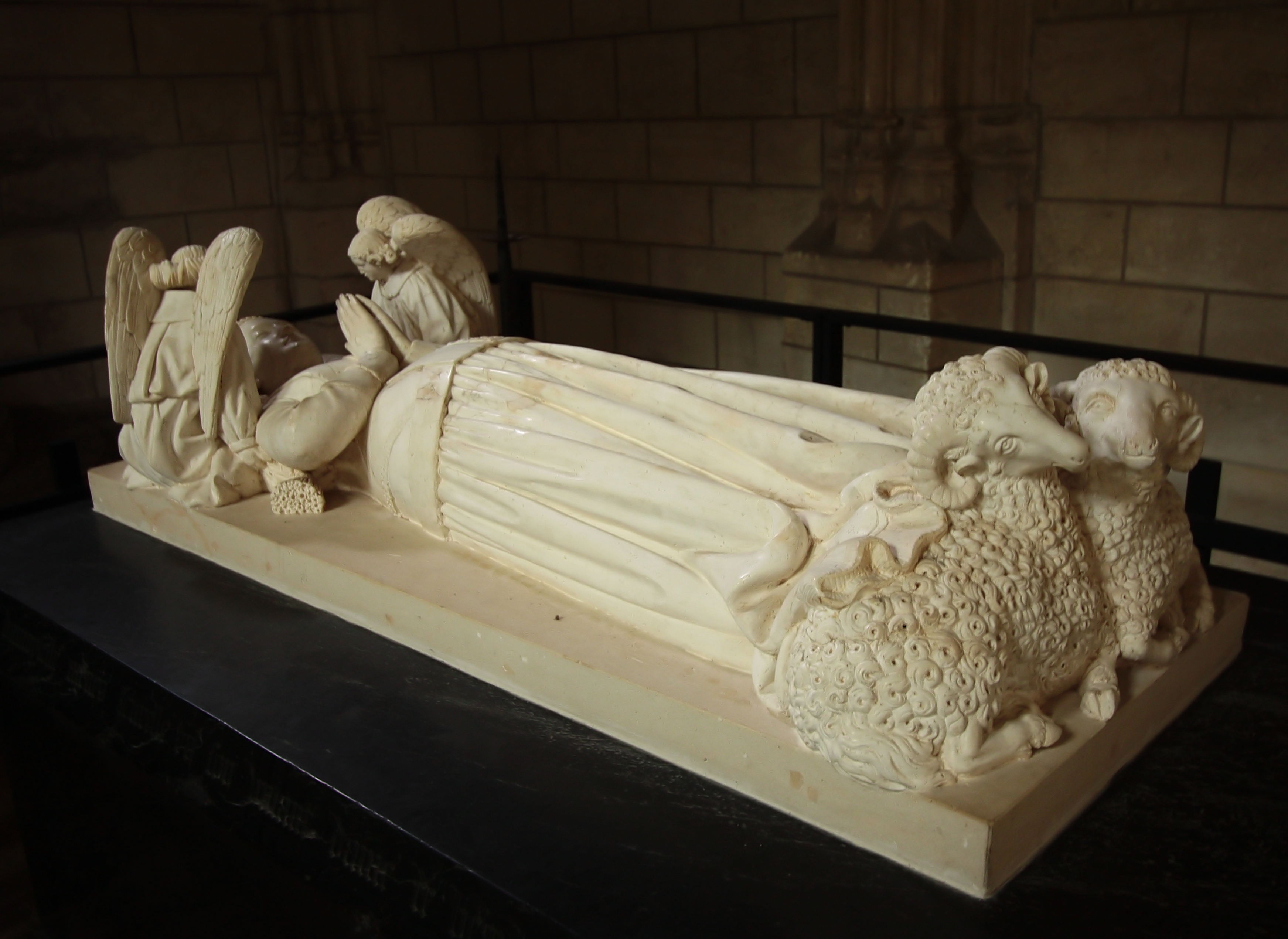
Agnès tomb at Loches (click here to enlarge)

French books I read about Agnès Sorel:
Other French books I heard about:
English books I found after some research:
Agnès Sorel's death always seemed suspicious and if many looked at the Dauphin as the main suspect, nothing could be ever proved. And several other people had as many reasons to eliminate the royal mistress as the king's son...

In 2004 a team of French scientists decided to examine Agnès skeleton who survived all those centuries of church renovations and grave robbing. They could not prove if she was murdered or not, but one thing was sure, her body contained very high levels of mercury who was a perfect poison. The same product was also used for worms treatment those days. A dosage accident is considered but her doctor was one of the most renowned of the realm. Accident or murder? We'll never know...

Considered by many of her contemporaries as the most beautiful woman in the world, Agnès Sorel continues to fascinate. I for instance would love to see more of her in historical fiction.