Showing posts with label Teddy's Reviews. Show all posts

Friday, June 8, 2012

The Doll by Daphne du Maurier

The Doll is a short story written by Daphne du Maurier that was lost for over 70 years. According to The Guardian, it was first published in 1937 and hadn't been published again until recently.

Dr. E. Strongman finds a mysterious diary washed up on the shore. The author of it is unknown and some of it is illegible and has some pages missing. However, Dr. Strongman writes a paper on it.

It is most certainly written by a man obsessed with a woman named, Rebecca. We learn that she is a violinist and met the unknown man at a party. He later starts coming to her flat.

"Before I left she showed me round her tiny flat. There was a little scullery place she used for a kitchen, a poky bathroom, and her own small bedroom which was furnished like a nun's cell, quite plain and bare. There was another room leading from the studio, but she did not show me this."

Rebecca does eventually show him the other room, to introduce him to Julio. He turns out to be a very evil looking mechanical doll. The he persistently asks Rebecca why she has this doll, she never tells him. He becomes more and more obsessed with her and the doll.

This is a pretty creepy story about obsession. Very well written and great character development. I highly recommend it, especially for those who can't get enough of Daphne du Mauier. Click on The Guardian to read it.

Tuesday, April 10, 2012

Voyagers of the Titanic by Richard Davenport-Hines

Description from Amazon.com:

Late in the night of April 14, 1912, the mighty Titanic, a passenger liner traveling from Southampton, England, to New York City, struck an iceberg four hundred miles south of Newfoundland. Its sinking over the next two and a half hours brought the ship—mythological in name and size—one hundred years of infamy.
Of the 2,240 people aboard the ship, 1,517 perished either by drowning or by freezing to death in the frigid North Atlantic waters. What followed the disaster was tantamount to a worldwide outpouring of grief: In New York, Paris, London, and other major cities, people lined the streets and crowded around the offices of the White Star Line, the Titanic’s shipping company, to inquire for news of their loved ones and for details about the lives of some of the famous people of their time.

While many accounts of the Titanic’s voyage focus on the technical or mechanical aspects of why the ship sank, Voyagers of the Titanic follows the stories of the men, women, and children whose lives intersected on the vessel’s fateful last day, covering the full range of first, second, and third class­—from plutocrats and captains of industry to cobblers and tailors looking for a better life in America.
Richard Davenport-Hines delves into the fascinating lives of those who ate, drank, reveled, dreamed, and died aboard the mythic ship: from John Jacob Astor IV, the wealthiest person on board, whose comportment that night was subject to speculation and gossip for years after the event, to Archibald Butt, the much-beloved military aide to Theodore Roosevelt and William Taft, who died helping others into the Titanic’s few lifeboats. With magnificent prose, Voyagers of the Titanic also brings to life the untold stories of the ship’s middle and third classes—clergymen, teachers, hoteliers, engineers, shopkeepers, counterjumpers, and clerks—each of whom had a story that not only illuminates the fascinating ship but also the times in which it sailed. In addition, Davenport-Hines explores the fascinating politics behind the Titanic’s creation, which involved larger-than-life figures such as J. P. Morgan, the ship’s owner, and Lord Pirrie, the ship’s builder.

The memory of this tragedy still remains a part of the American psyche and Voyagers of the Titanic brings that clear night back to us with all of its drama and pathos.
My Thoughts:

This is a non-fiction account of the Titanic and is in three parts.  The first covers Titanic "On Land".  The building of it, ship owners, shipbuilders, sailors and the boarding of it.  Second, it covers "At Sea" including first class, second class, third class, and the officers and crew.  The third part covers the collision and the news about it.
Some of the information was quite riveting and I could not turn the pages fast enough.  For instance, I learned that if the captain had not order that the ship be turned when they encountered the iceberg and hit it straight on, in all likelihood it would not have sunk.  The shipyard with the workers was very volatile and the managers were afraid every time they had to go in and talk with the workers.  Violence often erupted.

There were also parts that were very dry to me.  The people on the Titanic including passengers and crew were described in such a way that I couldn't muster any sympathy for them.  Perhaps that is due to this book being non-fiction and written from second and third hand accounts of the people involved.  However, I have read non-fiction book and have found some to be fascinating on other topics.
There are photos in the middle of the book which I enjoyed the most.  If you want a book that pretty much covers the entire topic of Titanic with all the smallest and largest details, this is the book for you.

3/5

For your chance to win a hardcover copy of this book, entire our giveaway here.

Saturday, December 31, 2011

Teddy's Best of 2011

Here are my best books of the year:

To Defy a King by Elizabeth Chadwick: To nobody's surprise here, Elizabeth Chadwick has become a favorite author of mine just within the last 2 years. For years, my colleagues here at H.T. had been telling me that I had to read her books and I finally listened. To Defy a King was published here in North America in March 2011.  Here is the link to my review. It will be posted here on H.T. soon.

Lady of the English by Elizabeth Chadwick: Honest, these are my top two books of 2011!  Here is the link to my review.  It will be posted here on H.T. soon.


Other notable historical fiction books I read this year included:

Tiger Hills by Sarita Mandanna
The Arrow Chest by Robert Parry
 The Betrayal of Maggie Blair by Elizabeth Laird
Deadly: How to Catch an Invisible Killer by Julie Chibbaro
Stranger Here Below by Joyce Hinnefeild
Madame Tussaud by Michelle Moran
The Guernsey Literary and Potato Peel Pie Society by Mary Ann Shaffer and Annie Barrows
Oregon Trail: The Road to Destiny by Frank young

Sunday, September 11, 2011

Deadly: How to Catch an Invisible Killer by Julie Chibbaro

It is 1906, New York City and 16 year old Prudence Galewski takes a job as an assistant to the Head Epidemiologist, Mr. Soper.  Prudence has always been interested in science and feels very fortunate to land a job in the field.   It is practically unheard of for a woman to get such a job.  In fact, some of the men in the lab give her a hard time.


Soon after starting her and Mr. Soper start investigating a new outbreak of Typhoid.  They visit the different families who have the dreaded disease and write down all of the different foods they have eaten and take samples from their septic systems.  Soon Prudence finds a food that links all of the families, peach ice cream.  It turns out that they all have a cook who has worked for all of them, who made the peach ice cream for them.


It was recently discovered by a scientist that disease could be carried by a healthy person.  The person doesn't get sick but can pass the illness on to others. 
"The challenge ahead of us is to find this elusive cook and test her for the typhoid germ by examining her body fluids."
The cook, Mary Mallon has moved around a lot but Prudence and Mr. Soper finally tracks her down.  She refuses to get tested, she can't understand how she could make people sick when she, herself is not sick. 

Mary Mallon was a real person who was to become known as Typhoid Mary. Julie Chibbaro takes a piece of history and runs with it.  She developed her main character Prudence well and we see her learn and grow.  As I read the story I kept thinking to myself, "you go girl, show people that not all women should be chained to a house with no other aspirations."


Deadly is geared for young adults.  It deals with issues of disease, feminism, and family.  It also explores ethical issues.  I think it would make for  great discussion for a young adult book club.  Though there is science in the book, it is well explained in fairly simple terms.  I highly recommend it!


5/5

Saturday, September 10, 2011

The Beauty Chorus by Kate Lord Brown

It is New Years Eve, 1940 and Evie Chase is determined to make a difference in the war effort.  On January 5th, 1941 she enlists  in the ATA to ferry  across WWII Britain.   Her father is a wealthy RAF commander and is not happy with her decision and takes away her allowance, but Evie sticks to her principals and moves into a mice infested cottage with two other new members of the ATA, Stella and Megan.


Stella is the mother of a baby boy but has left him with her parents in law.  She is trying to sort out her feelings regarding her "dead" husband.  Megan is a teenagers from a Welsh village, who has left for the first time.


Together the three woman train together and live together and become fast friends and allies.  Once they start ferrying planes, Evie meets a pilot from the U.S.A. and falls in love.  They are engaged to be married when tragedy strikes and her fiancĂ© is killed in combat.  Stella and Megan also find love.  


Beau is the trainer of the three woman and one of their commanders.  He and Evie mix together like cats and dogs most of the time.  He is also engages to a rich girl that he grew up with but the relationship is quite rocky.  He was burned badly in combat and she called off the engagement.  She abandoned him when he needed her most and then when he was better, came back  and begged forgiveness.  Can he forgive and does he want to?


Despite the fact that just about everything that happened in this book was totally predictable, I did enjoy it.  I knew nothing about the ATA and learned about its history.  The characters were well thought out and three dimensional.  You could call this book a character study.  That is it's true strength.  I would have liked a bit more plot and surprise.  I knew what was going to happen with each character well before it happened with only a couple of exceptions.  


This is Kate Lord Browns first book and a good attempt.  I am looking forward to seeing how she grows with her writing.  If you like character studies and want to learn more about the ATA in WWII, this is a book for you.


3/5

Wednesday, August 31, 2011

Becoming Marie Antoinette by Juliet Grey

This is the first book in a new trilogy.  It covers Marie Antoinette's life from when she was a pre-teen until she first became Queen of France.  She was raised with her brothers and sisters by the empress of Austria.  Her real name was Maria Antonia.  She knew that she would eventual be married off somewhere as her mother's political pawn but she had no idea that it would start at the tender age of ten.  

Her mother summoned her and told her that she was to be betrothed to the Dauphin of France.  Soon after that representatives of King Louis XVI started flooding in to assess Marie to see if she could indeed become the Dauphine of France.  They picked apart just about everything about her.  Her teeth weren't perfect, her hair, her posture, her education, and the list went on.  She had to endure braces for her teeth, a brace for her posture, numerous painful gadgets in her hair, etc.

Then, once she gets to court she finds a teenage boy who acts even younger than his years is her husband.  She is expected to start having babies right away but he is unable to consecrate their marriage.

Juliet Grey does not skimp on any detail, no matter how small.  I found myself getting bored in several parts of the book because of this.  Some of the details were important and interesting like what she had to endure with getting braces for her teeth and the torture she had to endure to get her hair just right.

The characters were well written.  I really enjoyed Maria's relationship with her sister, Charlotte.  Grey weaved a sympathetic  and compassionate relationship between Marie and her awkward husband. 
Though there are other books out there that deal with Marie in her earlier years, I hadn't read any before this.  Despite the parts that dragged, I did find this book worthwhile.  Will I read the next book in the trilogy?  I'm not sure at this point.

3/5
Cross posted at So Many Precious Books, So Little Time, where I am currently hosting a giveaway of this book.  Go here, to win.

Friday, February 25, 2011

The Arrow Chest by Robert Parry

In London, 1876, the bones of three females were discovered under the chapel in the Tower of London.  They were said to be the remains of two of Henry VIII's wives, Anne Boleyn and Katherine Howard and those of Lady Jane Grey.  The painter, Amos Roselli was summoned there to do sketches of the remains.

Amos didn't want to be left in the tower alone and asked for someone to be there with him.  In a short while, a yeoman warder, came in and they had a friendly chat.  When Amos finished the sketches, the warder was gone and the man who gave him the commission showed up with his wife.  He knew nothing about the yeoman warder.  When Amos made inquiries about the warder he was told the man had been dead for many year.  This started the strange sightings and creepy feeling which plagued Amos throughout the novel.

Amos recently hired a new maid, Beth for his humble home.  He didn't pay her much as he was a struggling artist.  However, Beth took to her work and master and did the best she could. 
Things were looking starting to look up for Amos.  Amos's inspiration/muse and childhood  friend, Daphne had married a very wealthy man, Oliver Ramsey, one year ago and Amos had just been commissioned to do a portrait of Oliver.  Amos knew that if Ramsey liked the portrait he would most likely gain more commissions.

Amos was happy that he was finally going to see Daphne again and once he arrived, their friendship continued like it was never interrupted.  Daphne confides in Amos that her marriage wasn't what she expected and the Oliver was very disappointed that she hadn't produced an heir yet.  Poor Daphne was stuck in a loveless marriage and it soon became apparent that Ramsey had his sights on another woman.  He wanted to get rid of Daphne one way or another.

During his visit with the Ramseys' many strange things happened.  He keeps seeing a woman from a distance that appears to be Daphne but couldn't be.  Later, Beth said that Daphne had dropped off some flowers while he was gone however, Daphne had been with him that entire day.  To add fuel to this strangeness, Daphne like to hold sĂ©ances with her guests after dinner and there were some cryptic messages from the dead.

Robert parry's poetic prose painted a haunting portrait of Victorian England and his characters.  He deftly weaved the story in with the story of Anne Boleyn .  It felt very authentic.  The characters were so well developed that I felt as if I was transported to Victorian England every time I picked up the book.  I felt like I was one of the characters.  There were a couple slow places in the book but those were minimal and then the book picked up again.   I loved The Arrow Chest and did not want it to end. 

4.5/5
 
Note: there are giveaways happening by the following blogs:
Let Them Read Books, ends March 5th

Tuesday, January 4, 2011

Teddy's Best of 2010

This was another good year of historical fiction for me.  How could it not be?  There are so many wonderful historical fiction authors out there these days.  2010 was an especially good year for WWII themed books as you will see below.  Here are my favourites:

The Postmistress by Sarah Blake

I read this all the way back in January but it has stuck with me. 
WWII fiction at it's finest! Frankie Bard, a reporter in London reports for Edward R. Murrow in th war and war effort while experiencing the nightly bombing raids first hand.  Meanwhile, Postmistress, Iris James struggle on the ethics of delivering upseting letter.

 Annexed by Sharon Dogar

Also based in WWII this YA novel is written from the imagined point of view of Peter van Pels's.  The boy trapped in the annex with Anne Frank and her family.  This is a wouunderful book for both young adults and adults.


The Twentieth Wife by Indu Sundarsen

In the 16th and 17th centuries, this is and epic adventure and love story of the emperor of the Mughal Empire and Mehrunnisa, his true love.  More historical fiction at it's finest.


The Confessions of Catherine De Medici by C.W. Gortner

Back in 2009 C.W. Gortner dazzled me with his book The Last Queen.  In 2010 he did it again with The Confessions of Catherine De Medici.  He tells a more balanced story of this powerful and controversial woman in history.

Restitution:Nazis, Communists, and the Fight For a Lost Heritage 

Based on a true story, this book tells the story who flied to Canada from Czechoslovakia during WWII.  With the help of an "honest smuggler" they try to recover paintings stolen from them in their homeland.

Tuesday, December 14, 2010

Annexed by Sharon Dogar

Most everybody knows about Anne Frank and her family but, mostly from Anne's point of view. Have you ever wondered what Peter van Pels point of view was? No, he did not keep a diary like Anne, so we will never know for sure however , thanks to Sharon Dogar we can imagine what he thought.

The dreadful day in 1942 when the Franks and van Pels were to meet up in the annex to hide from the Nazis, Peter van Pels decided to run away with his girlfriend, Liesl. He went to meet her but instead, to his horror he witnessed Lisel and her family being taken away from their home by the nazis. Now, with nowhere else to turn, he knew he had to go to the annex as planned.

He spends quite a bit of time there, in bed and thinking of Liesl. Pretty much everyone gets on his nerves, especially Anne with her overly cheery and talkative disposition. He thinks to himself,

"I wonder how this can be called living? How can we be in a space this small?
We’re trapped in this building like rats in a sinking ship,
waiting to be caught. The pain flashes through my head
again, lightning striking a steeple."

Finally Peter's father tells Peter that he must chip in with the work that needs to be done. His father said to him,

“Fight!” he says, and he sits back and shakes his head at
me. “You think you can fight this? Get up and make yourself
useful, that’s how we fight.”

He still dreams of Liesl and wonders if she is still alive. However, he starts to enjoy the company of Anne and her older sister, Margot. More and more the three of them spend time together making jokes and telling each other their fears.

After about a year together, Anne and Peter start to have romantic feelings for each other. The adults notice it and Otto Frank, Anne's father has a chat with Peter telling him that he thinks that Anne and Peter should just remain good friends so that Margot doesn't feel left out. However, love can't be controlled very well and Anne and Peter's relationship deepens.

Despite her strong feelings for Peter, Anne has another love, writing. She spends hours every day writing in her diary. Her father tells everyone how important it is to tell everyone they can their story when they get out. If for some reason they don't make it, Otto keeps Anne's diary for her in a hiding place so people can read it and learn about their circumstances.

Soon before the war ends the Nazis discover the annex and the people in it. They are all shipped off to death camps. The only survivor was Otto Frank. His friend and employee Miep keep Anne's diary and Otto edits it and has it published. It has been read by millions of people all over the world.

I'm ashamed to say, I have never read 'The Diary of Anne Frank.' I don't even know how that's possible, I am of Jewish heritage, why didn't my Sunday school assign it for the holocaust lessons? I don't practice Judaism but I know I must read Anne Frank's Diary. Actually, everyone should read it. IMO.

Sharon Dogar made the life in the Annex real. She gave Peter van Pels a voice, though fiction, it was a wonderful voice. I like to think that she got the essence of his voice right. Her poetic prose was strong and vibrant and never overly sentimental. She tells the fictionalized story of Peter, Anne, and the Annex in perfect pitch. This book is marketed as for young adults but I think it's an excellent book for adults as well.

5/5

Sunday, December 12, 2010

On the Proper Use of Stars by Dominique Fortier

The year was 1845 and Sir John Franklin and his crews on the Terror and the Erebus set sail on a mission to find the Northwest Passage.  Everyone, 129 men ultimately perished on the mission.  On the Proper Use of Stars is the fictionalized story of what happened. 

Francis Crozier was second in command and kept a journal where he wrote day to day about the mission but also about the woman of his dreams, Sophia.  Back in England Lady Jane Franklin and her niece, Sophia kept busy while waiting to hear word from Sir John Franklin.  After three years have passed Lady Jane used everything and everyone at her disposal to convince the Admiralty to send out a search party.  They refused again and again.  

I took me quite awhile to get into the story.  I found the beginning quite dull.  It wasn't until things started to happen in the story that the pace picked up for me.   This book is translated, so I'm not sure if that could be part of the problem or not.  I did find the writing quite poetic and as the story got going it was very visual.  Ultimately, I warmed up to the story and enjoyed it.

Grade: 3.5/5

Saturday, October 9, 2010

The Thousand Autumns of Jacob De Zoet by David Mitchell

Set on the Island of f Dejima in Japan in the early 19th century, Jacob De Zoet was trying to make a name for himself. Jacob has come all the way from Holland as a young clerk in the hopes of making his fortune. The plan was to go back to Holland to his fiancée and marry her with the approval of her wealthy father.

While on Dejima, Jacob has a chance encounter with Ortio Aibagawa, a midwife who was granted permission to learn medicine under the tutelage of Dr. Marinus. It is very rare to see a Japanese woman unless she is a prostitute. Jacob becomes infatuated with her.

The first chapter of the book grabbed me and wouldn't let me go. It was of a childbirth that Ortio was midwife for. The child appeared to be dead but Ortio breathed life into him. It's too bad that the next 130 pages didn't hold my interest much. They were about the day to day business of Jacob as a clerk. To me they were boring and at times, hard to understand. I felt like I needed to have an interest in Jacob's job as a clerk, to understand what was going on. Historically, it seemed quite accurate but painfully boring to me.

When Ortio was brought back onto the pages, the story picked up again for me. She ended up in a horrific place that I had to see resolved. That is what kept me reading this book. It was these parts of the book that made me fall in love with David Mitchell's writing.

I have had David Mitchell's Cloud Atlas and Black Swan Green on my "to be read" list for a very long time. The Thousand Autumns of Jacob De Zoet is the first book I have read by him but certainly won't be the last.

3.5/5

Saturday, September 25, 2010

For the King's Favor by Elizabeth Chadwick

Ida de Tosney was a ward of King HenryII through childhood. As a teenager she was presented to the King who would determine her future. Hopefully he would find a suitable marriage for her and she would have a happy life. However, once set eyes on Ida, he decided to keep her for himself and kept her as his mistress. She had no say in the matter.

Ida prayed that she wouldn't become pregnant and have King Henry's bastard child. She took every preventative measure she could find however, she conceived a son. Though she was worried about the religious ramifications, she fell in love with her son. In the mean time, she became infatuated with Roger Bigod.

Roger had a story of his own. He rebelled against his father and took the side of King HenryII. He spent the majority of the time trying to win the Kings favor and getting his family land holdings after his father died. His rightful title was Earl and he wanted it.

Eventually, King Henry married Ida de Tosney off to Roger Bigod and they had many children of their own. However, the son she had with King HenryII, was kept from her.

Many of my friends, including those at Historical Tapestry have been encouraging me to read a Elizabeth Chadwick book for a very long time. I have had her on my TBR and finely had the chance to read one of her books when I received an invitation to review this advance readers' copy.

Chadwick did not disappoint! She had a good cast of characters from real life to draw from. She made them come back to life with richly textured scenes of England and Royalty. I felt like I was one of the maids, getting to witness everything that happened. I will definitely be reading more Chadwick in the future!

Note: For the King's Favor was released previously as The Time of Singing.

4.5/5

Thursday, September 9, 2010

Restitution by Kathy Kacer

Restitution is the true story of one families' struggle to escape Czechoslovakia right after Hitler's invasion. Marie Reeser, the matriarch of the family enlists the aid of her husband, Victor's non-Jewish business associate, Alois Jirak to help her hideaway the families' valuables to claim back later. He is also given power of attorney. A big part of the belongings were four paintings which, she adored. She then arranges for her two children, Karl and Hana and herself to meet up with her husband, Victor in France. From there, they escaped to Toronto, Ontario Canada.

Soon after the war ends, Marie and Victor return to Czechoslovakia, in part to reclaim the family's belongings, including paintings that Marie loves so much. The Communist party has taken over the family home and there is no way to re-claim it. However, Alois Jirak is still there but does not want to give up the paintings and with the Communist party taking over the country, Marie and Victor are forced to flee again, without the beloved paintings.

50 years later, well after Victor and Marie's death, their son Karl receives a letter from Alois Jirak's grandson. He says that he inherited four painting but found out that they are rightfully owned by the Reeser family and would like to return them if possible.

What follows is the story of how Karl finally gets the paintings back. It is a story of friendship, betrayal, an "honest" smuggler, and restitution. Told seamlessly in part memoir and part fiction by ghost writer, Kathy Kacer Ms. Kacer writes a suspenseful story that reads like a novel.

I highly recommend it!

4.5/5

Thanks to Annie Paikeday, Marketing/Editorial Intern for Second Story Press for this book.

Sunday, September 5, 2010

Houdini Pie by Paul Michel

Halley, named after Halley's Comet was born right after his father Charles got caught in one of his fraudulent schemes. Once Hal was considered old enough he was expected to work for Charles in his less than honest business ventures including running a lucrative alcohol business during prohibition.

In 1934, as a young man Hal is a pitcher for and upstart baseball team and strikes just about everyone out. His Uncle Warren shows up after a long absence and asks Hal to join in him in a business venture that his Charles is also tied up with. Hal thinks it sounds preposterous but his mother Vera talks him into doing it with the promise of riches, gold actually. 

A Hopi Indian and his daughter lead the search, with the story of their ancestors, who were Lizard people. They hid treasure in Los Angeles California way beneath a downtown street. Somehow the crackpot sounding scheme get approval from the mayor and they are allowed to dig.

This is a story about love, hope and loyalty for Hal. Though the constant reference to Houdini Pie and it's symbolism got a little tiresome to me, the book flowed well with simple old fashioned story telling. Some of it was quite predictable but the book was enjoyable.

3/5

Thanks to Mary Myers of Bennet & Hastings Publishing for this book.

Wednesday, July 28, 2010

Captivity by Deborah Noyes

Captivity is actually two stories intertwined that took place mostly in upstate New York in the early to mid 19th century. The first is about the real life Fox Sisters. They were a family of women who were mediums who claimed that they could communicate with the deceased. They had many followers but were also constantly questioned by people who wanted to discredit them. They were put though numerous tests which included improper poking and prodding of the women by men. The Fox Sisters inadvertently gave birth to the Spiritualist Movement.

The second part of the story is about the fictional reclusive Clara Gill. She long ago suffered the loss of her secret lover William. The scandalous affair came out and Clara never fully recovered. Her mother had died in childbirth and she lived with her father all of her life, until his death. She never married.

Maggie Fox is invited in by Clara's father to work. She served Clara tea in her room, which she rarely left. Slowly Clara started to respond to Maggie and they became friends, even though Clara didn't believe in the Spiritual Movement. Because of their friendship, Clara starts coming out of her room and eventually starts going out into the community again.

There are many layers to this story and they are slowly peeled away, layer by layer until the very end. Deborah Noyes shows both sides of the historical Spiritualist Movement/ debate of the time, while crafting interesting characters and plots. At times I found the story dragged and in fact, I had trouble getting through the first 100 pages and almost gave up. However, I was rewarded greatly with my perseverance and I discovered a gem.

If you're looking for a fast paced story with a neat and tidy, all questions answered ending, this is not a good book for you. However, if you are a patient reader you will be greatly rewarded with a thought provoking and insightful story.

4/5

Saturday, July 24, 2010

Galore by Michael Crummey

It's sometime in the early 19th century, Newfoundland in a small fishing village called Paradise Deep. The village is anything but paradise and times are tough. The fish are no longer biting and a whale has beached on shore. There is no way to save the whale and the hungry villagers are waiting for it to die before they carve it up and portion it out. They will also harvest the oil for their lamps.

The whale finally dies and the villagers are carving away when all of a sudden a man pours out of its stomach. At first he appears to be dead but then it is discovered that he is alive. The Devine Widow is a healer and midwife and takes him home to nurse him. He is washed but no matter how many times he is washed he still stinks like dead fish. The other family members insist that he is kept in the shed.

He is mute but after a short time, healthy. They decide to call him Judah. many of the villagers decided that it is Judah brought them bad luck and that is why the fish left. They go after him but the widow has him hide.

The next day a bunch of the fisherman go out to try to catch some fish. They are desperate and feel it is they duty to try even though they now they will fail. They start rowing out but can't figure out where that nasty "dead fish" smell is coming from, when all of a sudden Judah comes out from under their gear. They decide it's too far to row back to shore and give Judah a turn at the oars. The men still call him "stranger".

Judah puts a line out and the fisherman think he's crazy they way he is doing it. However, "The stranger struck in then, hauling the line hand over hand, arms straining with the weight. The first pale glove of flesh let loose a pulse of oily ink as it broke the surface." Its squid, so many squid. The men fill up their boat and then hand of the line of squid to the next boat, and the next boat, until they couldn't carry any more. They discover that Judah is good luck, after all. After that they insist that he go with them every day they fish and then the cod start biting again.

This is a multi generational historical fiction saga. It chronicles two rival families, the rich Sellers family that pretty much owns the town and the Devine family, who try to scratch a living from fishing. When Judah is discovered from the whale, Mary Tryphena Devine is only nine years old. When she become of marriage age, she turns down every possible suitor, holding out hope that her secret love, Absalom Sellers will come back home and ask for her hand despite the rivalry between families. Mary Tryphena is finally talked into marrying Judah, to save him from King-Me Sellers.

Though Mary can't stand the smell of him, they consummate the marriage, in the shed and then Tryphena goes back to the house. Nine months later she has their son, Patrick. Later they have another son, Henley but is he really Judah's?

In part two of the book, Mary Tryphina is an old woman and still married to Judah, who still lives in the shed. The book goes on to follow her, her children, and her grandchildren, as well as the Sellers family.

I am a big fan of Michael Crummey. I absolutely loved the River Thieves and really enjoyed his follow up book, The Wreckage. He was born and raised in Newfoundland and it's the setting for his books. He took a departure from his usual writing style with Galore and I wasn't sure that I would enjoy it as much as his other works. He used a lot of folklore and some magical realism.

I am not a fan of magical realism at all. However, when I found out the Michael Crummy was finally coming to Vancouver (a friend of mine and I kept bugging the Vancouver International Writers and Readers Festival until they finally invited him) I had to buy Galore to get it signed. (See my meeting Michael Crummey post.)

That was back in October and now I finally got to read it. I was quite surprised by it. Even though I usually have a very strong dislike for magical realism, I actually liked this book. Though those parts were not my favorite by any stretch, Crummey is such a gifted writer that I was able to lose myself in the story. He has such strong character development and let me tell you, there were a lot of characters. His poetic prose from his other books was still there and pulled me in. I wonder what his next book will bring?

4/5

Thursday, July 22, 2010

The Confessions of Catherine de Medici by C.W. Gortner

Shortly after I finished reading and reviewing The Last Queen by C.W. Gortner, I asked him if I could review The Confessions of Catherine de Medici when he was finished writing it. I loved The Last Queen and I wanted more by this talented author.
I'm so glad that he agreed!

In this fictional memoir, Catherine De Medici, the last of the Italian Medicis, is sent to France as a young woman to marry Henri, the son of King Francois. Henri has no interest in Catherine, as he has a mistress, Diane le Poithers, that he is very much in love with. After years of not having a child together due to lack of trying, Catherine is forced to bargain with Diane to have a heir and secure her future in France. They come to an understanding and Diane even stays in the room while Catherine and Henri have sex, coaching them into different positions that will help Catherine become pregnant.

They finally have heirs but what Catherine doesn't bargain for, is that Diane raises her children. The later come to resent Catherine for that arrangement, even though it was beyond her control.

After Henri dies Catherine seizes power to secure the crown for her sons. Four of her sons became King, in succession but Catherine either served as regent or advisor to each of them.. She tried to broker peace and tolerance between the Catholics and the Protestant Huguenots again and again.

History has labelled Catherine De Medci as an evil witch, as Queen of France however, C.W. Gortner shows a different side of her. He treats her in a much more balanced view, as a mother, friend, lover, and Queen. He pulls this off smoothly and keeps the pages turning in a fury to see what happens next.

A lot of the story focused on the conflict between the Catholics and the Protestant Huguenots. Although Gortner had to do this, I thought the story got just a little bit bogged down with all of the details. This is a very minor flaw and otherwise the story seems flawless.

I don't know what Gortner's next book will be about but I can hardly wait! I'd love to review it Christopher.

4.5

Sunday, July 18, 2010

The Summer Before the Storm by Gabriele Wills

Muskoka is the summer playground for the very wealthy families that want to escape the stifling heat of summer in Toronto, Ontario Canada. The year is 1914 and one such family living there in the summer is the Wyndwoods. This large family lives an easy and fun filled summer with servants to meet their every need. The matriarch of the family is Augusta Wyndwood who took over the running of the family and business when her husband died. Al she has to do is threaten disinheritance and the family members jump to attention and do as she bids.

There are too numerous characters to mention here however I will mention the main characters of this story. Victoria is the headstrong granddaughter of Augusta. She would like to have more of the freedoms that men have but Augusta would like to marry her off to a wealthy cousin, Justin who is in love with Victoria. Victoria however is in love with her other wealthy cousin, Chas.

Then there is Jack, Augusta's grandson. He shows up, when the story opens, as a waiter at the resort restaurant that the family goes to every Monday for dinner. The next day he shows up at the Wyndwood estate and is introduced by Augusta. Jacks father was disinherited by Augusta for marrying beneath himself. His family was very poor and he died fairly young, leaving his family to survive on their own. Jack hopes to ingratiate himself into the family.

The family live there usual glutinous summer on the lake, boating, swimming, playing tennis, and the other things in their idyllic lifestyle. However, things start to turn dark when WWI is threatened and many of Victoria's cousins go off to war, to eventually become part of "the lost generation."

This story travels from Muskoka, Ontario Canada to Britain, and the skies of war torn France. It includes the horrific bombing and sinking of the famous Lusitania ship of the shores of Britain. There is a little of something for everyone including, wealthy living, romance, mystery, adventure, and war.

It is evident the Gabriele Wills did her research of the period. She has beautiful writing and very interesting characters that leap out from the pages. There are a couple more minor story lines that I didn't really care for. For instance Helena, who marries Victoria's father James later in the story. She is a stereotypical conniving stepmother. This took away from the story for me. That said, I really did enjoy this book over. This book is the first of a trilogy and I hope to read the other two books.


4/5


Gabriele Wills was our guest back in April and she did a guest post on Why I Love Times of Monumental Change.

Monday, May 17, 2010

The Green Bronze Mirror by Lynne Ellison

15 year old Karen is exploring the sea side when she finds an ancient looking mirror in the sand. Now everyone knows that if you find an old mirror, do not stare into it. Of course Karen does and she is transported through time to ancient Rome. Some solders happen upon her and believe she is a runaway slave.

She is taken to a house where she is given to a slave to give her decent clothes and to wash her. Shorts and a tee shirt were very odd clothes indeed. She was taken to the market place and sold. She was a slave to Mistress Julia and was made to take care of Julia's two children. She made friends with some of the other slaves and fell for a older slave boy, Kleon.

Christianity was a new religion back then and when the fires started and destroyed home after home, the Christians were blamed and persecuted. Karen and Kleon flee together to avoid persecution. Eventually Karen confesses to Kleon that she is from the future and he helps her find her way back.

Lynne Ellison wrote this short young adult novel in 1966, when she was just a teenager. It was just re-issued in 2009 by CnPosner Books. The copy I received was a final copy, not an advance reader edition. However, page after page I found spelling errors and word omissions. Instead of fixing these, the publisher has all of the errors listed on their website and invite readers to notify them of any other errors they may have missed. Though I really enjoyed the story, I found these errors rather annoying. I know it costs money to reprint books but I feel that it is unprofessional and does not do Lynne Ellison's good story justice.

Karen told Kleon that the time that she lives in everyone in the world is Christian and how wonderful it is. There is no persecution. I guess this is also suppose to be Christian fantasy novel, because the world I live in, not everyone is Christian and there are still all kinds of people who get persecuted because of their religion. That said, I did like Karen as a character and I liked the story of her as a slave. The story took place when the Roman Empire was ruled by Nero and Ms. Ellison did bring the ancient time to life.

3/5

Note: The publisher just informed me that they did a new printing of the book to correct all the the errors.

Wednesday, May 12, 2010

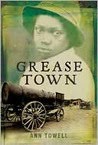
Grease Town by Ann Towell

fiction novel. The story is told through 12 year old Titus Sullivan. His parents both died and he is being raised by his Aunt Sophie. His older brother, Lemuel decides to move to Oil Springs , Ontario where their Uncle Amos lives, to try to make his fortune in the oil business. Titus wants to go along to get away from their overbearing Aunt but Lemuel says he's too young.

Titus sees Lemuel off and then sneaks into the back of his wagon. He is discovered much later when his brother stops to water the horse. He figures that he has gone too far to go all the way back so they continue to Oil Springs. However, they take along a passenger, John who promises to pay $20 for the trip. Titus knows right away that John is bad news and Lemuel figures it on soon after. They end up leaving him at their last stop. They figure that it isn't that far to walk or hitch a ride with someone else.

When Titus and Lemuel arrive at Oil Springs they get a big welcome with their Uncle Amos. He is surprised to see Titus and scolds him and makes him write a letter to his Aunt Sophie right away.

Oil Springs is a dirty town in a swamp. The well water has to be boiled before you can safely drink it and there is so much oil in the swamp water that it easily catches fire, as Titus witnesses soon after his arrival.

Titus makes friends with a black boy named Moses and they do just about everything together. However, Titus and Moses runs into John frequently. He is racist and makes trouble for them and later, the entire town.

From the book description, I thought that Titus was going to learn about the Underground Railroad from Moses but that is not the case. I expected this book to go into at least some detail about it but it does not. Also, we don't figure out that Titus himself is a white boy until later in the book. I think it was important to know this from the start. Johns, character is very predictable. The read figures out right away that John will be the villain of the story.

I enjoyed the story overall. The characters were memorable and the writing, simple but good. I just think that it could have been so much more.

3/5